
Most people only look closely at their tires when something goes wrong: a flat on the way to work, a nail in the tread, or a shop quoting a price for “a set of 225s.” That’s when the jumble of letters and numbers on the sidewall suddenly matters. The good news is that it’s far less cryptic than it looks. Once you know the pattern, you can read any passenger tire in about ten seconds.
This guide walks through the full size code using a common example, P225/60R16 97H, and then covers the other markings people tend to ignore, like the DOT date code, treadwear grades and the snowflake symbol. If you’d rather skip the math, our tire size calculator does the conversions for you.
Quick answer
In a tire size like P225/60R16 97H: P = passenger tire, 225 = width in millimeters, 60 = sidewall height as a percentage of the width, R = radial construction, 16 = wheel diameter in inches, 97 = load index (1,609 lb per tire) and H = speed rating (130 mph).
- Find your correct size on the driver’s door jamb sticker, not just on the old tires.
- The last four digits of the DOT code show when the tire was made (week + year).
- Never go below the original load index or speed rating when replacing tires.
Where to Find Your Tire Size
You have three easy places to check, and it’s worth checking more than one.
- The tire sidewall. The size is molded in large characters on the outer face of every tire. If your wheels are dirty, a quick wipe with a rag and a phone flashlight held at an angle makes the raised lettering much easier to read.
- The driver’s door jamb. Open the driver’s door and look for a sticker on the frame (sometimes it’s on the door edge, the glovebox lid or inside the fuel door). This “tire and loading information” placard lists the size the carmaker fitted at the factory, plus the recommended cold tire pressures.
- Your owner’s manual. The specifications section lists the original size and any optional sizes the manufacturer approved for your trim level.
Why check both the tire and the placard? Because the tires on a used car aren’t always the size the factory intended. A previous owner may have fitted cheaper or larger tires. If the two don’t match, the door placard is the safer reference for what your car was designed around.
The Tire Size Code, Piece by Piece
Here’s the example we’ll decode. You’ll see something like this on most sedans, crossovers and small SUVs:
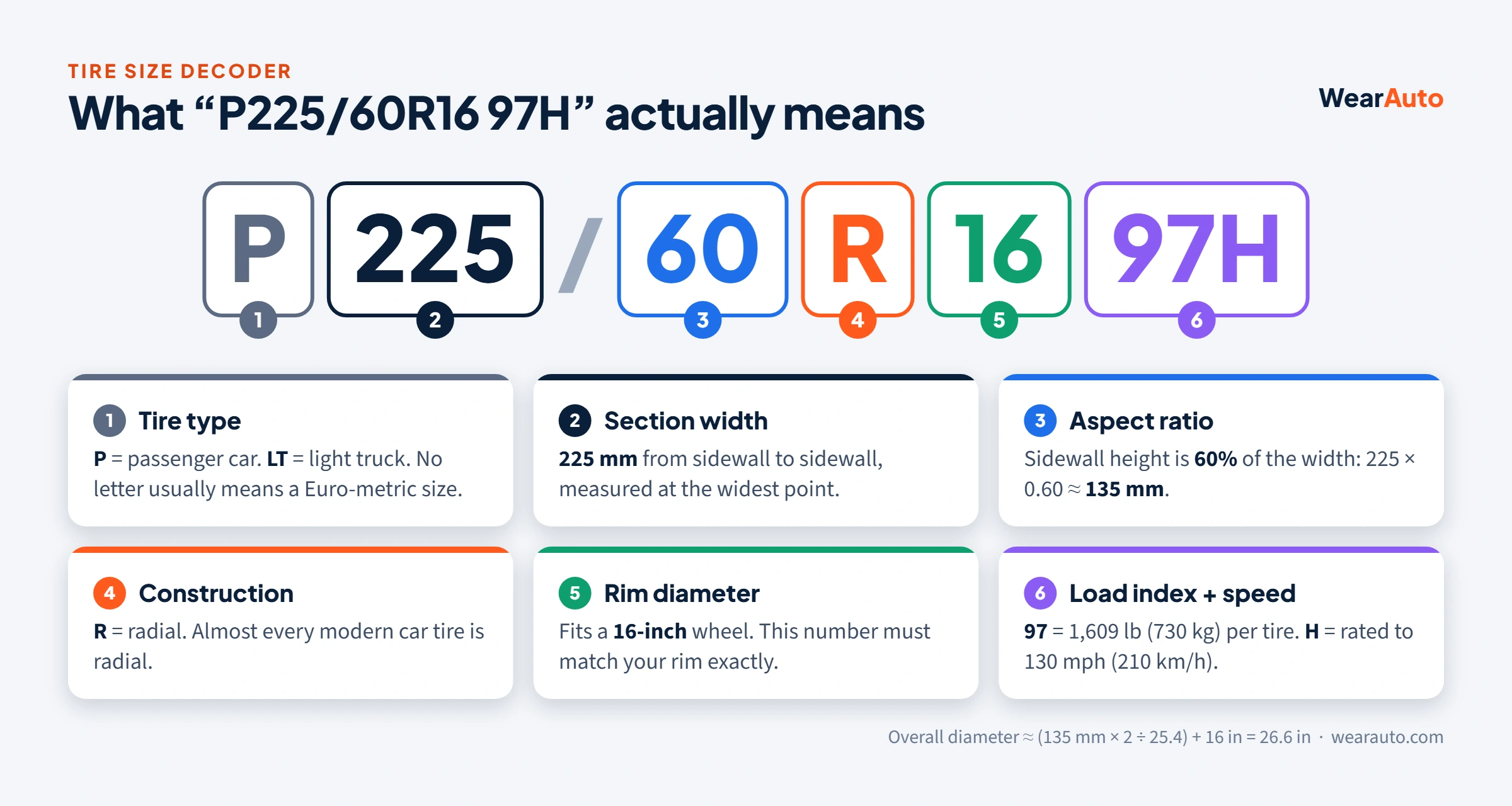
1. Tire type: P, LT, ST, T or nothing
The letter at the very start tells you what kind of vehicle the tire is built for.
- P means P-metric, a passenger car tire. This is what you’ll find on most cars, minivans and crossovers sold in the US.
- LT means light truck. These tires have stiffer construction for heavy loads and towing, and they often appear on 3/4-ton and 1-ton pickups.
- ST stands for special trailer. These belong on trailers only, never on a car or truck.
- T marks a temporary spare, the skinny “donut” in your trunk.
- No letter at all usually means a Euro-metric size. It’s the same measurement system, but load ratings are calculated a little differently. If you’re swapping from P-metric to Euro-metric (or the other way around), ask the tire shop to confirm the correct pressure, because the same load can need a slightly different PSI.
2. Section width: 225
The first three-digit number is the tire’s width in millimeters, measured from the outside of one sidewall to the outside of the other at the widest point. A 225 tire is about 8.9 inches wide. Wider tires put more rubber on the road, which can help grip, but they can also add road noise and slightly reduce fuel economy.
One quirk: this number is measured with the tire mounted on a specific “measuring rim” width. Put the same tire on a wider or narrower wheel and the real-world width changes a few millimeters.
3. Aspect ratio: 60
The number after the slash is not a measurement in millimeters. It’s a percentage. It tells you how tall the sidewall is compared with the tire’s width. In our example, the sidewall height is 60% of 225 mm, or about 135 mm (5.3 inches).
Lower numbers mean shorter sidewalls. A 40-series tire looks sporty and steers sharply, but it rides harder and is more likely to get a bent rim from a pothole. A 70-series tire, common on trucks and older sedans, soaks up bumps better and is less sensitive to curb damage.
4. Construction: R
R means radial, where the cord plies inside the tire run across it at roughly 90 degrees to the direction of travel. Virtually every modern passenger tire is a radial. On some trailer and vintage tires you might see a D, B or a dash instead, which marks bias-ply construction.
Performance tires sometimes show ZR, as in 245/40ZR18. That’s an older way of saying the tire is rated for speeds above 149 mph. These days the speed rating at the end of the code tells you the exact limit.
5. Rim diameter: 16
This is the diameter of the wheel the tire fits, in inches. It’s the one number you cannot fudge. A 16-inch tire only fits a 16-inch wheel. If you want to move to 17s or 18s, you’ll need new wheels as well as new tires, and you’ll want to keep the overall diameter close to the original (more on that below).
6. Load index and speed rating: 97H
The last group is called the service description. The number is the load index and the letter is the speed rating. Neither one is a direct measurement. Both are codes you look up in a chart.
A load index of 97 means each tire can carry up to 1,609 lb (730 kg) when properly inflated. Multiply by four and you get the maximum weight the set can support. Here are a few common values:
| Load index | Max load per tire | Typical use |
|---|---|---|
| 91 | 1,356 lb (615 kg) | Small cars, compact sedans |
| 94 | 1,477 lb (670 kg) | Midsize sedans |
| 97 | 1,609 lb (730 kg) | Larger sedans, small crossovers |
| 100 | 1,764 lb (800 kg) | Crossovers, minivans |
| 104 | 1,984 lb (900 kg) | Midsize SUVs, light pickups |
The speed rating is the maximum sustained speed the tire is certified for under its rated load. The letters roughly climb with the alphabet, with H as the odd one out:
| Speed rating | Max speed | Common on |
|---|---|---|
| S | 112 mph (180 km/h) | Family sedans, minivans |
| T | 118 mph (190 km/h) | Sedans, crossovers |
| H | 130 mph (210 km/h) | Sport sedans, many SUVs |
| V | 149 mph (240 km/h) | Performance sedans and coupes |
| W | 168 mph (270 km/h) | High-performance cars |
| Y | 186 mph (300 km/h) | Sports and exotic cars |
When you replace tires, match or beat the original load index and speed rating listed on your door placard. Going lower on load index is the bigger risk, especially on SUVs, vans and anything that tows.
A Quick Worked Example: How Tall Is the Tire?
Knowing the code lets you work out the overall diameter, which matters for clearance and speedometer accuracy. Using P225/60R16:
- Sidewall height = 225 × 0.60 = 135 mm
- Two sidewalls (top and bottom) = 270 mm
- Convert to inches: 270 ÷ 25.4 = 10.63 in
- Add the wheel: 10.63 + 16 = 26.6 inches overall diameter
Now compare a 235/55R17, a common “plus one” upgrade. That works out to about 27.2 inches, around 2.1% taller. Most tire professionals try to keep a replacement size within roughly 3% of the original diameter so the speedometer, ABS and stability control keep reading correctly. Rather than doing this by hand, plug both sizes into the WearAuto tire size calculator and it’ll show the difference, the revolutions per mile and the speedometer error side by side.
Other Sidewall Markings Worth Knowing
The size gets all the attention, but some of the smaller print is just as useful, especially when you’re buying used tires or a used car.
DOT code and tire age
Look for the letters “DOT” followed by a string of up to 13 characters. This is the Tire Identification Number required by US federal rules (49 CFR Part 574). The first characters identify the factory, the middle ones are manufacturer codes, and the last four digits are the build date. “2423” means the tire was made in the 24th week of 2023.
The full DOT code with the date is sometimes only printed on one side of the tire, so if you can’t find it, check the inside face. Rubber ages even when a tire sits unused, so a “new” tire that’s been in a warehouse for five years isn’t really new. Many carmakers suggest replacing tires around six years old regardless of tread, and most tire makers set an outer limit of ten years. Your owner’s manual will say what your manufacturer recommends.
UTQG: treadwear, traction and temperature
Most passenger tires sold in the US carry a Uniform Tire Quality Grading label, something like “TREADWEAR 500 TRACTION A TEMPERATURE A.”
- Treadwear compares the tire to a reference tire rated 100. A 500 should last noticeably longer than a 300, but only compare grades within the same brand, since each manufacturer runs its own testing.
- Traction (AA, A, B or C) is based on straight-line braking on wet pavement. AA is the best.
- Temperature (A, B or C) shows how well the tire resists heat build-up at speed. A is the best.
Winter tires and LT tires are exempt, so don’t be surprised if you don’t find a UTQG grade on them.
M+S and the three-peak mountain snowflake
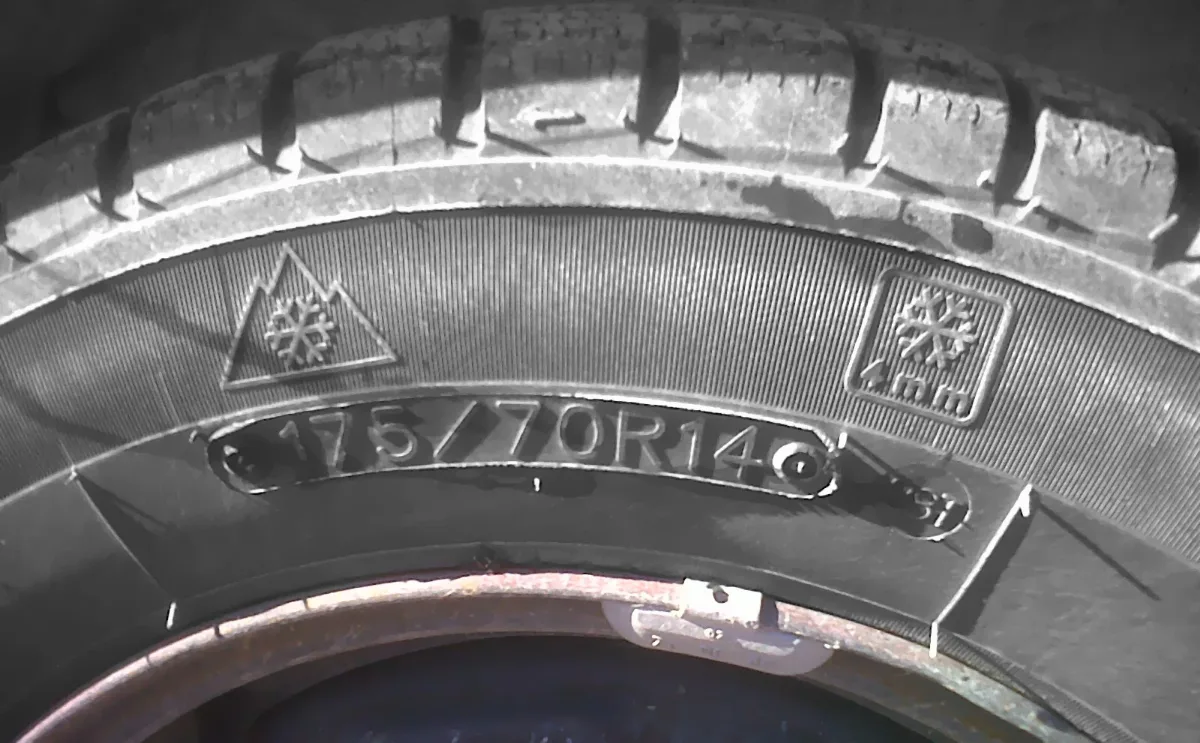
“M+S” (mud and snow) is common on all-season tires. It’s based on tread design, not on a performance test, so it doesn’t promise much on its own. The symbol to look for if you drive in real winter weather is the three-peak mountain snowflake (3PMSF). It means the tire passed a standardized snow traction test against a reference tire.
Maximum inflation pressure
You’ll see a line like “MAX. PRESS. 44 PSI” near the bead. This is the most pressure the tire can safely hold, not the pressure you should run. Inflating to the sidewall maximum makes the ride harsh and reduces grip. Always use the cold pressure on your door placard, and check it monthly with a gauge, because tires can lose about 1 PSI per month and roughly 1 PSI for every 10°F drop in temperature.
XL, Reinforced and load range
“XL” or “Extra Load” means the tire can carry more weight than a standard-load tire of the same size when inflated to a higher pressure. On LT tires you’ll see a load range letter instead, such as C, D or E. Load range E tires are built for heavy towing and run at much higher pressures than regular car tires.
Flotation Sizes on Trucks and Off-Road Tires
Some light truck and off-road tires use a completely different format, for example 33×12.50R17LT. Here the numbers are all in inches and read in a more literal way: 33 inches tall, 12.5 inches wide, radial construction, for a 17-inch wheel, light truck rated. If you’re comparing a flotation size with a metric size, convert both to overall diameter first. Our calculator accepts metric sizes, and you can treat the first number in a flotation size as the diameter directly.
Common Mistakes When Buying Tires
- Going by tire width alone. “I need 225s” isn’t enough. A 225/45R17 and a 225/65R17 are very different tires.
- Dropping the load index to save money. A cheaper tire with a lower load index may not be rated for your vehicle’s weight, especially when it’s loaded with passengers and luggage.
- Mixing sizes on all-wheel-drive cars. Many AWD systems need all four tires to be the same size and close in tread depth. A mismatch can strain the center differential or transfer case.
- Ignoring the date code. Ask to see the DOT date before the tires are mounted. Anything more than a couple of years old at the time of sale is worth questioning.
- Trusting the sidewall pressure. As covered above, the placard pressure is the one to follow.
For more practical advice on choosing, rotating and caring for your tires, browse our Tires & Wheels guides or the broader Car Maintenance section.
Frequently Asked Questions
What do the numbers on a tire mean?
In a size like 225/60R16, 225 is the width in millimeters, 60 is the sidewall height as a percentage of that width, R means radial and 16 is the wheel diameter in inches. The number and letter that follow, such as 97H, are the load index and speed rating.
Can I put a different tire size on my car?
Often, yes, as long as the new size fits your wheel, clears the suspension and body, and stays within about 3% of the original overall diameter. Bigger changes can throw off your speedometer and safety systems. Check your owner’s manual for approved optional sizes, and compare sizes with a tire size calculator before you buy.
Is a 225 tire the same as a 225/65?
No. 225 only describes the width. A 225/45R17 and a 225/65R17 have the same width but very different sidewall heights and overall diameters, so they are not interchangeable.
How do I tell how old my tires are?
Find the DOT code on the sidewall. The last four digits are the week and year of manufacture, so 0822 means the 8th week of 2022. If you only see a partial code, check the other side of the tire.
Does a higher speed rating mean a better tire?
Not always. Higher speed ratings usually mean sharper handling, but they can also wear faster and ride firmer. Match or exceed the rating on your door placard, then choose based on how and where you drive.
What is the difference between P-metric and Euro-metric tires?
They use the same size measurements, but load ratings are calculated slightly differently. A Euro-metric tire may need a different inflation pressure to carry the same load as a P-metric tire, so ask the installer to confirm the right PSI if you switch.
The Bottom Line
A tire size like P225/60R16 97H reads left to right as type, width, sidewall ratio, construction, wheel size, load capacity and speed limit. Once that clicks, shopping for tires gets a lot less stressful. You can double-check a quote, spot a wrong size before it’s mounted, and know whether a bigger wheel upgrade will actually fit.
Before you buy, confirm the size on your door placard, match or exceed the original load index and speed rating, and check the DOT date on the tires you’re being sold. If you’re thinking about a different size, run it through the tire size calculator first so you know exactly how it changes diameter and speedometer readings.
Thinking about a new tire size?
Compare your current size with any other size and see the diameter difference, revolutions per mile and speedometer error in seconds.
Open the Tire Size Calculator →Keep reading
Free tools for this topic
Sources and further reading
- NHTSA: Tires and tire safety
- NHTSA: Consumer Guide to Uniform Tire Quality Grading
- eCFR: 49 CFR Part 574, Tire Identification and Recordkeeping
- Tire Industry Association: Reading a tire sidewall
Written and fact-checked by the WearAuto Editorial Team. This guide is general information; always follow your vehicle manufacturer’s tire specifications. See our editorial policy for how we research and update articles.