Ask three people how long tires last and you’ll get three answers: “about 50,000 miles,” “five years,” or “until they go bald.” All three are partly right. A tire’s useful life depends on how far you drive, how you drive, how old the rubber is and how well the tires are looked after. The trick is knowing which limit you’ll hit first.
This guide gives you the realistic numbers, shows you how to check tread depth and tire age in a couple of minutes, and covers the habits that add thousands of miles to a set.
Quick answer
Most all-season car tires last 40,000 to 80,000 miles, which works out to roughly 3 to 6 years for an average driver. Replace them when the tread reaches 4/32 inch if you drive in rain, and no later than 2/32 inch, the legal minimum in most US states. Regardless of tread, tires older than about 10 years should be replaced.
How Many Miles Do Tires Really Last?
The mileage warranty printed in a tire ad is a decent starting point, but treat it as a best case. Warranties assume regular rotations, correct pressure and good alignment. Here’s what most drivers can expect in practice:
| Tire type | Typical tread life | Notes |
|---|---|---|
| Touring / grand-touring all-season | 60,000–80,000 miles | Harder compounds built for long life and comfort |
| Standard all-season | 40,000–60,000 miles | What most sedans and crossovers leave the factory on |
| Performance / summer | 20,000–40,000 miles | Softer rubber trades mileage for grip |
| Winter | 3–5 winter seasons | Wear quickly if driven on warm, dry roads |
| All-terrain / LT | 40,000–60,000 miles | Heavy loads and towing shorten life |
The average American drives somewhere around 12,000 to 14,000 miles a year. At that pace, a 50,000-mile tire wears out in about four years. Someone with a long highway commute might go through the same set in two and a half years, while a weekend-only driver may run out of time before running out of tread.
Electric vehicles deserve a special mention. They’re heavy, and their instant torque scrubs rubber off the tread every time you pull away hard. Many EV owners find their tires wear noticeably faster than on a similar gas car, which is why EV-specific tires with tougher compounds have become common.
Tread Depth: The Rule That Matters Most
Mileage is only an estimate. Tread depth is the actual measurement of how much tire you have left. New passenger tires usually start with 10/32 to 11/32 inch of tread. Light truck and winter tires often start deeper.
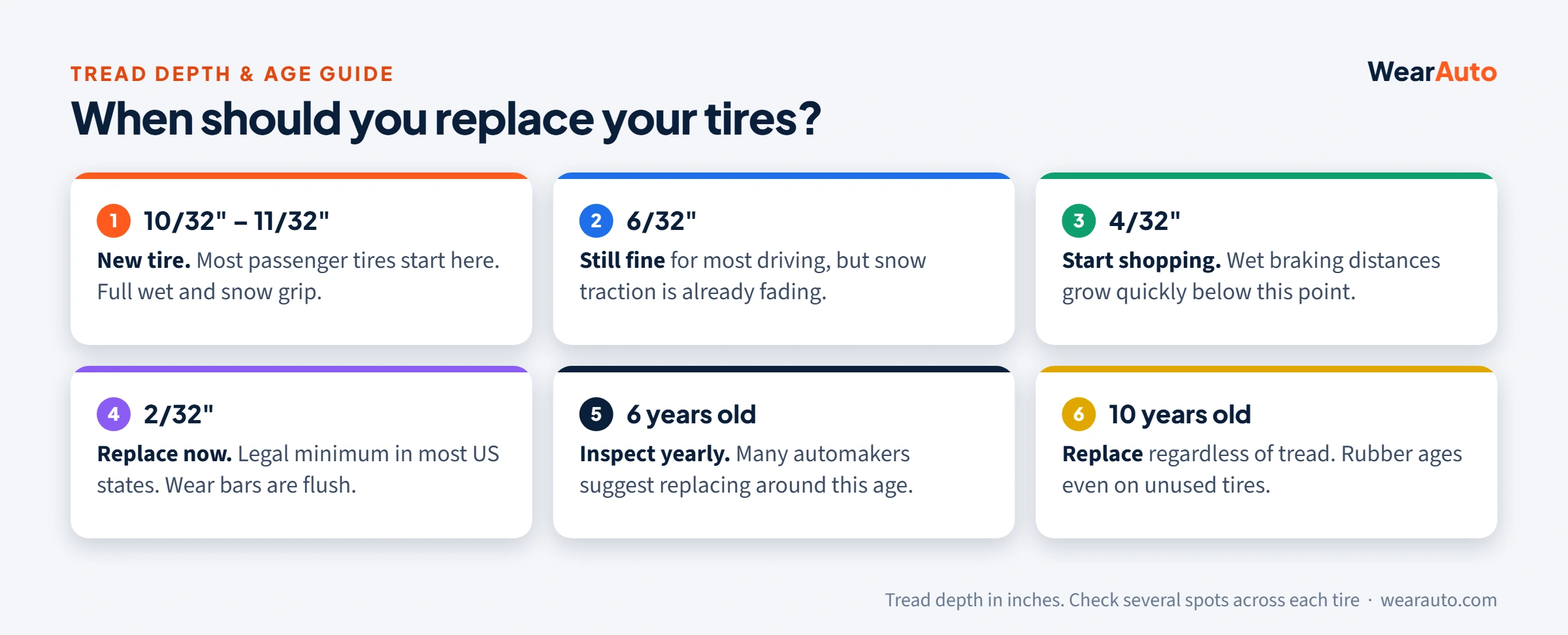
The legal limit in most states is 2/32 inch. That’s the point where the small rubber “wear bars” molded across the grooves sit flush with the tread. But legal and safe aren’t the same thing. Grooves are what channel water away from the contact patch, and as they get shallow, the tire has to push through water instead of cutting through it. Stopping distances on wet roads grow long before you reach 2/32, so plenty of tire engineers and safety groups recommend replacing at 4/32 inch. If you regularly drive on snow, consider new tires at around 5/32 or 6/32, since deep tread is what packs and grips snow.
How to check tread depth at home
- Use a tread depth gauge. They cost a few dollars at any parts store and give a real number. Measure in the inner, center and outer grooves of each tire.
- Try the quarter test. Put a quarter upside down into a groove. If the top of Washington’s head is visible, you’re at about 4/32 inch or less and it’s time to start shopping.
- Try the penny test. Same idea with Lincoln. If you can see all of his head, you’re at 2/32 inch or below. Replace the tires right away.
- Look at the wear bars. If the bars running across the grooves are level with the surrounding tread, the tire is done.
Check several spots around each tire, not just one. Uneven wear is common, and the shallowest point is the one that counts.
Tire Age: Why Old Tires Fail Even With Good Tread
Rubber breaks down over time from heat, sunlight and oxygen, even if the car hardly moves. An old tire can look fine and still have hardened rubber, poor wet grip and a higher risk of tread separation. This matters most for low-mileage cars, RVs, trailers and spare tires.
There’s no single federal expiration date, but the industry guidance is fairly consistent. Many vehicle manufacturers suggest replacing tires around six years from their production date, and most tire makers say ten years is the absolute maximum, no matter how much tread is left. After five years, have the tires inspected at least once a year.
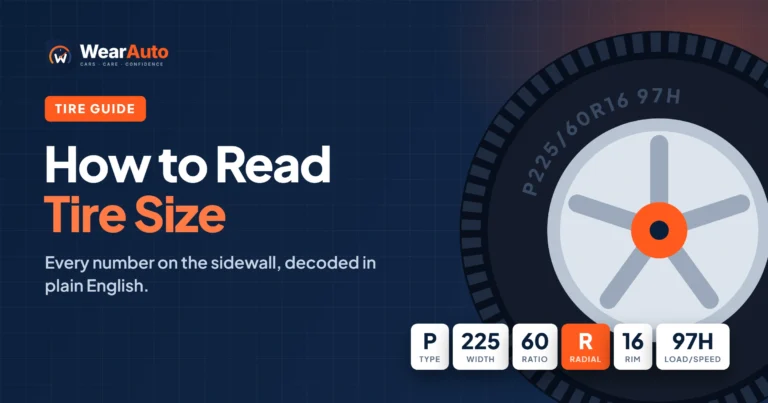
To find a tire’s age, look for the DOT code on the sidewall. The last four digits are the week and year it was made, so “1822” means the 18th week of 2022. We explain every marking in our guide on how to read tire size and sidewall codes.
Signs Your Tires Need Replacing Now
Some problems mean a tire should come off the car regardless of its age or mileage:
- Bulges or bubbles on the sidewall. This means the internal structure is damaged, usually from a pothole or curb strike. It can fail without warning.
- Cracks in the sidewall or between tread blocks. Fine “crazing” is a classic sign of aged, dried-out rubber.
- Cords or steel belts showing. Stop driving on it.
- A new vibration at highway speed. It could be a balance issue, but it can also be a separating belt.
- Repeated slow leaks or a puncture in the sidewall or shoulder, which can’t be safely repaired.
What Wears Tires Out Faster
If your last set didn’t make it anywhere near its warranty, one of these is usually the reason:
- Low tire pressure. An underinflated tire flexes more, runs hotter and wears both outer edges. It’s the single most common cause of short tire life. Check pressure monthly against the sticker in your driver’s door jamb.
- Bad alignment. If the inner or outer edge of a tire is wearing much faster than the rest, the wheels are probably out of alignment. Potholes and curbs knock alignment out more easily than most people think.
- Skipping rotations. Front tires on a front-wheel-drive car handle steering, most of the braking and all the power, so they wear much faster than the rears. Rotating every 5,000 to 7,500 miles evens that out.
- Driving style. Hard launches, late braking and fast cornering all take rubber off the tire. Smooth driving saves tread as well as fuel.
- Heat and road surface. Hot climates, rough chip-seal roads and gravel speed up wear.
- Worn suspension parts. Tired shocks or struts let the tire bounce, which leaves a scalloped, “cupped” wear pattern.
How to Make Your Tires Last Longer
None of this takes much time, and it’s the difference between replacing tires every three years and every five:
- Check tire pressure once a month and before long trips, with the tires cold.
- Rotate the tires every 5,000 to 7,500 miles, or at every other oil change.
- Get an alignment check once a year and after any hard pothole hit.
- Don’t overload the car. Stay within the load rating on your door placard.
- Swap winter tires off once temperatures stay above about 45°F (7°C).
- Buy the right size and load index for your car. If you’re considering a different size, compare it first with our tire size calculator.
Should You Replace Two Tires or All Four?
On most front- or rear-wheel-drive cars, replacing a pair is fine. The new tires should go on the rear axle, even on a front-wheel-drive car, because worn rear tires are more likely to lose grip in the wet and cause a spin. On all-wheel-drive vehicles, many manufacturers want all four tires within a small tread-depth difference of each other, often 2/32 to 4/32 inch, to protect the drivetrain. Check your owner’s manual before replacing just one or two. Some tire shops can “shave” a new tire down to match the others.
For more advice on buying, sizing and caring for tires, browse our Tires & Wheels guides.
Frequently Asked Questions
How many years do tires last on average?
For an average driver covering 12,000 to 14,000 miles a year, most all-season tires last about 3 to 6 years. Low-mileage cars may need new tires because of age before the tread wears out.
Is 4/32 tread depth safe?
It’s legal, but wet-weather grip is already reduced at 4/32 inch, so it’s a good time to replace. At 2/32 inch, tires should be replaced immediately.
Do tires expire if they are not used?
Yes. Rubber ages with time, heat and sunlight even when a tire is unused. Most tire makers say no tire should be in service more than 10 years after its production date.
Why did my tires wear out so fast?
The usual causes are low tire pressure, poor wheel alignment, skipped rotations, worn suspension parts and aggressive driving. Look at the wear pattern: edge wear points to pressure or alignment problems.
Do EV tires wear out faster?
Often, yes. Electric vehicles are heavy and deliver instant torque, which can wear tread faster than on a comparable gas car. EV-specific tires use tougher compounds to offset this.
The Bottom Line
Plan on roughly 40,000 to 80,000 miles from a set of all-season tires, but let tread depth and age make the final call. Replace at 4/32 inch if you want full wet grip, never run below 2/32, and don’t trust any tire that’s a decade old. A monthly pressure check, regular rotations and a yearly alignment check are the cheapest way to get every mile you paid for.
Shopping for new tires?
Make sure the size is right before you buy. Compare any two sizes for diameter, revolutions per mile and speedometer error.
Open the Tire Size Calculator →Sources and further reading
- NHTSA: Tires and tire safety
- NHTSA TireWise: tire buying, maintenance and aging
- Tire Industry Association: Reading a tire sidewall
Written and fact-checked by the WearAuto Editorial Team. This guide is general information; always follow your vehicle and tire manufacturer’s recommendations. See our editorial policy for how we research and update articles.