
Few things make a driver’s stomach drop quite like that little amber engine symbol lighting up on the dashboard. It doesn’t say what’s wrong, how serious it is or whether you’ll make it home. It just sits there.
Take a breath. Most of the time a check engine light points to something minor, and almost every time you can find out exactly what triggered it within a few minutes. Here’s what the light means, the problems that most often cause it, and how to decide whether to keep driving.
Quick answer
The check engine light means your car’s computer has detected a fault in the engine, emissions or fuel system and stored a diagnostic code. A solid light means get it checked soon; you can usually keep driving carefully. A flashing light usually means a serious misfire that can damage the catalytic converter, so reduce speed and get the car checked as soon as possible. The fastest next step is to read the OBD-II code, which most auto parts stores will do for free.
What the Check Engine Light Actually Means
Every car and light truck sold in the US since the 1996 model year has an on-board diagnostics system, known as OBD-II. It constantly monitors dozens of sensors, from oxygen sensors in the exhaust to the pressure in the fuel vapor system. When a reading falls outside the expected range, the computer stores a trouble code and, if the problem affects emissions or could damage the engine, turns on the light. The EPA’s OBD overview explains how the system ties into emissions testing.
That’s important to understand: the light is about the engine and emissions system specifically. Problems with brakes, airbags, tire pressure or oil pressure have their own warning lights.
Solid vs. Flashing: How Serious Is It?
| What you see | What it usually means | What to do |
|---|---|---|
| Solid light, car drives normally | A fault that isn’t immediately harmful | Read the code within a few days |
| Solid light plus rough running, stalling or loss of power | A problem affecting how the engine runs | Drive gently and get it checked soon |
| Flashing light | Active, severe misfire | Reduce speed, avoid hard acceleration, get it checked right away |
| Light plus red temperature or oil warning | Possible overheating or oil pressure loss | Pull over safely and switch off the engine |
A flashing light deserves real urgency. During a misfire, unburned fuel goes into the exhaust and burns inside the catalytic converter, which can overheat and ruin it. A catalytic converter is one of the most expensive parts on the car, so a few extra days of driving with a flashing light can turn a cheap spark plug job into a very costly repair.
The Most Common Causes
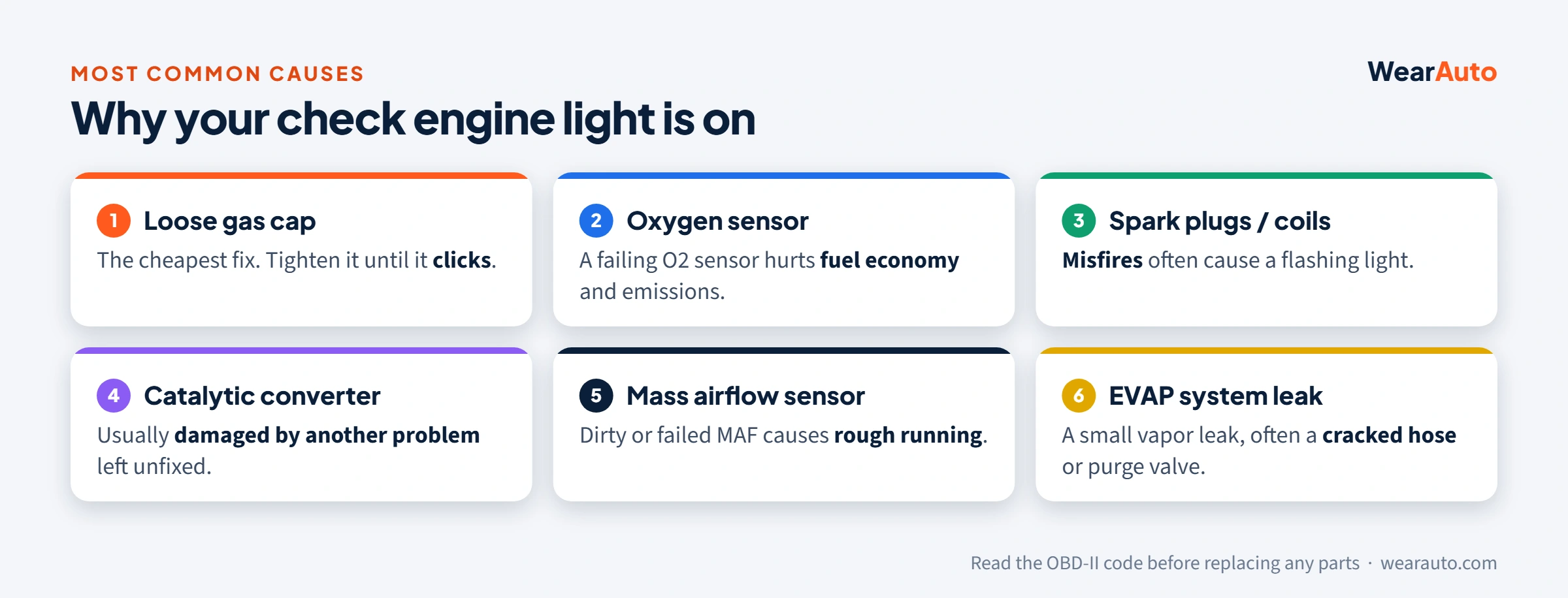
1. A loose or damaged gas cap
It sounds too simple, but it’s one of the most frequent triggers. The fuel system is sealed to stop gasoline vapor escaping, and a cap that isn’t clicked tight registers as a leak. Tighten it, drive normally for a few days, and the light may switch itself off. If the cap’s seal is cracked, a new cap is inexpensive.
2. A failing oxygen sensor
Oxygen sensors measure how much unburned oxygen is in the exhaust so the computer can fine-tune the fuel mixture. As they age they get slow or inaccurate, which can quietly cut your fuel economy. Most cars have two to four of them.
3. Worn spark plugs or ignition coils
A weak spark means fuel doesn’t burn completely, causing a misfire. Codes from P0300 to P0308 point to misfires, with the last digit often telling you which cylinder. Spark plugs are a routine replacement item, typically every 60,000 to 100,000 miles on modern cars.
4. Catalytic converter problems
Codes like P0420 indicate the converter isn’t cleaning the exhaust as well as it should. Converters rarely fail on their own. They’re usually damaged by another problem, such as misfires or burning oil, so it’s worth finding the root cause before replacing one.
5. Mass airflow (MAF) sensor
The MAF sensor measures the air entering the engine. A dirty or failing one can cause hesitation, rough idle and poor mileage. Sometimes cleaning it with a dedicated MAF cleaner fixes the issue.
6. EVAP system leaks
Beyond the gas cap, the evaporative emissions system has hoses, valves and a charcoal canister. Small leaks are common on older cars and usually aren’t urgent, but they will cause an emissions test failure.
Other frequent culprits include a thermostat stuck open, vacuum leaks, a failing EGR valve and, on some cars, simply a weak battery causing odd sensor readings. Our guide to how long car batteries last covers the signs of a weak battery.
How to Find Out Why Your Light Is On
- Check the obvious first. Is the gas cap tight? Are any other warning lights on? Does the car drive, sound and smell normal?
- Read the code. Plug an OBD-II scanner into the port under the dashboard, usually near the steering column. Basic scanners and Bluetooth adapters that work with a phone app are inexpensive. Many auto parts stores will scan it free.
- Write down every code, including “pending” codes. A code looks like P0171 or P0442: the letter shows the system (P for powertrain) and the numbers pinpoint the fault.
- Research before buying parts. A code tells you what the computer noticed, not always what failed. A lean code (P0171), for example, can come from a vacuum leak, a dirty MAF sensor or a weak fuel pump. Proper diagnosis avoids replacing parts that weren’t broken.
- Fix the cause, then clear the code. Once the repair is done, the light can be cleared with the scanner or will turn off on its own after several normal drive cycles.
For a closer look at more dashboard symbols, browse our Warning Lights guides.
Can You Just Reset the Light?
You can clear it with a scanner, and disconnecting the battery often clears it too. But if the underlying fault is still there, the light will come back, sometimes within minutes. Clearing codes also resets the car’s “readiness monitors,” the self-tests an emissions inspection checks. Show up for an inspection right after clearing codes and you’ll likely fail for being “not ready.” On top of that, you lose the stored information a mechanic would use to diagnose the problem.
Will It Pass Inspection?
In states and cities with OBD-based emissions testing, an illuminated check engine light is generally an automatic fail. State programs such as Oregon DEQ’s OBD testing explain the rules in detail. Fix the problem and drive normally for a few days so the readiness monitors complete before you test.
Frequently Asked Questions
Is it safe to drive with the check engine light on?
If the light is solid and the car drives normally, it’s usually safe to drive for a short time while you arrange a diagnosis. If it’s flashing, or the car is running badly, reduce speed and get it checked right away.
Can a loose gas cap really turn on the check engine light?
Yes. A loose or damaged cap lets fuel vapor escape, which the EVAP system detects as a leak. Tighten it and the light may go off after a few days of driving.
How much does it cost to diagnose a check engine light?
Reading the code is often free at auto parts stores. A full diagnosis at a repair shop usually costs about an hour of labor, which varies by region.
Will the check engine light turn off by itself?
Sometimes. If the fault was temporary, like a loose gas cap, the light usually turns off after several normal drive cycles once the system confirms the problem is gone.
Why is my check engine light flashing?
A flashing light usually means an active engine misfire that can overheat and damage the catalytic converter. Avoid hard acceleration and get the car checked as soon as possible.
The Bottom Line
A check engine light is a request for attention, not a reason to panic. Check the gas cap, read the code, and treat a flashing light as urgent. Most causes, from loose caps to tired spark plugs and oxygen sensors, are affordable when caught early. The expensive repairs usually come from ignoring the light for months.
Another light on your dash?
Our warning light guides explain what each symbol means and how urgent it is.
Browse Warning Lights →Keep reading
Free tools for this topic
Sources and further reading
- US EPA: Vehicle emissions on-board diagnostics (OBD)
- Oregon DEQ: On-board diagnostics testing
- FuelEconomy.gov: Keeping your vehicle in shape
Written and fact-checked by the WearAuto Editorial Team. This guide is general information; if your car is running badly or shows red warning lights, stop safely and seek professional help. See our editorial policy for how we research and update articles.