
For decades, the windshield sticker said the same thing: come back in 3,000 miles. Plenty of drivers still follow that rule, and plenty of quick-lube shops are happy to let them. But engines and oils have changed a lot since that advice became standard. Most cars built in the last fifteen years can go much longer between changes, and doing it too often just costs money and creates more waste oil.
That doesn’t mean you can ignore it, either. Old, broken-down oil is one of the fastest ways to damage an engine. Here’s how to find the right interval for your car and your driving.
Quick answer
Most modern cars using full synthetic oil need an oil change every 7,500 to 10,000 miles. Older cars on conventional oil are usually on a 3,000 to 5,000 mile schedule. Either way, change the oil at least every 6 to 12 months, and switch to the shorter “severe service” interval if you mostly make short trips, tow, or drive in extreme heat or dust. Your owner’s manual or oil life monitor has the final say.
Why the 3,000-Mile Rule Is Out of Date
The 3,000-mile figure dates back to a time when engines ran looser tolerances, burned more oil and used simpler oils that broke down quickly. Modern engines are built more precisely, fuel injection keeps combustion cleaner, and today’s oils carry far stronger additive packages. Industry standards for motor oil, such as the American Petroleum Institute’s API certification and the ILSAC specifications most automakers require, have been tightened repeatedly.
The result is that many manufacturers now specify 7,500, 10,000 or even 15,000 miles between changes under normal conditions. If your car is from the last decade and you’re still changing oil every 3,000 miles, you may be doing two or three changes for every one your engine actually needs.
Oil Change Intervals by Oil Type
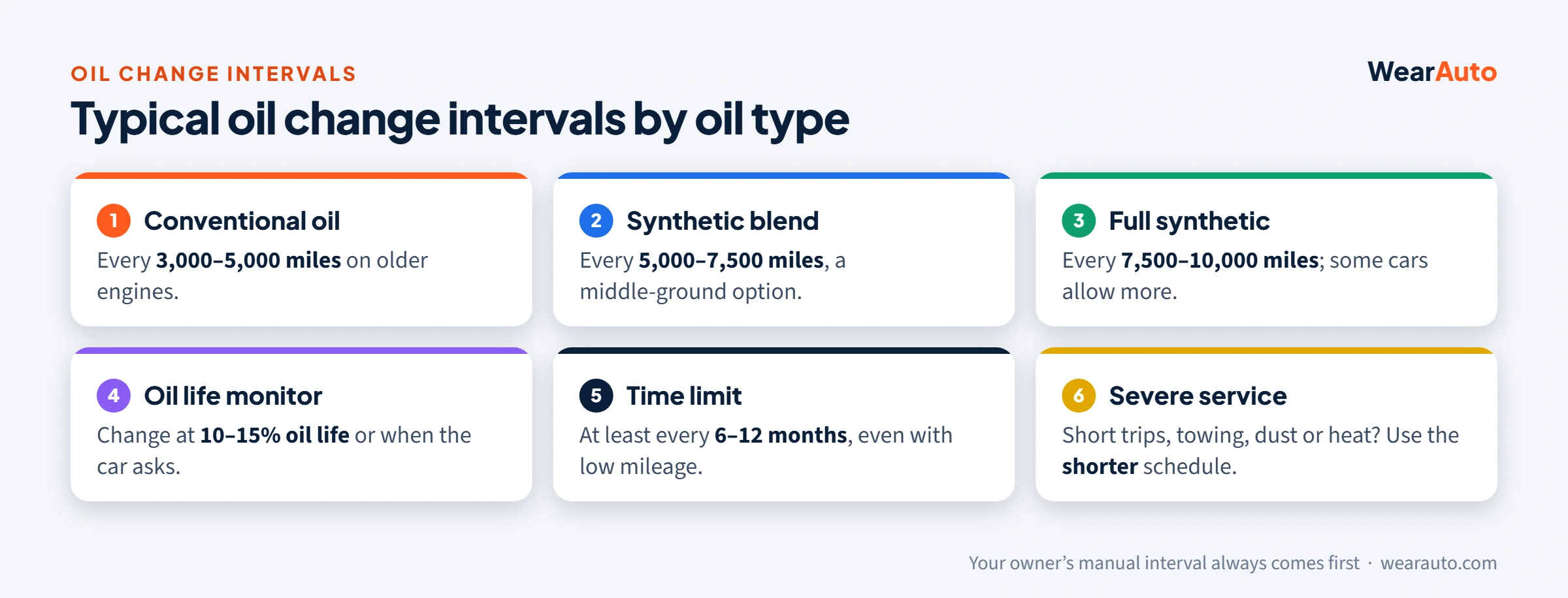
| Oil type | Typical interval | Common on |
|---|---|---|
| Conventional (mineral) | 3,000–5,000 miles | Older and high-mileage engines, some trucks |
| Synthetic blend | 5,000–7,500 miles | Many mid-2000s to mid-2010s cars |
| Full synthetic | 7,500–10,000 miles | Most cars built since about 2015, turbo engines |
| Extended-life synthetic | Up to 15,000 miles | Only where the manufacturer allows it |
These are typical ranges, not promises. The interval printed in your owner’s manual is based on testing your specific engine and should override any general rule. If your manual lists a viscosity like 0W-20 or 5W-30, stick with that grade.
Don’t Forget the Time Limit
Oil ages even when the car doesn’t move much. Moisture from condensation and unburned fuel slowly contaminate it, and its additives wear out. That’s why most manufacturers specify a time limit alongside the mileage, usually every 6 or 12 months, whichever comes first.
This catches a lot of people out. If you only drive 4,000 miles a year, you still need at least one oil change a year, even though you’re nowhere near the mileage limit. Low-mileage cars that only do short trips are actually among the hardest on oil, because the engine never gets hot enough to boil off the moisture that collects inside.
Normal vs. Severe Driving: Which One Are You?
Most owner’s manuals list two schedules. The “severe service” one is shorter, often around half the normal interval. The name makes it sound rare, but a lot of everyday driving qualifies. You should probably follow the severe schedule if you regularly:
- Make lots of short trips under about 5 to 10 miles, especially in cold weather
- Sit in heavy stop-and-go traffic or idle for long periods (delivery, rideshare, police work)
- Tow a trailer or carry heavy loads, or use a roof box often
- Drive on dusty, sandy or gravel roads
- Live somewhere with very hot summers or very cold winters
- Drive hard on track days or in mountainous terrain
Steady highway driving at a constant speed is actually the easiest thing you can ask of engine oil. If that describes most of your miles, the normal schedule is fine.
Should You Trust Your Car’s Oil Life Monitor?
Many cars now have an oil life percentage on the dashboard. Most of these systems don’t actually test the oil. Instead, they track engine revolutions, operating temperature, trip length, cold starts and other data, and calculate how hard the oil has been worked. For normal use they’re generally reliable, and they automatically shorten the interval if you drive in severe conditions.
A few tips for using one well:
- Plan the change when the monitor reaches about 10 to 15%, rather than waiting for 0%.
- Make sure whoever changes your oil resets the monitor. If it isn’t reset, it can’t do its job.
- The monitor doesn’t know your oil level. You still need to check the dipstick.
Signs Your Engine Needs an Oil Change Now
- The oil pressure warning light comes on. Pull over safely and switch the engine off. This light means the engine isn’t getting enough oil pressure, and continuing to drive can destroy it in minutes.
- Low level on the dipstick. Top it up to the full mark with the correct oil, then figure out where it’s going.
- Dark, gritty or sludgy oil. Fresh oil is amber and see-through. Oil darkens normally as it cleans, but if it feels gritty between your fingers it’s overdue.
- Louder engine noise or ticking, especially on cold starts.
- A burning oil smell inside the car, which can point to a leak dripping onto hot exhaust parts.
Make a habit of checking the dipstick once a month. Park on level ground, wait a few minutes after switching off (or check before starting), pull the dipstick, wipe it, push it fully back in and pull it again. The oil should sit between the two marks. Some newer cars have no dipstick and show the oil level in the instrument cluster instead.
How to Save Money on Oil Changes
- Follow the manual, not the sticker. Many shops print a sticker based on their own policy rather than your car’s real interval.
- Combine jobs. Have the tires rotated at every oil change or every other one. Our guide on how often to rotate your tires explains why that timing works well.
- Keep records. Save receipts or log the date and mileage. It protects your warranty and adds resale value.
- Consider doing it yourself. On many cars, an oil and filter change is a straightforward job with basic tools. Take the old oil to a parts store or recycling center. Most accept it free.
For more maintenance guides covering oil, coolant, transmission and brake fluid, visit our Oil & Fluids section.
Frequently Asked Questions
Is it OK to change oil every 10,000 miles?
Yes, if your car uses full synthetic oil and the manufacturer specifies 10,000 miles for normal driving. If you drive in severe conditions or your manual lists a shorter interval, follow that instead.
Do I need an oil change if I barely drive?
Yes. Most manufacturers require an oil change at least every 6 to 12 months regardless of mileage, because oil degrades with time and short trips let moisture build up in it.
What happens if I go too long without an oil change?
Old oil loses its ability to lubricate and clean, which speeds up wear, can create sludge and, in the worst case, can lead to engine failure. Going a few hundred miles over is not a disaster, but don’t make it a habit.
Should I change the oil filter every time?
Yes. A new filter costs little, and most manufacturers specify replacing it with every oil change.
How long does an oil change take?
About 20 to 45 minutes at a shop, or roughly an hour if you do it yourself for the first time.
The Bottom Line
For most modern cars on synthetic oil, every 7,500 to 10,000 miles or once a year is the right rhythm. Older engines on conventional oil still need 3,000 to 5,000 miles. Shorten the interval if your driving is severe, never skip the time limit, and check the dipstick monthly in between. When in doubt, the owner’s manual and the oil life monitor are better guides than any sticker.
More car maintenance guides
Oil, brakes, batteries and engine care, explained in plain English by the WearAuto Editorial Team.
Browse Car Maintenance →Keep reading
Free tools for this topic
Sources and further reading
- American Petroleum Institute: Motor Oil Guide
- API Engine Oil Licensing and Certification System
- FuelEconomy.gov: Keeping your vehicle in shape
Written and fact-checked by the WearAuto Editorial Team. Oil change intervals vary by engine; always follow your owner’s manual. See our editorial policy for how we research and update articles.