
Car batteries have a habit of failing at the worst possible moment: a freezing morning, a packed airport parking lot, the day you’re already running late. Part of the reason is that they rarely give much warning. A battery can start the car perfectly on Tuesday and leave you with nothing but a click on Wednesday.
The good news is that battery life is fairly predictable once you know what affects it. Here’s how long a typical battery lasts, what wears it out, how to check its health yourself and how to squeeze a few more years out of it.
Quick answer
A typical 12-volt car battery lasts 3 to 5 years. In hot climates, expect the low end or less; in mild climates with regular driving, some last 6 years or more. A healthy, fully charged battery reads about 12.6 volts with the engine off. Once a battery passes 3 years old, have it tested every year, ideally before winter.
What Really Determines Battery Life
Heat is the biggest enemy
It surprises a lot of people, but summer does more damage to car batteries than winter. High under-hood temperatures speed up the chemical reactions inside the battery, which accelerates corrosion of the internal plates and evaporates electrolyte. The Car Care Council points out that heat and overcharging are among the main causes of shortened battery life. Drivers in places like Arizona, Texas or Florida often replace batteries every 2 to 3 years.
Cold reveals the damage
Cold weather reduces a battery’s available power and makes the engine harder to turn over, since the oil is thicker. A battery that was weakened by summer heat often makes it through autumn and then fails on the first truly cold morning. That’s why winter gets the blame.
Short trips and lots of electronics
Starting the engine takes a big gulp of power, and the alternator needs time to put it back. If most of your drives are under 15 or 20 minutes, the battery may never fully recharge. Over months, a battery that lives in a partly charged state builds up sulfate on its plates and loses capacity. Modern cars add to the load with alarms, keyless entry, telematics and infotainment systems that draw a little power even when parked.
Battery type
Standard flooded lead-acid batteries are the most common and least expensive. AGM (absorbent glass mat) batteries handle deep cycling better and are required in many cars with automatic start-stop systems. They usually last a bit longer but cost more. If your car came with an AGM or EFB battery, replace it with the same type.
Warning Signs of a Dying Car Battery
- Slow cranking. The engine turns over sluggishly before it starts, especially on cold mornings.
- Clicking when you turn the key or press start, with no cranking at all.
- Dim headlights or interior lights at idle, which brighten when you rev the engine.
- Electrical gremlins such as the radio resetting, warning lights flickering or start-stop no longer working.
- A battery warning light on the dash. This often points to the charging system (alternator) rather than the battery itself, but either way it needs checking.
- A swollen case, leaks or a rotten-egg smell. Replace the battery and handle it carefully.
- Heavy white or blue-green corrosion on the terminals.
Remember that a car that won’t start isn’t always a battery problem. If the lights and dash work but the engine won’t crank, the starter, connections or ignition switch could be at fault. Our troubleshooting guides walk through the most common no-start causes.
How to Check Your Battery’s Health
Start by finding the battery’s age. Most batteries have a date sticker or a stamped code on the case, often a letter for the month and a number for the year, such as “K5” for November 2025. If it’s more than three years old and you’re seeing any of the signs above, it’s on borrowed time.
Next, check the voltage with an inexpensive multimeter. Let the car sit for a few hours first, or switch the headlights on for a minute and then off, so you’re reading the true resting voltage rather than a temporary surface charge.
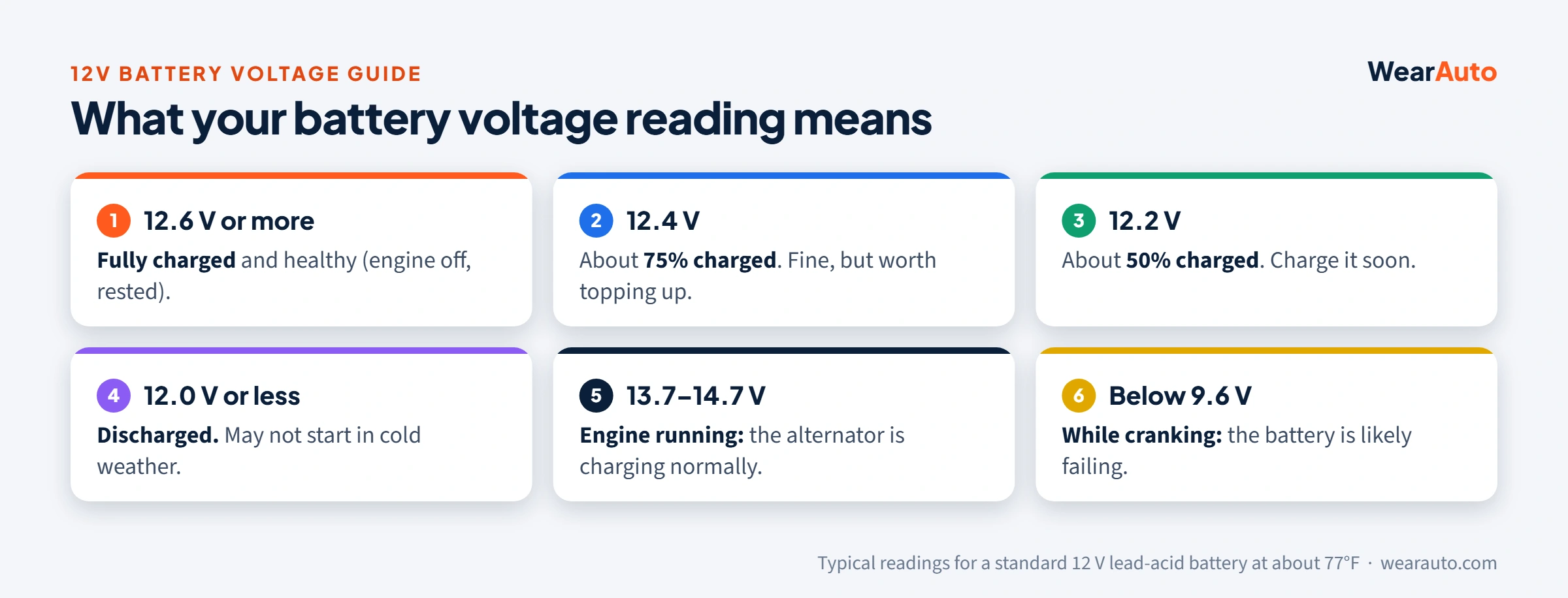
Voltage tells you the state of charge, not the battery’s ability to deliver current under load. A worn battery can show 12.6 volts and still collapse when you try to start the engine. For a proper verdict, use a load tester or a modern conductance tester. Most auto parts stores will test your battery and charging system for free in a few minutes.
With the engine running, you should see roughly 13.7 to 14.7 volts at the battery. Much lower suggests the alternator isn’t charging properly; much higher suggests overcharging, which can cook a battery.
How to Make Your Car Battery Last Longer
- Drive at least 20 to 30 minutes regularly. One longer drive a week helps if most of your trips are short.
- Use a battery maintainer (a smart trickle charger) if the car sits for more than a couple of weeks at a time.
- Park in the shade or a garage in hot weather to keep under-hood temperatures down.
- Keep the terminals clean and tight. Clean corrosion with a baking soda and water solution and a wire brush, with the negative cable disconnected first.
- Make sure it’s held down firmly. A loose battery vibrates, which damages the internal plates.
- Turn off accessories before switching off the engine, and don’t sit with the radio or lights on and the engine off.
- Have it tested every year after the third year, especially before winter.
Choosing a Replacement Battery
When it’s time for a new battery, match these specs from your owner’s manual or the old battery’s label:
- Group size, which sets the physical dimensions and terminal layout (for example Group 24F, 35 or H6).
- Cold cranking amps (CCA): meet or exceed the original rating, especially in cold climates.
- Type: replace AGM with AGM and EFB with EFB or AGM. Some cars need the new battery registered with the car’s computer.
- Freshness: check the date code and avoid batteries that have sat on the shelf for more than about six months.
- Warranty: the free-replacement period is a good clue to quality. Three years is common on mid-range batteries.
Old batteries are highly recyclable, and most retailers take them back when you buy a new one. For more guides on charging systems, fuses and wiring, visit our Batteries & Electrical section.
Frequently Asked Questions
Can a car battery last 10 years?
It’s rare. A few batteries reach 7 to 8 years in mild climates with regular driving and good care, but most need replacing between 3 and 5 years.
Should I replace my car battery every 3 years?
Not automatically. Have it tested once it reaches 3 years, and replace it when testing shows it’s weak or it starts showing warning signs.
Does driving charge a car battery?
Yes. The alternator recharges the battery while the engine runs, but short trips may not give it enough time to fully recover from starting.
What voltage is too low for a car battery?
With the engine off and the battery rested, 12.4 volts is about 75% charged and 12.0 volts or less is essentially discharged. If the voltage drops below about 9.6 volts while cranking, the battery is likely failing.
How long can a car sit before the battery dies?
Often two to four weeks for a modern car, depending on the battery’s condition and how much power the car’s electronics draw while parked. A battery maintainer prevents this.
The Bottom Line
Plan on 3 to 5 years from a car battery, less in hot climates. Heat does the damage and cold exposes it, so get the battery tested every autumn once it’s past three years old. Regular longer drives, clean terminals and a maintainer for cars that sit will help yours reach the long end of that range, and replacing it on your schedule beats waiting for a no-start.
More battery and electrical guides
Testing, jump-starting, charging systems and fuses, explained step by step.
Browse Batteries & Electrical →Sources and further reading
- Car Care Council: Summer heat takes a toll on your car’s battery
- FuelEconomy.gov: Keeping your vehicle in shape
Written and fact-checked by the WearAuto Editorial Team. Car batteries contain acid and can release explosive gas; wear eye protection and follow your owner’s manual when working on them. See our editorial policy for how we research and update articles.