
Stand in the oil aisle of any parts store and you’ll see the same viscosity, say 5W-30, sold as conventional, synthetic blend, full synthetic and high mileage, with prices that can differ by two or three times. It’s fair to wonder whether the expensive bottle is genuinely better or just better marketed.
The honest answer is that synthetic oil really is a better lubricant in almost every measurable way, but not every engine needs it. Here’s what separates the two, what it means for cost, and how to decide for your car.
Quick answer
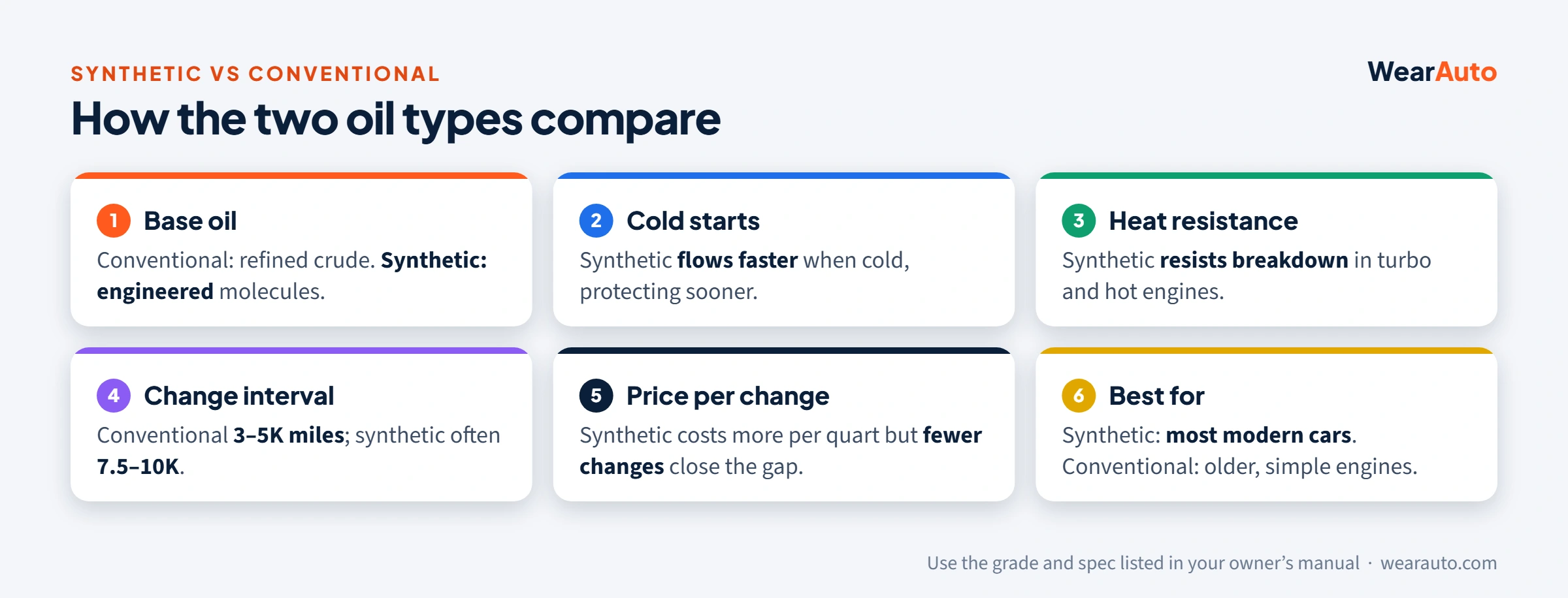
Synthetic oil flows better when cold, resists breaking down in heat and usually lasts 7,500 to 10,000 miles between changes. Conventional oil is cheaper per quart but typically needs changing every 3,000 to 5,000 miles. If your owner’s manual calls for synthetic, as most newer and turbocharged cars do, you must use it. If it allows conventional, synthetic is still an upgrade, but conventional will do the job.
What’s the Difference Between Synthetic and Conventional Oil?
All motor oil starts with a base oil and then gets an additive package of detergents, dispersants, anti-wear agents and friction modifiers. The difference is in the base.
Conventional oil uses base oil refined from crude oil. It’s a mix of molecules of different shapes and sizes, along with a few impurities the refining process doesn’t fully remove.
Synthetic oil uses base oil that has been chemically engineered or very heavily processed so the molecules are far more uniform. Most synthetics sold today use highly refined base stocks, while premium products may use fully man-made ones such as PAO. Either way, the uniform structure is what gives synthetic its advantages.
Synthetic blend sits in between: mostly conventional base oil with some synthetic mixed in. High-mileage oil can be conventional, blend or synthetic, with extra seal conditioners meant for engines past about 75,000 miles.
Where Synthetic Oil Has the Edge
Cold starts
Most engine wear happens in the first seconds after a cold start, before oil has reached every bearing and cam lobe. Synthetic oil stays thinner in the cold and flows to the top of the engine faster. If you live somewhere with freezing winters, that’s a real benefit every single morning.
Heat and turbochargers
At high temperatures, conventional oil oxidizes and breaks down faster, leaving deposits and sludge. Synthetic holds its viscosity and resists oxidation much longer. This matters a lot for turbocharged engines, where the turbo’s bearings are bathed in oil and can run extremely hot. It’s a big reason most small turbocharged engines now require synthetic.
Cleaner engines and longer intervals
Because synthetic breaks down more slowly, it keeps working longer. That’s why manufacturers that specify synthetic usually allow 7,500 to 10,000 miles between changes, compared with 3,000 to 5,000 for conventional. Our guide to how often to change engine oil goes through intervals in detail.
Where Conventional Oil Still Makes Sense
- Older, simple engines designed and tested around conventional oil, driven gently in a mild climate.
- Engines that burn or leak oil and need frequent top-ups anyway. Paying synthetic prices for oil that disappears doesn’t make much sense.
- Some classic and vintage cars, where owners prefer specific oils with older additive formulas. Specialist advice applies here.
- Tight budgets on a car whose manual allows conventional. Changing conventional oil on time beats stretching synthetic oil past its limit.
The Real Cost Difference
Per oil change, synthetic costs more, often something like $25 to $50 extra at a shop depending on the car and how many quarts it takes. But the comparison that matters is cost per year, not cost per change. Here’s a rough example for someone driving 12,000 miles a year:
| Conventional | Full synthetic | |
|---|---|---|
| Interval | Every 4,000 miles | Every 8,000 miles |
| Changes per year | 3 | 1.5 |
| Example cost per change | $50 | $90 |
| Example cost per year | About $150 | About $135 |
Prices vary widely by region and vehicle, but the pattern holds for most drivers: fewer changes go a long way toward closing the gap, and you save time too. The math only favors conventional if your car’s manual still requires short intervals no matter which oil you use.
Common Myths About Synthetic Oil
- “Synthetic causes leaks in older engines.” Modern synthetics don’t damage seals. They can sometimes reveal a seal that was already worn and only sealed up by sludge. If you’re worried, a high-mileage synthetic includes seal conditioners.
- “Once you switch to synthetic, you can’t go back.” Not true. Synthetic and conventional oils are fully compatible, and you can switch either way at any oil change.
- “New engines need conventional oil to break in.” Many cars leave the factory filled with synthetic. Follow the manual.
- “Synthetic means you never need to change it.” Synthetic lasts longer, not forever. Additives wear out and contaminants build up, so stick to the interval.
How to Choose the Right Oil for Your Car
- Read the owner’s manual. It lists the viscosity (such as 0W-20 or 5W-30) and the specification the oil must meet. Many manufacturers name their own standard, such as GM’s dexos, or a European approval code.
- If it says synthetic is required, use synthetic. Using conventional oil in an engine that requires synthetic can risk damage and void the warranty.
- Look for the API “donut” and “starburst” symbols on the bottle. They show the oil meets current industry standards. The API Motor Oil Guide explains what each symbol means.
- Match the oil to your driving. Short trips, towing, cold winters, hot summers or a turbo engine all favor synthetic, even if conventional is allowed.
- Consider high-mileage oil once you pass about 75,000 miles, especially if you notice small leaks or the engine uses a little oil between changes.
You’ll find more guides on oil, coolant and other fluids in our Oil & Fluids section.
Frequently Asked Questions
Can I mix synthetic and conventional oil?
Yes. They’re compatible, and topping up synthetic with conventional (or the reverse) won’t harm the engine. You’ll just end up with something closer to a synthetic blend.
Is synthetic oil worth it for an old car?
Often, yes, especially in cold climates or if you drive short trips. If the engine burns or leaks a lot of oil, a high-mileage conventional or blend may be the more economical choice.
Does synthetic oil improve fuel economy?
Slightly, in some cases, because it flows more easily, especially in thin grades like 0W-20. Don’t expect a big change, though.
Is synthetic blend good enough?
For many cars that allow conventional oil, a blend is a reasonable middle ground. If your manual requires full synthetic, a blend is not a substitute.
How long does synthetic oil last?
Typically 7,500 to 10,000 miles, and sometimes up to 15,000 where the manufacturer allows it. Most carmakers also set a time limit of 6 to 12 months.
The Bottom Line
Synthetic oil is the better lubricant: it protects faster on cold starts, survives heat better and lasts longer between changes, which often makes it close to the same cost per year. If your manual requires it, there’s no debate. If your car allows conventional and you drive gently in a mild climate, conventional changed on time is perfectly fine. What matters most is the right grade and spec, changed at the right interval.
Not sure when your next oil change is due?
See typical intervals by oil type, the time limit most drivers forget, and when to use the severe service schedule.
Read: How Often to Change Oil →Keep reading
Free tools for this topic
Sources and further reading
- American Petroleum Institute: Motor Oil Guide
- API Engine Oil Licensing and Certification System
- FuelEconomy.gov: Keeping your vehicle in shape
Written and fact-checked by the WearAuto Editorial Team. Example prices are illustrative and vary by vehicle and region. See our editorial policy for how we research and update articles.