A lease can get you into a brand-new car for a lower monthly payment than a loan. Buying usually costs more each month, but you own the car at the end. So which one actually saves more money?
The honest answer is that it depends on how long you keep cars, how much you drive, and what matters most to you. This guide explains how each option works, compares the real costs, and shows which drivers come out ahead with each.
Quick answer
Buying a car and keeping it for many years almost always costs less in total than leasing, because you stop making payments and still own something with resale value. Leasing usually means lower monthly payments and a new car every few years, but you never build equity and face mileage limits and wear fees. Leasing can make sense if you drive less than about 12,000 miles a year, want a new car often, or can deduct it for business.
- Compare the total cost over the same period, not just the monthly payment.
- Use our lease vs buy calculator with your real numbers.
How Leasing Works
When you lease, you pay for the car’s expected depreciation during the lease term, plus interest (the money factor), taxes, and fees. At the end, you return the car, buy it for a set price, or lease a new one.
Key lease terms:
- Capitalized cost: the negotiated price of the car. Yes, you can negotiate it.
- Residual value: what the car is expected to be worth at the end of the lease.
- Money factor: the interest rate. Multiply by 2,400 for an approximate APR.
- Mileage allowance: often 10,000, 12,000, or 15,000 miles a year. Extra miles typically cost $0.15 to $0.30 each.
How Buying Works
When you buy, you pay the full price of the car, either in cash or with a loan. Once the loan is paid off, you own the car outright and have no monthly payment. You can keep it, sell it, or trade it in.
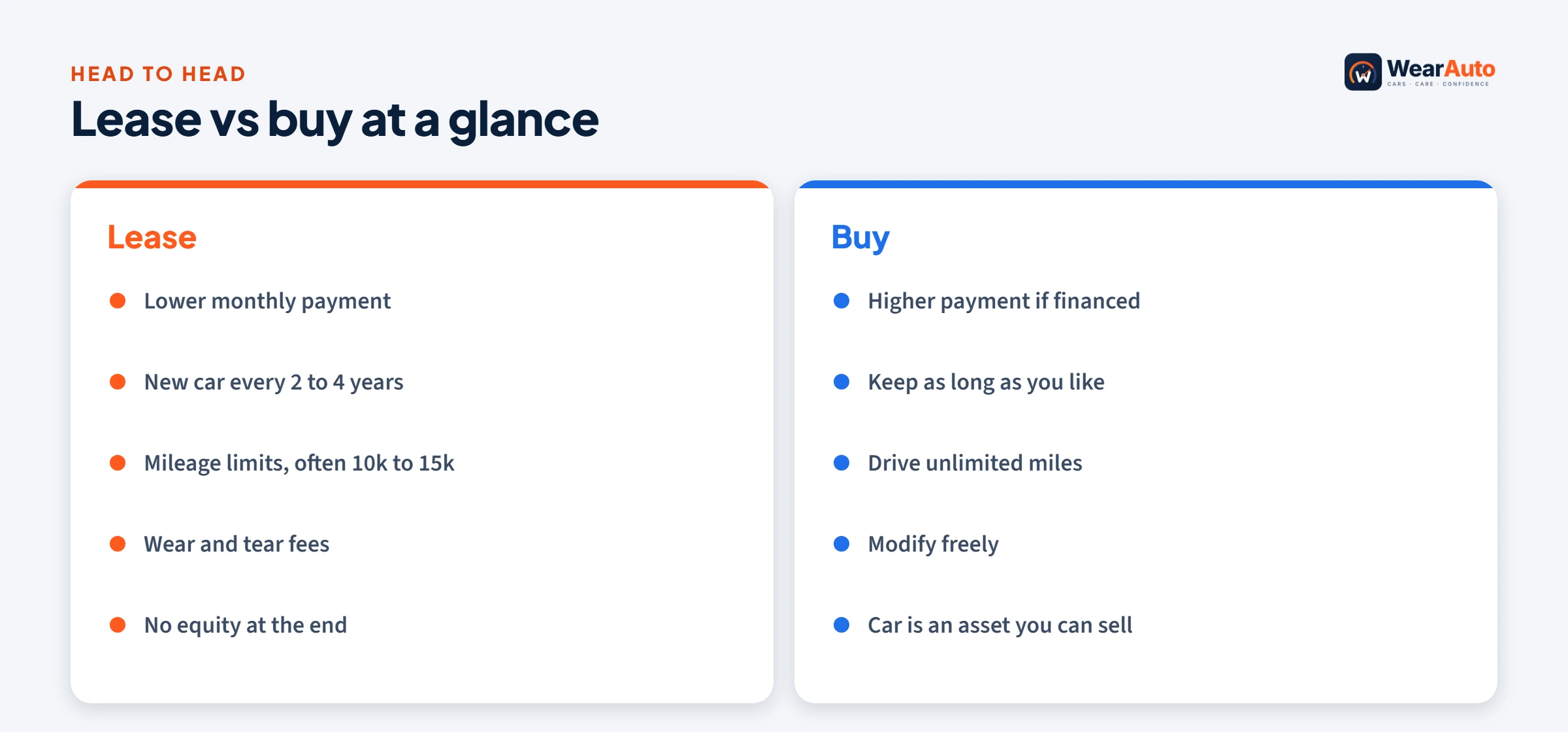
Leasing vs Buying: Cost Comparison
| Factor | Lease | Buy (financed) |
|---|---|---|
| Upfront cost | First month, fees, often a down payment | Down payment, taxes, fees |
| Monthly payment | Usually lower | Usually higher |
| Total cost over 3 years | Often lower | Higher, but you keep the car |
| Total cost over 6+ years | Higher | Usually lower |
| Mileage | Limited, fees for extra miles | Unlimited |
| Wear and tear | Fees for excess damage | Affects resale only |
| Equity | None | Yes, the car’s value |
| Customization | Not allowed | Allowed |
A Worked Example
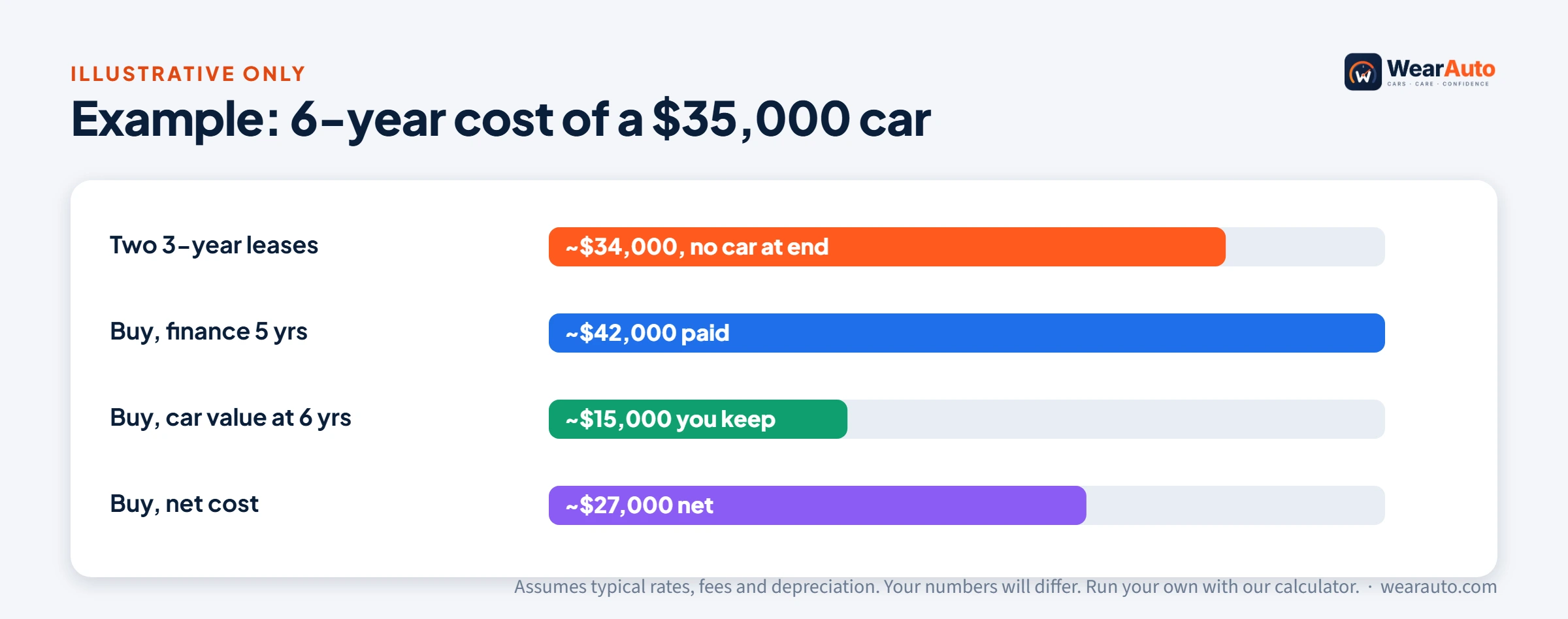
Take a $35,000 car. Two back-to-back three-year leases at about $450 a month plus fees might total around $34,000 over six years, and you have no car at the end.
Buying the same car with a five-year loan at a typical rate might total around $42,000 in payments. But after six years, the car could still be worth about $15,000. That makes your net cost closer to $27,000, and you can keep driving it with no payment.
These numbers are illustrative. Interest rates, incentives, and resale values change a lot. That is why it pays to run your own figures.
Compare lease vs buy with your numbers
Enter the car price, lease offer, loan rate and how long you keep cars to see which costs less.
Open the calculator →When Leasing Makes Sense
- You want a new car every two to four years and value always having the latest safety and tech features.
- You drive a predictable, modest number of miles, usually under 12,000 to 15,000 a year.
- You want lower monthly payments and do not mind never owning the car.
- You use the car for business, where lease payments may be partly tax-deductible. Ask a tax professional.
- You want to avoid out-of-warranty repairs, since most leases end before the warranty does.
- EVs and fast-changing technology, where leasing protects you from uncertain resale values and sometimes passes on incentives.
When Buying Makes Sense
- You keep cars for five years or more. The longer you keep a car after it is paid off, the more you save.
- You drive a lot of miles, making lease mileage limits expensive.
- You want to modify the car or do not want to worry about dings and stains.
- You want an asset you can sell or trade in later.
- You plan to buy used, which avoids the steepest depreciation of the first few years.
Watch out for lease extras
Lease contracts often include acquisition and disposition fees, high charges for extra miles, and charges for worn tires or damage at turn-in. Read the contract carefully and ask for every fee in writing before you sign.
How to Get a Better Deal Either Way
- Negotiate the price first. For a lease, that is the capitalized cost. For a loan, it is the purchase price.
- Get pre-approved for a loan with a bank or credit union before visiting the dealer.
- Ask for the money factor and convert it to an APR to compare with loan rates.
- Pick the right mileage for a lease. Buying extra miles upfront is cheaper than paying at the end.
- Factor in total ownership cost, including insurance, fuel, and maintenance. Our guide on how to lower car insurance can help with one of the biggest ongoing costs.
- Use our car lease calculator to check a dealer’s lease quote.
Frequently Asked Questions
Is it cheaper to lease or buy a car?
Leasing is usually cheaper month to month, but buying and keeping a car for several years is usually cheaper overall, because you stop making payments and own an asset with resale value.
Can I buy my car at the end of a lease?
Yes. Most leases include a buyout price, set at the start of the lease as the residual value. It can be a good deal if the car is worth more than the buyout.
What happens if I go over my lease miles?
You pay a per-mile fee at turn-in, often $0.15 to $0.30 per mile. Going 5,000 miles over could cost $750 to $1,500.
Can I end a lease early?
Usually, but it can be expensive. Options include paying early termination fees, transferring the lease to someone else, or selling the car to a dealer for the buyout price.
Does leasing affect my credit differently than buying?
Both a lease and an auto loan show up on your credit report as debt, and on-time payments help your credit in both cases.
The Bottom Line
Leasing gives you lower monthly payments and a new car every few years, but you pay for that convenience over time and never own the car. Buying costs more each month at first, but if you keep the car for five years or longer, it almost always saves more money. Compare the total cost over the same period using your real numbers, and choose the option that fits how you drive and how long you keep cars.
Sources and further reading
- Consumer Financial Protection Bureau: Auto loans and leases
- Federal Trade Commission: Financing or leasing a car
- Edmunds: Leasing vs buying
Written and fact-checked by the WearAuto Editorial Team. This guide is general information; always follow your vehicle manufacturer’s specifications and see a qualified mechanic for safety-critical repairs. See our editorial policy for how we research and update articles.