You turn the key or press the start button. The dashboard lights up, the radio plays, the headlights work, but the engine will not start. It is a frustrating situation, and a confusing one, because working lights make it seem like the battery must be fine.
In fact, a weak battery is still the most common cause. Lights and the radio need only a few amps. The starter motor needs well over a hundred. This guide explains the seven most likely causes and how to narrow down which one you are dealing with.
Quick answer
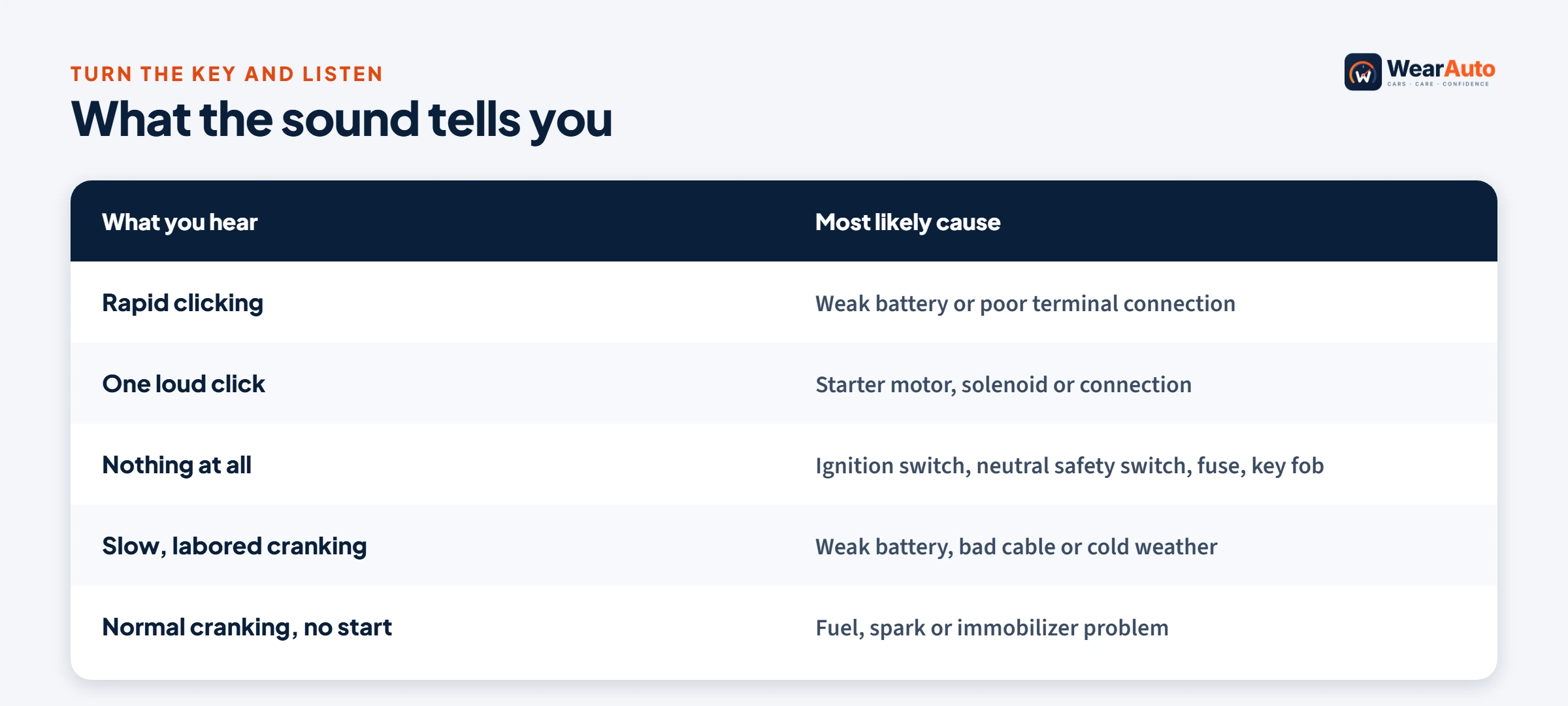
When a car won’t start but the lights work, the most common cause is a battery that has enough charge for lights but not enough to crank the engine. Corroded or loose battery terminals, a failing starter, a bad ignition switch, a faulty neutral safety switch, a key fob or immobilizer problem, or a fuel or spark problem can also be to blame. Rapid clicking points to the battery, one loud click to the starter, and normal cranking without starting to fuel, spark, or the immobilizer.
- Try a jump start first. If the car starts right away, focus on the battery and charging system.
- Use our car won’t start diagnosis tool to narrow it down.
First: Does the Engine Crank?
The single most useful question is whether the engine turns over (cranks) when you try to start it.
- No crank: the problem is usually electrical, such as the battery, connections, starter, or switches.
- Cranks but will not start: the starter works, so the problem is fuel, spark, air, or the immobilizer.
7 Likely Causes
1. Weak or dying battery
A battery can show bright dash lights and still be too weak to crank the engine. You will usually hear rapid clicking, or the engine cranks slowly. Dash lights often dim sharply when you turn the key. Batteries typically last 3 to 5 years. Our guide on how long car batteries last covers the warning signs.
Test it: measure the battery with a multimeter. Below about 12.2 volts at rest suggests the battery is low. Our guide on how to use a multimeter on a car shows how. A jump start that works immediately also points to the battery.
2. Corroded or loose battery terminals
White, green, or blue crust on the terminals, or a clamp that moves by hand, can block the high current the starter needs while still letting a small amount through for the lights.
Fix it: disconnect the negative cable first, then the positive. Clean the posts and clamps with a wire brush and a baking soda and water solution, rinse, dry, and reconnect positive first, then negative. Tighten them so they cannot twist.
3. Failing starter motor or solenoid
A single loud click, or a grinding or whirring noise without the engine turning, often means the starter or its solenoid has failed. Sometimes tapping the starter lightly with a tool while a helper turns the key will get it working temporarily, which confirms the diagnosis.
4. Faulty ignition switch
If the dash lights come on but nothing at all happens when you turn the key to Start, and there is no click, the ignition switch may not be sending the signal to the starter. Wiggling the key while turning it may produce a crank if this is the issue.
5. Neutral safety switch or clutch switch
Automatic cars will only crank in Park or Neutral. Manual cars need the clutch pressed fully. If this switch is worn or misadjusted, the car may not crank. Try starting in Neutral, or move the shifter firmly into Park. On a manual, press the clutch all the way to the floor.
6. Key fob or immobilizer problem
Modern cars use an immobilizer chip in the key. If the car does not recognize the key, it may crank but not start, or not crank at all. A flashing security or key light on the dash is a strong clue. A dead fob battery is a common cause. See our guide on how to replace a key fob battery, or try your spare key.
7. Fuel or spark problem
If the engine cranks normally but never fires, it may not be getting fuel or spark. Common causes include an empty tank (fuel gauges can fail), a failed fuel pump, a blown fuel pump fuse or relay, or a crankshaft position sensor fault. Listen for the fuel pump’s brief hum when you turn the key to On without starting.
Do not keep cranking
Cranking for more than about 10 to 15 seconds at a time can overheat the starter and drain the battery. Wait 30 seconds or more between attempts.
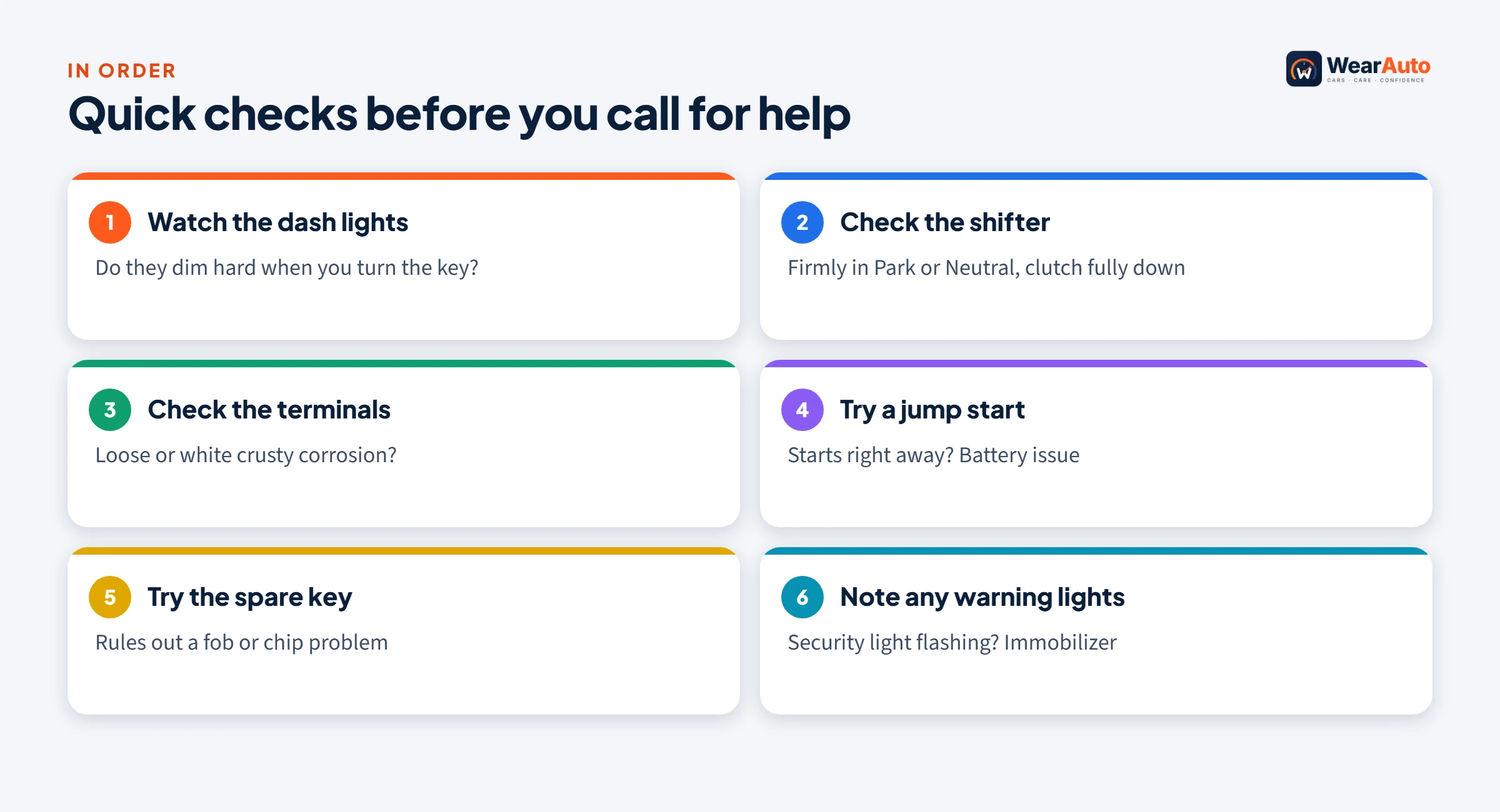
Quick Checks You Can Do Yourself
Diagnose a no-start
Answer a few questions about what you hear and see to narrow down why your car won’t start.
Open the diagnosis tool →Cost to Fix Common No-Start Problems
| Repair | Typical cost (US) |
|---|---|
| Battery replacement | $150 to $350 installed |
| Cleaning terminals | Free DIY, $20 to $50 at a shop |
| Starter replacement | $300 to $800 |
| Ignition switch | $150 to $400 |
| Neutral safety switch | $100 to $300 |
| Key fob battery | $5 to $10 DIY |
| Fuel pump | $500 to $1,200 |
When to Call a Professional
If a jump start does not help, the car still clicks after cleaning the terminals, or you suspect a fuel pump or immobilizer issue, it is time for a mechanic or mobile service. Many auto parts stores test batteries, alternators, and starters for free, which is a good first step if you can get the car there.
You can also run the symptoms through our car symptom checker to see other possible causes. If a warning light came on before the no-start, read our guide on what the check engine light means.
Frequently Asked Questions
Why will my car not start when the battery seems fine?
Lights and the radio need very little current, while the starter needs a lot. A battery can run the lights but still be too weak to crank the engine. Loose or corroded terminals can cause the same symptom.
What does rapid clicking mean when trying to start a car?
Rapid clicking almost always means the battery cannot supply enough current to the starter, either because it is discharged or because of a poor connection.
How do I know if it is the starter or the battery?
If a jump start fixes the problem, it is most likely the battery or charging system. If you hear a single loud click and jump starting does not help, the starter or its wiring is more likely at fault.
Can a bad alternator cause a car not to start?
Yes, indirectly. A failing alternator does not recharge the battery, so the battery eventually becomes too weak to start the car.
Can a dead key fob stop a car from starting?
It can stop a push-button start car from detecting the key. Most cars have a backup method, such as holding the fob against the start button.
The Bottom Line
When the lights work but the car will not start, start with the simplest causes: a weak battery and dirty or loose terminals. Listen for clicking, check whether the engine cranks, try a jump start, and test with your spare key. If the engine cranks normally but will not fire, look at fuel, spark, and the immobilizer. Most no-start problems can be narrowed down in a few minutes with these checks.
Sources and further reading
- AAA: Battery and no-start tips
- Car Care Council: Battery and starting system
- Battery Council International: Battery basics
Written and fact-checked by the WearAuto Editorial Team. This guide is general information; always follow your vehicle manufacturer’s specifications and see a qualified mechanic for safety-critical repairs. See our editorial policy for how we research and update articles.