
Buying a used car can save you thousands of dollars compared with buying new, but only if you avoid the lemons. A car can look spotless in photos and still hide flood damage, a tired transmission or a rolled-back history. The best protection is a methodical inspection before any money changes hands.
This checklist walks you through 40 specific things to look at, in the order that makes sense when you’re standing next to the car. It takes about 45 minutes including a test drive. You don’t need to be a mechanic. You just need a flashlight, a paper towel, a tire tread gauge or a penny, and the patience to look closely.
Quick answer
Before buying a used car, check the paperwork and VIN, the body and tires, the engine bay and fluids, the interior and electronics, and take a 20-minute test drive that includes a cold start, highway speeds and hard braking.
- Run a vehicle history report on the VIN first.
- Inspect in daylight on dry, level ground.
- For any car you are serious about, pay for a pre-purchase inspection.
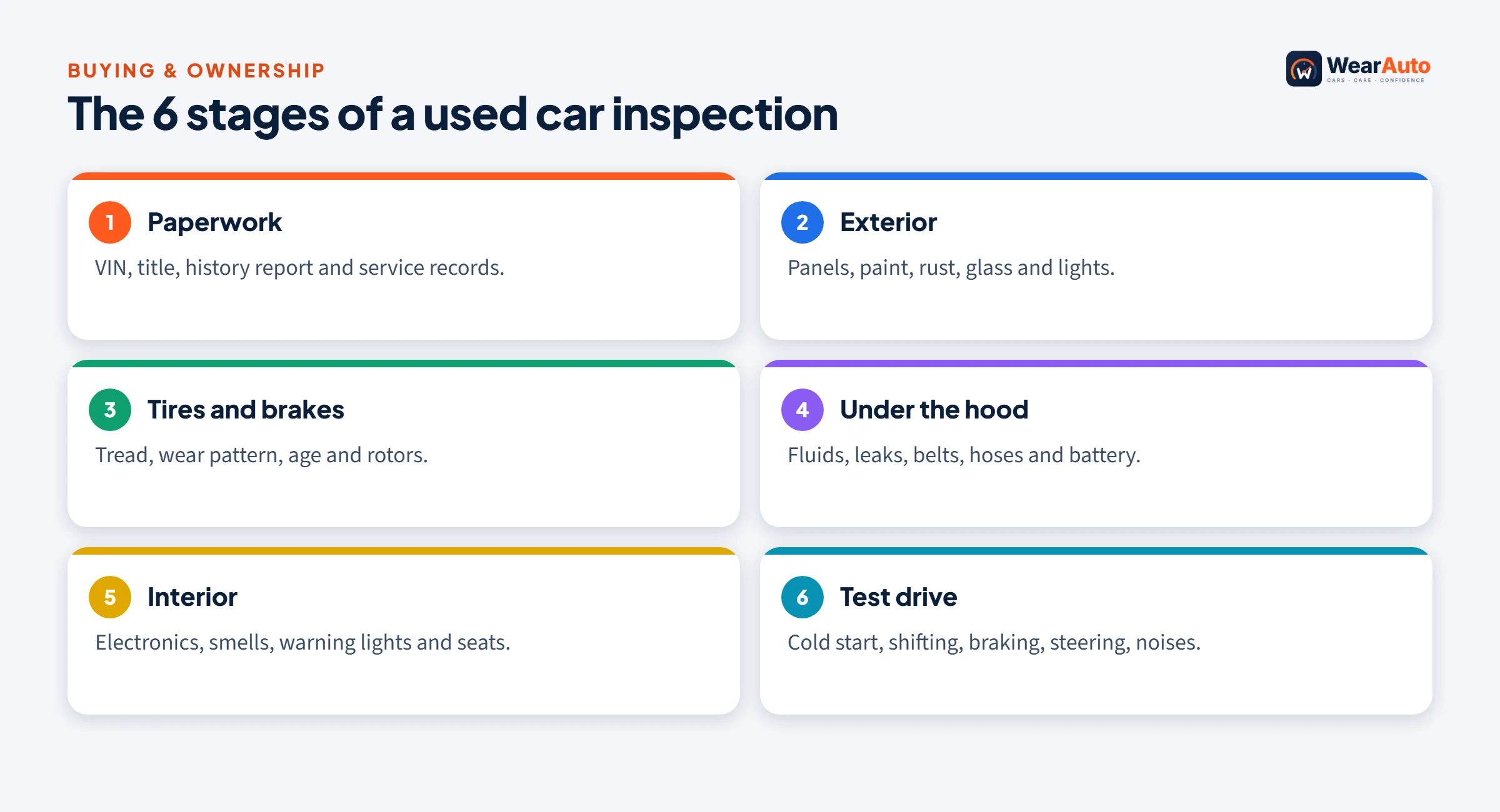
Before You Go: Paperwork and History (Checks 1 to 6)
- Run the VIN. Use the free NHTSA recall lookup and a paid history report to check for accidents, title brands and odometer readings.
- Check for open recalls. Unrepaired safety recalls are free to fix at a dealer but you need to know they exist.
- Match the VIN in three places. The dashboard (through the windshield), the driver’s door jamb and the title should all match.
- Read the title. Words like salvage, rebuilt, flood, lemon or junk change the car’s value and insurability.
- Ask for service records. Regular oil changes and major services like timing belts are a strong sign of a cared-for car.
- Confirm the seller’s identity. The name on the title should match the seller’s ID, or the dealer’s paperwork.
Exterior and Body (Checks 7 to 14)
- Walk around from 10 feet away. Look for panels that don’t match in color or shine.
- Check panel gaps. Gaps around the hood, doors and trunk should be even on both sides.
- Look for overspray on rubber seals, trim and inside the door jambs, a sign of repainting.
- Inspect for rust on wheel arches, rocker panels, door bottoms and under the trunk carpet.
- Check all glass for chips and cracks, and make sure windshield logos match on all windows.
- Test every light: headlights, high beams, brake lights, reverse lights, turn signals and hazards.
- Look underneath with a flashlight for fresh leaks, heavy rust or bent parts.
- Open and close every door, the hood and trunk to check hinges and latches.
Tires, Wheels and Brakes (Checks 15 to 19)
- Measure tread depth. Below 4/32 inch means new tires soon, which is a bargaining point. Our guide on how long tires last explains the limits.
- Look for uneven wear. Wear on one edge often points to alignment or suspension problems.
- Check tire age. Read the four-digit DOT date code. Tires older than about six years should be replaced regardless of tread.
- Make sure all four tires match in brand and size, especially on all-wheel-drive cars.
- Peek at the brake rotors through the wheel spokes. Deep grooves or a large lip at the edge mean brake work is due.
Under the Hood (Checks 20 to 28)
Do this with the engine cold. A seller who has warmed the car up before you arrive may be hiding a cold-start problem.
- Check the oil. It should be amber to dark brown, not milky or gritty, and at the right level. Milky oil can mean a head gasket problem.
- Check the coolant in the overflow tank. It should be clean and the right color, with no oily film.
- Check transmission fluid if there’s a dipstick. It should be reddish and not smell burnt.
- Look at the brake fluid in its reservoir. Very dark fluid is overdue for a change.
- Inspect belts and hoses for cracks, fraying or soft, bulging spots.
- Look at the battery for a date code and corrosion on the terminals.
- Look for leaks around the engine, oil pan and under the car.
- Check for signs of a recently cleaned engine. A spotless engine on an older car can be hiding leaks.
- Listen to the cold start. Ticking, knocking or a long crank before starting are warning signs.
Interior and Electronics (Checks 29 to 34)
- Sniff the cabin. Musty or mildew smells can mean water leaks or flood damage. Heavy air freshener can mask smoke or mold.
- Lift the floor mats and trunk floor to check for damp carpet, rust or silt.
- Watch the dashboard at startup. All warning lights should come on briefly and then go out.
- Test every electric feature: windows, locks, mirrors, seats, infotainment, Bluetooth, cameras and sensors.
- Run the AC and heat on full. AC should blow cold within a minute or two.
- Compare wear to mileage. A worn steering wheel, pedals and driver’s seat on a low-mileage car is suspicious.
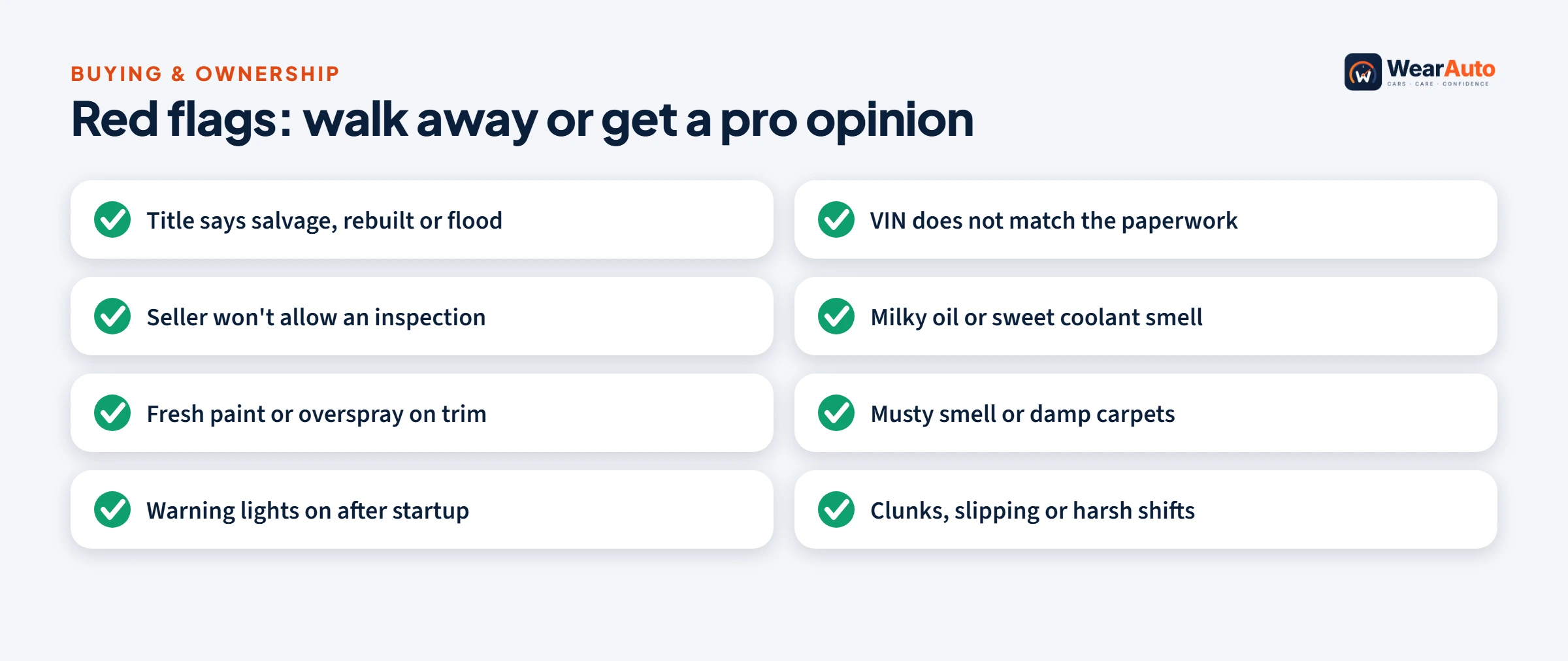
The Test Drive (Checks 35 to 40)
Aim for at least 20 minutes on a mix of roads, including some highway driving if possible.
- Steering: the car should track straight on a flat road without pulling.
- Braking: stop firmly from about 40 mph in a safe place. There should be no pulling, pulsing or grinding.
- Transmission: shifts should be smooth with no slipping, flare in revs or clunks into gear.
- Suspension: drive over bumps and listen for knocks or rattles.
- Noises: listen for whining, humming that changes with speed (often a wheel bearing) or clicking when turning.
- After the drive: park, leave the engine running and look underneath for new drips. Then check the temperature gauge and warning lights again.
Should You Pay for a Pre-Purchase Inspection?
Yes, for almost any car you’re serious about. An independent mechanic will put the car on a lift, scan the computer for stored codes and spot problems you can’t see from the driveway. Expect to pay roughly $100 to $250. If a seller refuses to allow an inspection, treat that as a red flag and walk away.
Watch for flood cars
After major storms, flood-damaged cars can be cleaned up and sold in other states. Look for silt under seats, rust on seat bolts, fogged headlights and corroded wiring connectors under the dash.
How Long Will It Last?
Mileage alone doesn’t tell the whole story. A well-maintained car at 120,000 miles can be a better buy than a neglected one at 60,000. If you want a rough idea of how much life is left in a car you’re looking at, try our car life expectancy calculator.
How many miles are left in it?
Estimate a used car’s remaining life from its age, mileage and how it has been maintained.
Try the Car Life Expectancy Calculator →Common Mistakes Used Car Buyers Make
- Falling for the car before inspecting it. Decide in advance which red flags will make you walk away.
- Only test driving a warm engine. Ask the seller not to start the car before you arrive.
- Skipping the history report to save a few dollars.
- Ignoring tires and brakes. Four new tires and a brake job can easily add $1,000 or more.
- Not checking insurance cost first. Some models cost far more to insure than you’d expect.
Frequently Asked Questions
What should I check first when buying a used car?
Start with the paperwork. Run the VIN through a history report and the NHTSA recall lookup, and make sure the VIN on the car matches the title. There is no point inspecting a car with a branded or mismatched title.
How long should a used car test drive be?
Aim for at least 20 minutes, covering a cold start, city streets, highway speed, hard braking and some bumpy roads. A five-minute loop around the block is not enough to reveal most problems.
How much does a pre-purchase inspection cost?
Most independent shops charge about $100 to $250, depending on the car and how detailed the inspection is. It is one of the best values when buying used.
What mileage is too high for a used car?
There is no single number. Maintenance history matters more than mileage. Many modern cars run well past 200,000 miles if serviced on time, while a neglected car can be worn out much sooner.
How can I tell if a used car has been in a flood?
Look for a musty smell, damp or new carpet, silt under seats and in the trunk, rust on seat bolts and pedals, and corrosion on wiring under the dash. A history report may also show a flood title.
The Bottom Line
A used car inspection doesn’t need special tools or expertise, just a system. Check the paperwork first, then work around the car from the outside in, finish with a proper test drive, and don’t be afraid to walk away from red flags.
For any car you’re ready to buy, a professional pre-purchase inspection is cheap insurance. Print this checklist, take it with you, and tick off each item as you go.
Keep reading
Free tools for this topic
Sources and further reading
- NHTSA: Check for vehicle recalls by VIN
- National Insurance Crime Bureau: VINCheck
- Federal Trade Commission: Buying a used car
Written and fact-checked by the WearAuto Editorial Team. This guide is general information; always follow your vehicle manufacturer’s specifications and see a qualified mechanic for safety-critical repairs. See our editorial policy for how we research and update articles.