Choosing the right car seat is one of the most important things you can do to protect a child in a car. Car crashes are a leading cause of death for children in the US, and a correctly used car seat greatly reduces the risk of serious injury.
The rules can feel confusing because they depend on age, weight, height, and each seat’s specific limits. This guide explains the four car seat stages, when to move to the next one, and the mistakes to avoid.
Quick answer
Children go through four stages: rear-facing seats from birth until they outgrow the seat’s rear-facing limits (at least age 2, often up to age 4), forward-facing seats with a harness until they outgrow those limits (often age 5 to 7), booster seats until the adult seat belt fits properly (usually when they are about 4 feet 9 inches tall, between ages 8 and 12), and then the seat belt. All children under 13 should ride in the back seat.
- Delay each move up as long as your child fits the current seat.
- Always follow the height and weight limits on your seat’s label.
The Four Car Seat Stages at a Glance
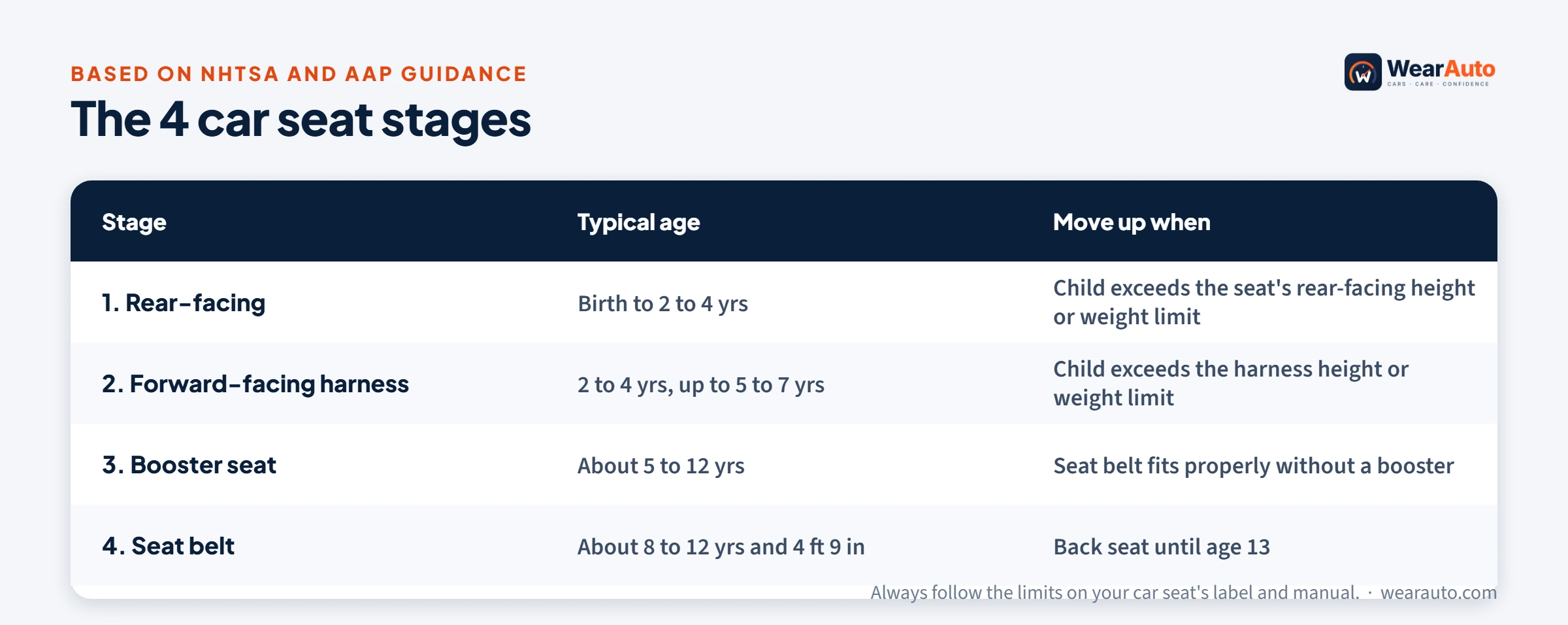
The National Highway Traffic Safety Administration (NHTSA) and the American Academy of Pediatrics (AAP) both recommend keeping children in each stage for as long as possible, until they reach the maximum height or weight allowed by the seat’s manufacturer.
Stage 1: Rear-Facing Car Seats
Who: infants and toddlers, from birth.
How long: until your child reaches the highest weight or height allowed for rear-facing on their seat. For most children that is at least age 2, and many convertible seats allow rear-facing up to 40 to 50 pounds, often around age 3 or 4.
Rear-facing is the safest way for young children to ride. In a frontal crash, the seat cradles the head, neck, and spine and spreads the crash forces across the whole back.
Types of rear-facing seats
- Infant seats: rear-facing only, with a carrier and base. Most fit babies up to about 22 to 35 pounds.
- Convertible seats: can be used rear-facing and later forward-facing, with higher rear-facing limits.
- All-in-one seats: convert from rear-facing to forward-facing to booster.
Bent legs are fine
Many parents move to forward-facing because a toddler’s legs touch the vehicle seat. That is not a safety problem. Children are comfortable sitting with bent or crossed legs, and leg injuries are rare in rear-facing seats.
Stage 2: Forward-Facing Seats with a Harness
Who: children who have outgrown the rear-facing limits of their seat.
How long: until they reach the highest weight or height allowed for the harness. Many seats allow harnessed use up to 65 pounds or more, often until about age 5 to 7.
The five-point harness holds a child at the shoulders and hips, the strongest parts of the body. Always use the top tether strap with a forward-facing seat. It reduces how far the child’s head moves forward in a crash.
Stage 3: Booster Seats
Who: children who have outgrown their forward-facing harness seat.
How long: until the vehicle seat belt fits properly on its own. That is usually when a child is about 4 feet 9 inches (145 cm) tall and between 8 and 12 years old.
A booster raises the child so that the adult lap and shoulder belt fit correctly. Without one, the lap belt rides up over the stomach and the shoulder belt crosses the neck, which can cause serious injury in a crash.
- High-back boosters give head and side support and help position the shoulder belt. They are best in cars without headrests.
- Backless boosters are portable and work well for older children in seats with good headrests.
Stage 4: Seat Belts
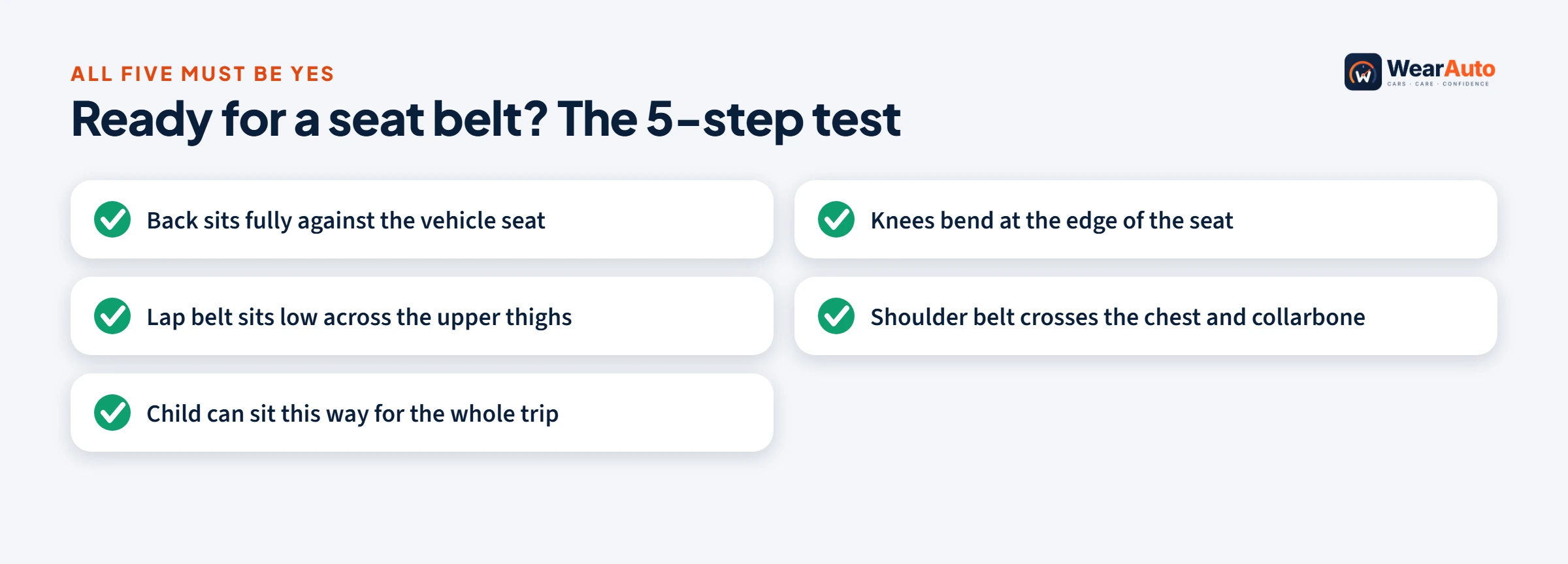
A child is ready for the adult seat belt only when it fits properly. Use the five-step test above. If your child cannot pass all five steps, they still need a booster, regardless of age.
Children under 13 belong in the back seat
Front airbags deploy with great force and can seriously injure a child. Keep all children under 13 in the back seat. Never place a rear-facing seat in front of an active airbag.
Car Seat Stages Quick Reference
| Stage | Typical weight | Typical height or age | Key rule |
|---|---|---|---|
| Rear-facing | Birth to 40 to 50 lb (convertible) | Until seat’s limit, at least age 2 | Harness at or below shoulders |
| Forward-facing harness | About 22 to 65 lb | Until seat’s limit, often age 5 to 7 | Always use the top tether |
| Booster | About 40 to 100+ lb | Until 4’9″ tall, ages 8 to 12 | Lap belt on thighs, shoulder belt on chest |
| Seat belt | Varies | 4’9″ and passes 5-step test | Back seat until 13 |
These are typical ranges. Your seat’s label and manual set the actual limits.
Common Car Seat Mistakes
- Moving up too early. Each move up gives slightly less protection. Use every seat to its limits.
- Loose installation. The seat should not move more than one inch side to side or front to back at the belt path.
- Loose harness straps. You should not be able to pinch any slack in the strap at the child’s collarbone.
- Chest clip in the wrong place. It belongs at armpit level, not on the stomach or neck.
- Bulky winter coats. Thick coats compress in a crash and leave the harness too loose. Buckle the child in without the coat and put a blanket or the coat over the harness.
- Expired or crashed seats. Most seats expire 6 to 10 years after manufacture. Replace any seat that has been in a moderate or severe crash.
- Using both LATCH and the seat belt unless the manual allows it.
Getting Your Installation Checked
Many car seats are installed incorrectly. Certified Child Passenger Safety Technicians can check your installation, often for free, at fire stations, hospitals, and community events. NHTSA has a car seat inspection station locator on its website.
Keeping your car’s interior and seat ready for kids also matters on long trips. Our car emergency kit checklist includes add-ons for families with young children.
Frequently Asked Questions
When can my child face forward in a car seat?
When they have outgrown the rear-facing height or weight limit of their convertible seat. That is at least age 2 for most children, and many can stay rear-facing until age 3 or 4. Check your seat’s label.
What age can a child stop using a booster seat?
When the seat belt fits correctly without it, which usually happens when a child is about 4 feet 9 inches tall, typically between 8 and 12 years old. Use the five-step test to check.
At what age can a child sit in the front seat?
NHTSA and the AAP recommend that all children under 13 ride in the back seat.
Do car seats really expire?
Yes. Plastic and other materials weaken over time, and safety standards change. Most seats expire 6 to 10 years after the manufacture date, printed on a label on the seat.
Can I use a second-hand car seat?
Only if you know its full history, it has never been in a crash, it is not expired, it has all its parts and labels, and it has not been recalled. When in doubt, buy new.
The Bottom Line
Car seat stages are about fit, not birthdays. Keep your child rear-facing as long as their seat allows, then use a forward-facing harness until they outgrow it, then a booster until the adult belt fits properly. Keep every child under 13 in the back seat. Install each seat carefully, check it regularly, and have it inspected by a certified technician if you are unsure.
Sources and further reading
- NHTSA: Car seats and booster seats
- HealthyChildren.org (AAP): Car seats information for families
- CDC: Child passenger safety
Written and fact-checked by the WearAuto Editorial Team. This guide is general information; always follow your vehicle manufacturer’s specifications and see a qualified mechanic for safety-critical repairs. See our editorial policy for how we research and update articles.