Tire pressure is one of those things everyone knows they should check and almost nobody does until a warning light comes on. That’s a shame, because it’s the cheapest piece of car maintenance there is. The right pressure makes your car brake shorter, steer more predictably, use less fuel and wear its tires evenly. The wrong pressure quietly does the opposite.
Here’s how to find the exact number for your car, why the figure on the tire itself is the wrong one to use, and how to check it properly in about five minutes.
Quick answer
The correct tire pressure for your car is printed on the tire and loading information sticker, usually on the driver’s door jamb. Most passenger cars call for 30 to 35 PSI when the tires are cold. Don’t use the “max pressure” number molded on the tire sidewall. Check monthly, because tires lose roughly 1 PSI a month and about 1 PSI for every 10°F drop in temperature.
Where to Find Your Car’s Recommended Tire Pressure
Your car’s manufacturer chose a specific pressure after testing the car’s weight, handling, braking and comfort with its original tire size. You’ll find it in three places:
- The driver’s door jamb. Open the door and look at the frame or the edge of the door. The placard lists front, rear and spare tire pressures, plus the original tire size.
- Inside the fuel door or glovebox. Some brands put the sticker here instead.
- The owner’s manual. Look in the tires or specifications section. Some manuals list a higher pressure for full loads or sustained highway speeds.
Notice that front and rear pressures aren’t always the same. Many cars, especially those with heavy engines up front or sporty handling, specify a few PSI more on one axle. Follow the placard exactly.
Why not use the number on the tire?
The sidewall says something like “MAX. PRESS. 44 PSI” or “51 PSI.” That’s the highest pressure the tire can safely hold to carry its maximum load. It has nothing to do with your particular car. Running at the sidewall maximum makes the ride harsh, shrinks the contact patch and reduces grip, especially in the wet. If you want to decode the rest of the sidewall, see our guide on how to read tire size and markings.
Typical Tire Pressures by Vehicle Type
Your placard always wins, but these ranges give you a feel for what’s normal. If your reading is way outside them, double-check before you drive far.
| Vehicle type | Typical cold pressure | In bar / kPa |
|---|---|---|
| Small and midsize cars | 30–35 PSI | 2.1–2.4 bar / 207–241 kPa |
| Crossovers and SUVs | 32–38 PSI | 2.2–2.6 bar / 221–262 kPa |
| Minivans | 33–36 PSI | 2.3–2.5 bar / 228–248 kPa |
| Half-ton pickups | 35–40 PSI | 2.4–2.8 bar / 241–276 kPa |
| Heavy-duty pickups (LT tires) | 50–80 PSI | 3.4–5.5 bar / 345–552 kPa |
| Temporary “donut” spare | 60 PSI | 4.1 bar / 414 kPa |
Quick conversions if your gauge reads in metric: 1 bar is about 14.5 PSI, and 1 PSI is about 6.9 kPa.
How to Check Tire Pressure Properly
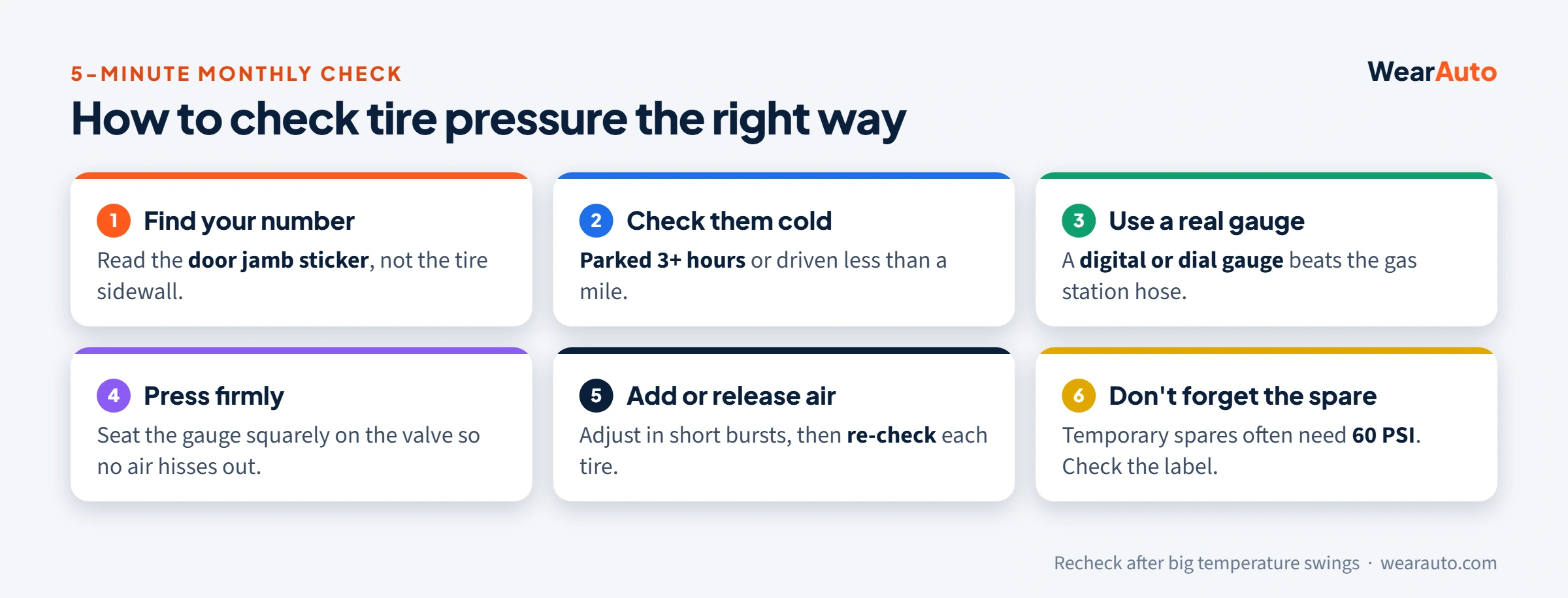
- Check when the tires are cold. That means the car has been parked for three hours or more, or driven less than a mile. Driving warms the air inside and can raise the reading by 2 to 4 PSI, which would trick you into letting air out.
- Use your own gauge. A decent digital or dial gauge costs less than a tank of gas and is far more trustworthy than the worn gauge on an air station hose.
- Remove the valve cap and press the gauge on firmly. A short hiss is normal. A long hiss means the gauge isn’t seated, and the reading will be off.
- Compare with the placard. Add air in short bursts if you’re low, or press the small pin in the valve to let air out if you’re high. Re-check after each adjustment.
- Do all four, then the spare. A flat spare is a nasty surprise on a dark roadside.
- Put the caps back on. They keep dirt and moisture out of the valve core.
If you have to fill up at a gas station after driving there, it’s fine to inflate to about 3 PSI above the placard figure, then re-check once the tires have cooled.
How Temperature Changes Tire Pressure
Air contracts when it gets cold. As a rule of thumb, tire pressure drops about 1 PSI for every 10°F (about 5.6°C) fall in air temperature. That’s why so many TPMS warning lights come on during the first cold morning of autumn. A car set to 35 PSI on a 75°F afternoon can read 30 PSI on a 25°F morning without any leak at all.
The reverse is also true. In summer, pressure rises as the day heats up and as you drive. Don’t let air out of hot tires to bring them back to the placard figure, because they’ll end up underinflated once they cool down. Adjust in the morning, when the tires are cold, and recheck whenever the seasons change.
What Happens If Pressure Is Too Low or Too High
| Underinflated | Overinflated | |
|---|---|---|
| Handling | Slow, vague steering | Twitchy, less grip |
| Braking | Longer stopping distances | Less rubber on the road, longer stops in the wet |
| Tire wear | Both outer edges wear fast | Center of the tread wears fast |
| Fuel economy | Worse, from extra rolling resistance | Slightly better, but not worth the trade-off |
| Safety risk | Heat build-up and possible blowout | More prone to impact damage from potholes |
Of the two, underinflation is the more dangerous, because a soft tire flexes more and builds up heat at highway speed. That heat is a leading cause of tread separation and blowouts.
What the TPMS Light Actually Tells You
Cars sold in the US since the 2008 model year have a tire pressure monitoring system. Under federal rules, the warning light must come on when a tire is 25% or more below the recommended pressure. On a car that needs 35 PSI, that’s about 26 PSI. In other words, by the time the light is on, the tire is already well under where it should be. TPMS is a backup, not a substitute for a monthly check with a gauge.
A solid light means at least one tire is low. A light that flashes for about a minute and then stays on usually means a problem with the system itself, such as a dead sensor battery.
Special Cases: Loads, Towing and Different Tires
- Carrying a full load or towing: Some owner’s manuals list a higher rear pressure for heavy loads. Use it when the car is packed for a road trip or hooked to a trailer.
- Aftermarket tire sizes: If you’ve changed tire size or switched from P-metric to Euro-metric tires, the correct pressure may change. Ask the installer to check the load tables for your new size, and compare sizes first with our tire size calculator.
- Nitrogen-filled tires: Nitrogen leaks out a little more slowly than air, but the pressure target is the same. Topping up with regular air is perfectly fine.
Keeping pressure right is also the easiest way to stretch tire life. Our guide to how long tires last covers the other habits that help, and you’ll find more tire advice in our Tires & Wheels section.
Frequently Asked Questions
Is 35 PSI a good tire pressure?
35 PSI is a common recommendation for many cars and crossovers, but the right number is whatever your door jamb placard says. Some cars need 32 PSI, others 38 PSI or more.
Should tire pressure be checked hot or cold?
Always cold, meaning parked for at least three hours or driven less than a mile. The placard pressure is a cold pressure, and warm tires read 2 to 4 PSI higher.
Why does my tire pressure light come on when it’s cold?
Cold air contracts, so tire pressure drops roughly 1 PSI for every 10°F fall in temperature. A sudden cold snap can push one or more tires below the TPMS warning threshold.
Is 40 PSI too high for a car?
For most passenger cars, 40 PSI is higher than recommended and will make the ride harsh and reduce grip. It may be correct for some SUVs and pickups, so check your placard.
How often should I check my tire pressure?
At least once a month and before any long trip or heavy load. It takes about five minutes with a basic gauge.
The Bottom Line
The correct tire pressure for your car is the cold pressure on the door jamb sticker, not the maximum on the tire. For most cars that lands between 30 and 35 PSI. Check it once a month with your own gauge, before the car has been driven, and recheck when the weather turns cold. It’s five minutes that pays you back in grip, fuel and tire life.
Changed your tire size?
A new size can change diameter, speedometer accuracy and the pressure you need. Compare sizes before you buy.
Open the Tire Size Calculator →Sources and further reading
- NHTSA: Tires and tire safety
- NHTSA TireWise: tire pressure and maintenance
- FuelEconomy.gov: Keeping your vehicle in shape
Written and fact-checked by the WearAuto Editorial Team. Always follow the tire pressure printed on your vehicle’s placard and in your owner’s manual. See our editorial policy for how we research and update articles.