
Changing a tire, rotating wheels, inspecting brakes, or doing an oil change all start the same way: getting the car off the ground. It is a simple job, but it is also one of the most dangerous things a home mechanic does. Every year people are seriously hurt when a car slips off a jack.
The good news is that safe jacking comes down to a few rules you follow every time. This guide covers the right equipment, how to find your car’s jack points, how to use jack stands, and the mistakes to avoid.
Quick answer
Park on flat, solid ground, set the parking brake, and chock the wheels on the opposite end. Place the jack under a manufacturer-approved jack point, lift slowly, then set jack stands under rated support points and lower the car onto them. Never put any part of your body under a car held up only by a jack.
- A jack is for lifting. Jack stands are for holding.
- Do a firm shake test before you go underneath.
The Equipment You Need
| Item | What to look for | Notes |
|---|---|---|
| Floor jack | Rated for at least 75% of the car’s weight | Low-profile model for lowered cars |
| Scissor jack | Usually comes with the car | For roadside tire changes only |
| Jack stands (pair) | Rated capacity per pair, ratchet or pin lock | Pin locks are the most secure |
| Wheel chocks | Rubber or heavy plastic | A block of wood works in a pinch |
| Jack pad | Rubber or slotted puck | Protects pinch welds |
A 2- or 3-ton floor jack and a pair of 3-ton jack stands cover most cars, small SUVs, and light trucks. Heavier trucks need higher-rated equipment. Check the curb weight on your door jamb sticker or in the manual.
Step-by-Step: How to Jack Up a Car Safely

1. Choose a level, solid surface
Concrete is ideal. Asphalt can work, but on a hot day jack stands can sink into it, so place a piece of plywood under each stand. Never jack a car on grass, gravel, sand, or a slope.
2. Park, set the brake, and chock the wheels
Put the transmission in Park (or first gear on a manual), set the parking brake, and turn the engine off. Chock the wheels on the end you are not lifting. If you are raising the front, chock the rear wheels front and back.
3. Find the correct jack point
Your owner’s manual shows the jack points. On most unibody cars, they are on the pinch weld, a reinforced seam under the rocker panel just behind the front wheel and just in front of the rear wheel. Small notches or arrows often mark the exact spot.
Many cars also have central lifting points for a floor jack, such as the front subframe or the rear differential on some rear-wheel-drive cars. Never lift on the oil pan, transmission pan, floor pan, or suspension arms unless the manual specifically allows it.
4. Lift slowly and watch the car
Center the jack saddle under the jack point and pump slowly. Watch that the saddle stays centered and the car rises straight. If the car shifts or the jack tilts, lower it and start again. Raise it just high enough to fit the jack stands.
5. Place the jack stands and lower the car onto them
Set the stands under a solid support point, such as the pinch weld near the jack point, the frame rails, or the subframe. Raise each stand to the same height and lock it with its pin or ratchet. Then lower the jack slowly until the car’s weight rests on the stands. Leave the jack lightly in place as a backup.
6. Do the shake test
Before you put any part of your body under the car, push firmly on the car from the side and the front. It should not move or rock. If it does, raise it again and reposition the stands.
Jack vs Jack Stand: Why You Need Both
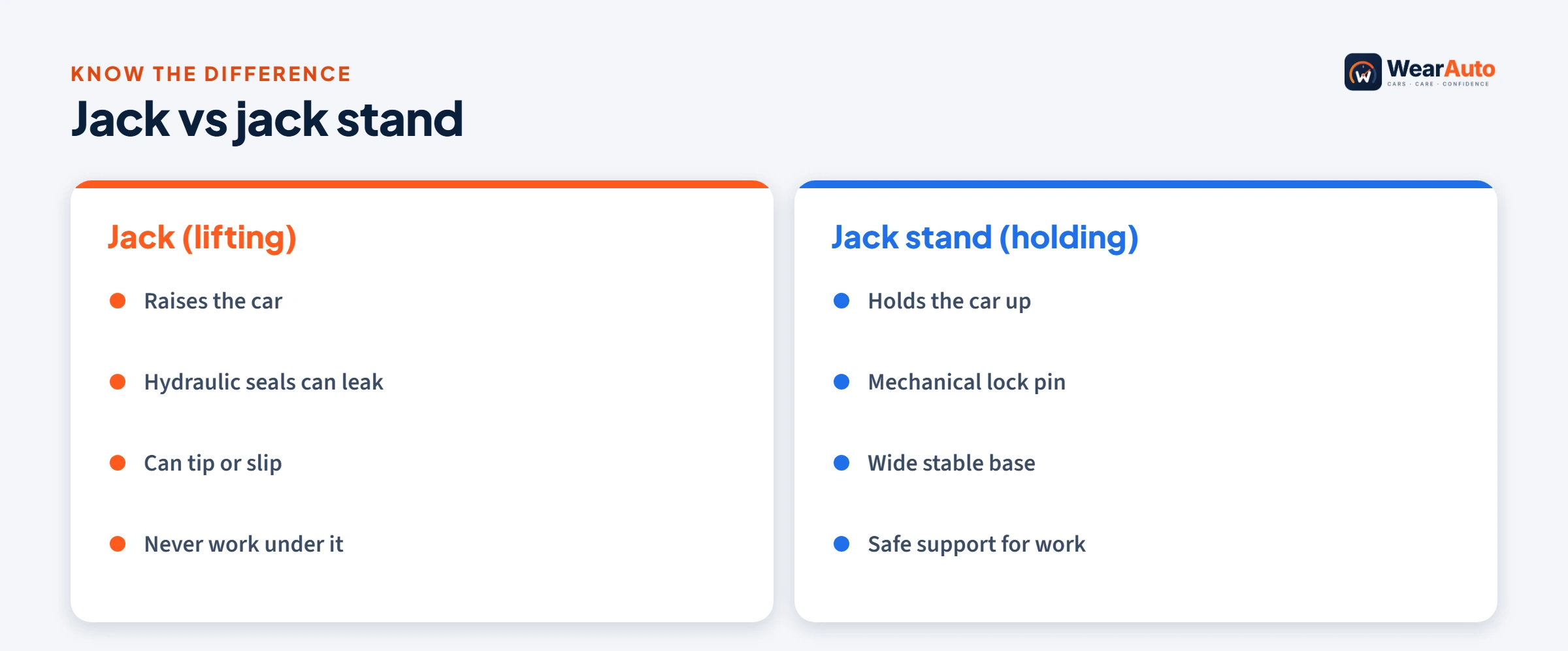
Hydraulic jacks rely on seals that can fail without warning, and the small saddle can slip off a jack point. A jack stand is a simple mechanical support with a wide base and a locking pin. That is why the rule is absolute: a jack is only for lifting, and stands are for holding.
Never work under a car on a jack alone
Even for a quick look, always use jack stands. Bricks, cinder blocks, and wood stacks can crack or crumble under load and are not a safe substitute.
How to Lower the Car Safely
- Clear all tools, parts, and people from under the car.
- Raise the car slightly with the jack so the stands are no longer carrying weight.
- Remove the stands.
- Lower the jack slowly and steadily. Do not let the car drop.
- Once the wheels are on the ground, torque the lug nuts to spec if you removed a wheel, and remove the wheel chocks.
Jacking Up a Car on the Roadside
For a flat tire on the road, you will usually use the scissor jack that came with the car. Get as far from traffic as possible, turn on the hazard lights, and set out reflective triangles. Loosen the lug nuts slightly before lifting, then lift only enough to swap the wheel. Do not get under the car. Our car emergency kit checklist covers what to carry for this.
If you have a spare tire, check its pressure regularly. A flat spare is no help. Our guide to the correct tire pressure for your car explains where to find the right number.
Common Jacking Mistakes to Avoid
- Lifting on the wrong point. This can bend the floor pan, crush a pinch weld, or let the car slip.
- Skipping the wheel chocks. A car on a slight slope can roll even with the parking brake on.
- Using one jack stand. Always use them in pairs on the same axle.
- Mixing up capacity ratings. Jack stand ratings are usually for the pair, not each stand.
- Lifting with someone in the car. Everyone should be out and clear before you start.
- Using worn or damaged equipment. Check stands for cracked welds and bent pins, and check the jack for leaks.
When Jacking Is Part of Routine Work
You will lift your car for many common jobs, such as rotating tires, checking brake pad wear, or changing oil. For rotations, lifting one whole side or one whole end at a time on four stands makes the job faster and safer.
Frequently Asked Questions
Where are the jack points on my car?
On most cars, they are on the reinforced pinch weld seam under the side of the car, just behind the front wheels and just in front of the rear wheels. Check your owner’s manual for the exact spots and any central lifting points.
Can I use a scissor jack to work under the car?
No. A scissor jack is designed for emergency tire changes only. Always use a floor jack to lift and jack stands to support the car before working underneath.
How high should I jack up my car?
Only as high as you need. For a tire change, about an inch of clearance under the tire is enough. For work underneath, raise it just high enough to fit the stands at a comfortable working height.
What size jack stands do I need?
Choose stands with a combined rating above the weight of the end of the car you are lifting. For most cars and small SUVs, a pair of 3-ton stands is plenty.
Can I leave a car on jack stands overnight?
Yes, if it is on a solid, level surface and the stands are properly placed and locked. Check them before you go back under the car.
The Bottom Line
Jacking up a car safely is about routine, not strength. Pick a flat, solid surface, chock the wheels, lift only at approved jack points, and always support the car on jack stands before you go underneath. Do the shake test every time. These few minutes of setup are what keep a simple job from becoming a dangerous one.
Sources and further reading
- OSHA: Vehicle lifting safety
- ASME PASE: Portable automotive service equipment standard
- Consumer Reports: How to change a flat tire
Written and fact-checked by the WearAuto Editorial Team. This guide is general information; always follow your vehicle manufacturer’s specifications and see a qualified mechanic for safety-critical repairs. See our editorial policy for how we research and update articles.