Tire rotation is the maintenance job people skip most often, mostly because nothing seems wrong when you skip it. The car drives the same. The tires look fine. Then, 25,000 miles later, the front pair is bald while the rears still have plenty of tread, and you’re buying tires a year or two earlier than you should have.
Rotating simply means moving each tire to a different position on the car so they all wear at the same rate. Here’s how often to do it, which pattern your car needs, and what happens if you don’t.
Quick answer
Rotate your tires every 5,000 to 7,500 miles, or about every six months. An easy way to remember is to do it with every oil change if you use conventional oil, or every other oil change on longer synthetic intervals. Front-wheel-drive cars use a forward cross pattern, while rear-, all- and four-wheel-drive vehicles use a rearward cross. Always follow your owner’s manual if it says otherwise.
Why Tires Wear Unevenly in the First Place
Each corner of a car does a different job. On a front-wheel-drive car, which describes most sedans, hatchbacks and crossovers, the front tires steer, put down all the engine’s power and handle most of the braking force. They can easily wear twice as fast as the rears. Rear-wheel-drive cars spread the work more evenly, but the rears still wear faster from acceleration and the fronts still scrub through every turn.
Even side to side, wear differs. In countries that drive on the right, the right-side tires take more abuse from road edges, potholes and the camber of the road. Rotation spreads all of this out so the four tires stay close in tread depth and wear out together.
How Often to Rotate Your Tires
The common recommendation is every 5,000 to 7,500 miles. Your owner’s manual will give a precise figure, and some manufacturers allow up to 10,000 miles. Consider rotating sooner if:
- You drive a front-wheel-drive car with a lot of stop-and-go city driving.
- You drive an electric vehicle. The extra weight and instant torque wear tires quickly, and many EV makers recommend rotating every 5,000 to 7,500 miles or even more often.
- You have performance tires with soft compounds.
- You tow, carry heavy loads or drive on gravel regularly.
Also rotate a new set at the first service interval. The first few thousand miles are when wear differences start to set in.
Tire Rotation Patterns Explained
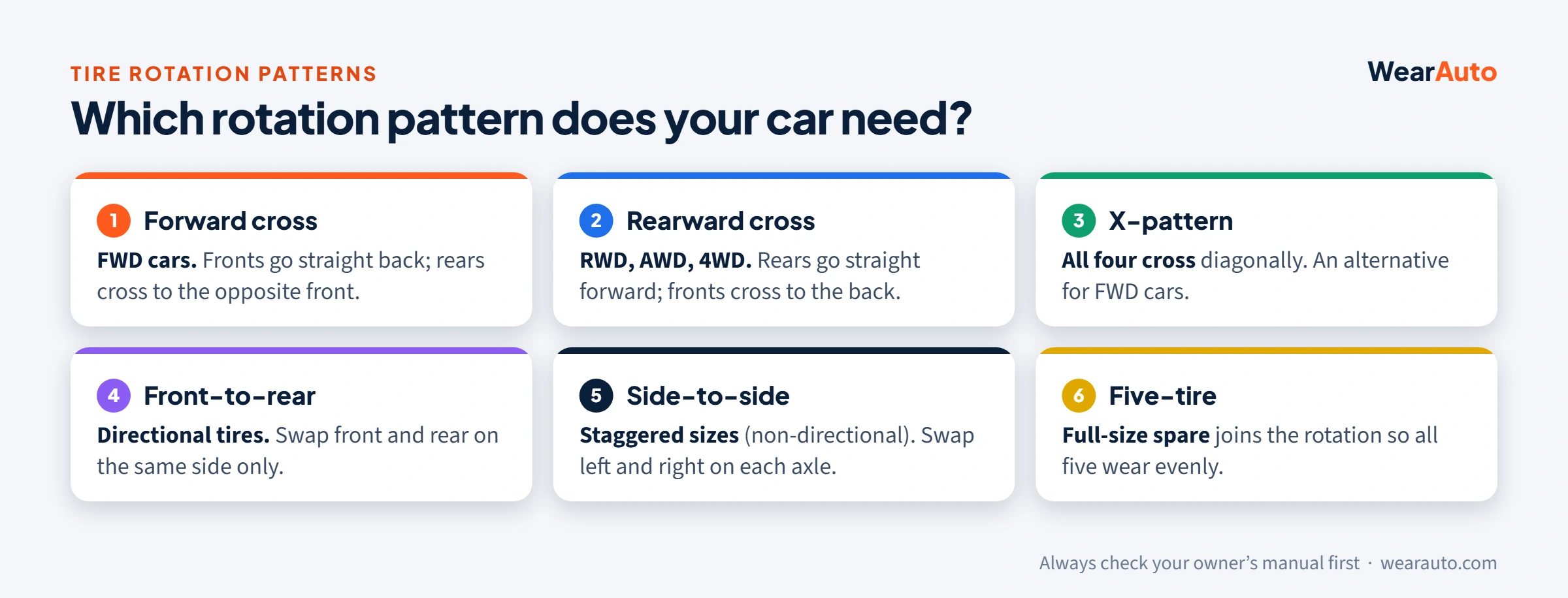
Which pattern you use depends on your drivetrain and your tires. Moving tires the wrong way isn’t dangerous, but it won’t even out wear as well.
Forward cross (front-wheel drive)
The front tires move straight back to the rear on the same side. The rear tires cross over to the opposite side as they move to the front: left rear goes to right front, right rear goes to left front. This is the standard pattern for most front-wheel-drive cars.
Rearward cross (rear-wheel, all-wheel and four-wheel drive)
This is the mirror image. The rear tires move straight forward on the same side, and the front tires cross to the opposite side as they move to the back. Most trucks, SUVs and all-wheel-drive cars use this pattern.
X-pattern
Every tire moves diagonally: left front to right rear, right front to left rear, and so on. Some manufacturers suggest it as an alternative for front-wheel-drive cars.
Front-to-rear (directional tires)
Directional tires have a V-shaped tread designed to roll one way only, with an arrow on the sidewall showing the direction. They can only swap front to back on the same side of the car. Crossing them to the other side would make them roll backward, which hurts wet grip. Many winter and performance tires are directional.
Side-to-side (staggered sizes)
Some sports cars use wider tires at the rear than the front. Since the sizes differ, the tires can’t move between axles. If they’re non-directional, you can swap left and right on each axle. If they’re both staggered and directional, they generally can’t be rotated without remounting them on the wheels. Not sure what size you have? Our guide to reading tire size explains the sidewall code.
Five-tire rotation
If your vehicle has a full-size spare that matches the other four, include it in the rotation. All five tires then wear evenly, and the spare isn’t a stiff, ten-year-old tire when you finally need it. This is common on trucks and some SUVs.
Can You Rotate Tires Yourself?
Yes, if you have the right gear and a flat, solid surface. You’ll need a floor jack, at least two jack stands (four makes it much easier), a lug wrench and a torque wrench. The basic process:
- Loosen the lug nuts slightly while the car is still on the ground.
- Lift the car at the manufacturer’s jacking points and support it on jack stands. Never work under a car held up only by a jack.
- Remove the wheels and move them to their new positions using the right pattern.
- Hand-tighten the lug nuts in a star pattern, lower the car, then torque them to the spec in your owner’s manual.
- Adjust tire pressures, because front and rear pressures are sometimes different. See our guide to the correct tire pressure for your car.
- Re-check lug nut torque after the first 50 to 100 miles.
On some cars the TPMS system needs a relearn after a rotation so it knows which sensor is in which corner. Your manual will say if this applies.
If you’d rather not, most tire shops rotate for a modest fee, and many include free rotations for the life of tires bought from them. A shop rotation is also a chance to have the wheels balanced and the brakes looked at while the wheels are off.
Signs Your Tires Are Overdue for Rotation
- Tread depth differs by more than 2/32 inch between the front and rear tires.
- The front shoulders are rounded or worn more than the center.
- A new vibration or hum at highway speed, which can come from uneven or “cupped” wear.
- It’s been more than 7,500 miles or six months and you can’t remember the last rotation.
Keep in mind that rotation evens out wear but doesn’t fix its cause. If one tire is wearing on just the inner or outer edge, get an alignment check. If both edges are wearing, check your pressures.
What Happens If You Never Rotate?
You’ll wear out one pair of tires much sooner than the other, which usually means buying tires in pairs at odd times instead of all four together. Uneven tread can make the car feel less stable in the rain, and on all-wheel-drive vehicles a large tread difference between axles can strain the drivetrain. Many tire warranties also require proof of regular rotation, so skipping it can void a treadwear claim. Our guide on how long tires last covers the other factors that shorten tread life.
Frequently Asked Questions
Is it OK to rotate tires every 10,000 miles?
Some manufacturers allow it, so check your owner’s manual. For most cars, 5,000 to 7,500 miles gives more even wear, especially on front-wheel-drive cars and EVs.
Does tire rotation require balancing?
Not always, but it’s a good time to do it. If you feel a vibration after a rotation, the wheels probably need balancing.
Should tires be rotated front to back or crisscross?
It depends on the car. Front-wheel-drive cars usually use a forward cross, rear- and all-wheel-drive vehicles use a rearward cross, and directional tires only move front to back on the same side.
How long does a tire rotation take?
At a shop, about 20 to 30 minutes. Doing it yourself with jack stands typically takes 45 minutes to an hour.
Do I need to rotate tires on an AWD car?
Yes, and it matters even more. Many AWD systems require all four tires to stay close in tread depth, and regular rotation is the easiest way to keep them matched.
The Bottom Line
Rotate every 5,000 to 7,500 miles using the pattern that fits your car: forward cross for front-wheel drive, rearward cross for rear-, all- and four-wheel drive, and front-to-back only for directional tires. It’s a quick job that keeps the car balanced, protects your warranty and gets more miles from every set. For more tire care tips, browse our Tires & Wheels section.
Replacing tires soon?
Check how a new size compares with your current one before you buy: diameter, revolutions per mile and speedometer error.
Open the Tire Size Calculator →Sources and further reading
- NHTSA: Tires and tire safety
- NHTSA TireWise: tire maintenance
- Tire Industry Association: consumer tire safety
Written and fact-checked by the WearAuto Editorial Team. Rotation intervals and patterns vary by vehicle; always follow your owner’s manual. See our editorial policy for how we research and update articles.