Charging an electric car can take anywhere from 20 minutes to more than two days. That huge range is why the question is so confusing for new EV owners. The answer depends mainly on the type of charger, the size of the battery, and how much charging speed the car itself can accept.
This guide breaks down charging times for each type of charger, explains what slows charging down, and shows how to estimate the time for your own car.
Quick answer
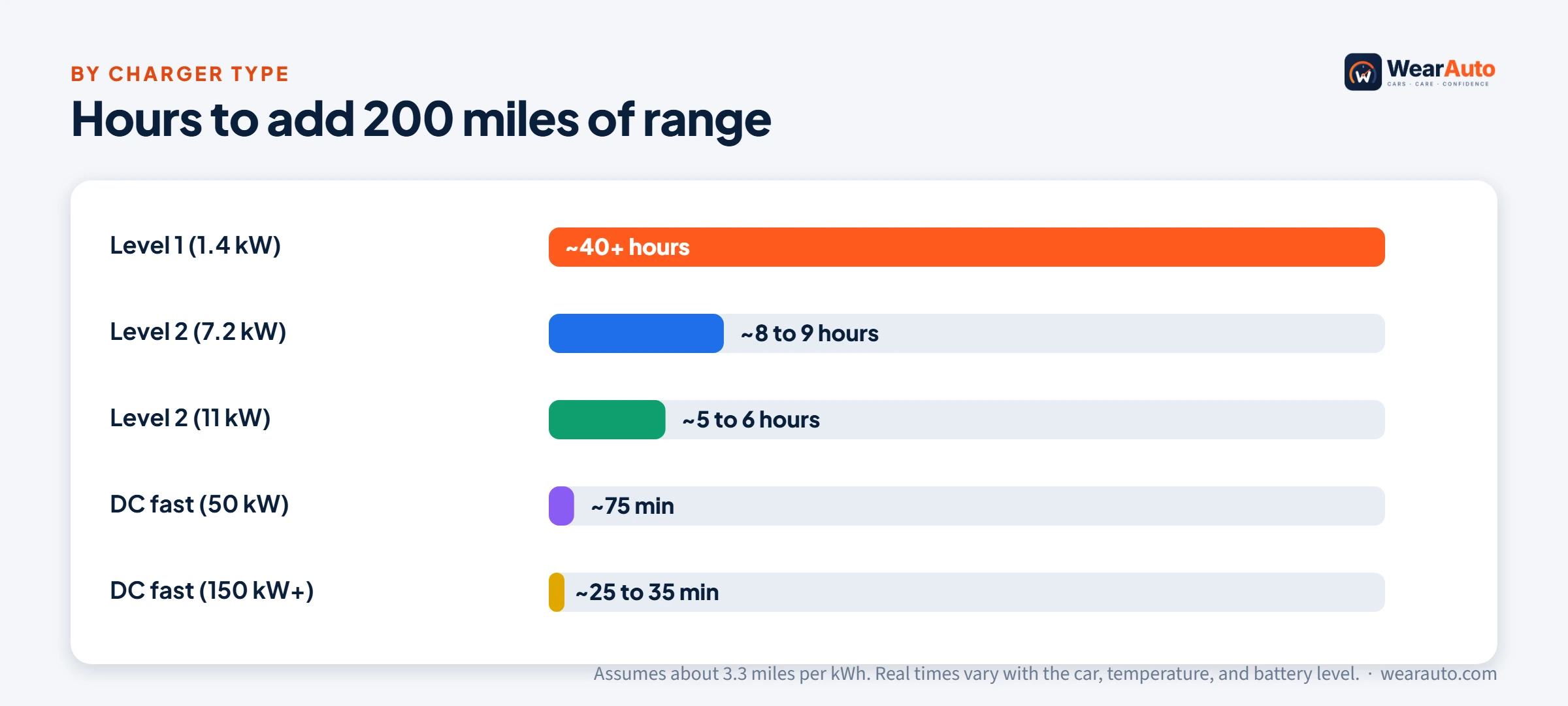
On a standard household outlet (Level 1), most EVs gain only about 3 to 5 miles of range per hour, so a full charge can take two days or more. A Level 2 home or public charger adds about 20 to 40 miles per hour and fully charges most EVs overnight in 6 to 12 hours. A DC fast charger can take a battery from about 10% to 80% in roughly 20 to 60 minutes.
- Fast charging slows down sharply above about 80%.
- Use our EV charging time calculator for your exact car and charger.
EV Charging Levels Explained
| Charger type | Power | Range added per hour | Full charge (typical EV) |
|---|---|---|---|
| Level 1 (120V outlet) | 1.2 to 1.9 kW | 3 to 5 miles | 40 to 60+ hours |
| Level 2 (240V) | 7 to 19 kW | 20 to 60 miles | 4 to 12 hours |
| DC fast charging | 50 to 350 kW | 150 to 1,000+ miles | 20 to 60 min to 80% |
Level 1: the standard outlet
Level 1 uses a regular 120-volt household outlet and the portable cord that comes with many EVs. It is slow, but it can be enough if you drive fewer than about 30 to 40 miles a day and can plug in for 10 to 12 hours each night. It also works well for plug-in hybrids with small batteries.
Level 2: home and workplace charging
Level 2 runs on 240 volts, like a clothes dryer. A home Level 2 charger on a 40-amp circuit delivers about 7.7 kW to 9.6 kW, which fully charges most EVs overnight. This is the most practical choice for daily charging.
DC fast charging: road trips
DC fast chargers send power directly to the battery, bypassing the car’s onboard charger. They are found along highways and in shopping areas. Most EVs can go from about 10% to 80% in 20 to 45 minutes on a powerful charger, depending on the model.
How to Estimate Charging Time
A simple formula gives a good estimate:
Charging time (hours) = energy needed (kWh) / charging power (kW)
For example, if your EV has a 75 kWh battery and you want to go from 20% to 80%, you need 45 kWh. On a 9 kW Level 2 charger, that takes about 5 hours. Add around 10% for charging losses.
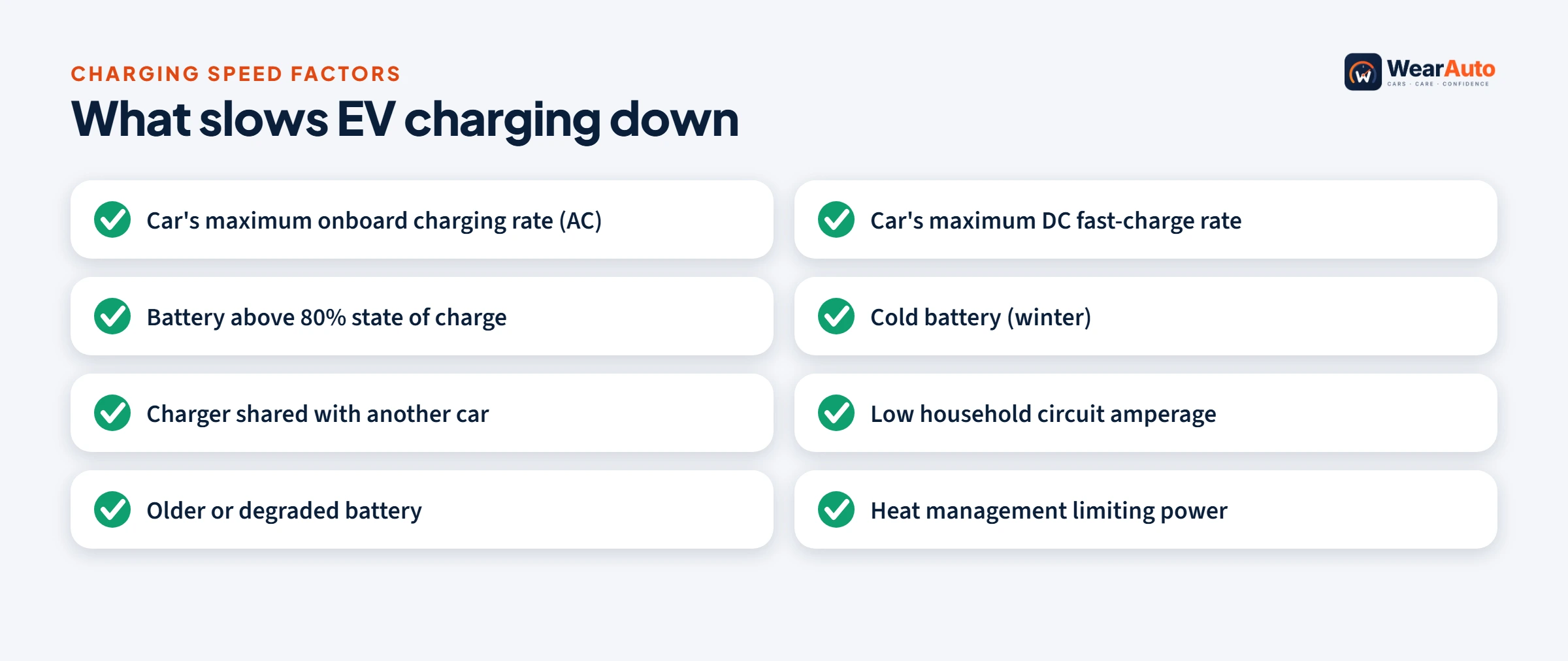
The actual charging power is the lower of two numbers: what the charger can supply, and what your car can accept. A car with an 11 kW onboard charger will not charge faster on a 19 kW Level 2 station. A car that accepts a maximum of 100 kW will not charge faster on a 350 kW fast charger.
Calculate your EV charging time
Enter your battery size, charge level, and charger power to see how long it will take.
Open the calculator →What Affects EV Charging Speed
The charging curve
EVs charge fastest when the battery is low. As it fills, the car reduces power to protect the battery. On a DC fast charger, going from 80% to 100% can take as long as going from 10% to 80%. That is why road trip charging stops are usually best kept between about 10% and 80%.
Temperature
Cold batteries accept charge more slowly, sometimes much more slowly. Many EVs let you precondition the battery by setting a fast charger as the destination in the navigation system, which warms the battery on the way so it charges faster on arrival.
Battery size
A larger battery takes longer to fill from empty, but it also usually supports higher charging power. Comparing range added per minute is more useful than comparing total charging time.
The car’s onboard charger
For Level 2 charging, the car’s onboard charger sets the limit. Common ratings are 7.2 kW, 9.6 kW, and 11 kW. A few models accept 19 kW.
Shared or limited chargers
Some public fast chargers split power between two cars. Home chargers may be limited by your electrical panel’s capacity.
Charging Times for Popular EV Battery Sizes
| Battery size | Level 2, 7.2 kW (10 to 100%) | DC fast, 150 kW (10 to 80%) |
|---|---|---|
| 40 kWh (small EV) | About 5.5 hours | About 25 to 35 min |
| 65 kWh (midsize) | About 9 hours | About 25 to 35 min |
| 80 kWh (long range) | About 11 hours | About 25 to 40 min |
| 100+ kWh (truck or large SUV) | 14 hours or more | About 30 to 45 min |
These are typical estimates. Fast charging times depend heavily on each model’s charging curve, so check real-world tests for your car.
Tips to Charge Faster and Smarter
- Charge at home overnight. For most owners, a Level 2 home charger covers almost all daily needs.
- Keep daily charging to about 80%. Many manufacturers recommend this for battery health, saving 100% for long trips.
- Precondition the battery before fast charging in cold weather.
- Avoid charging to 100% at fast chargers unless you need the range to reach the next stop.
- Plan road trip stops around chargers that match your car’s maximum charging rate.
Use the right outlet and wiring
Level 1 charging draws continuous power for many hours. Use a properly grounded outlet in good condition and avoid extension cords. Have a licensed electrician install any Level 2 charger.
Frequently Asked Questions
Can I charge an electric car from a normal outlet?
Yes. Most EVs can charge from a standard 120-volt outlet using a portable cord. It is slow, adding about 3 to 5 miles of range per hour, but it can be enough for short daily commutes.
How long does it take to charge an EV to 80%?
On a DC fast charger, most EVs reach 80% from about 10% in 20 to 45 minutes. On a Level 2 charger, it typically takes 4 to 9 hours, depending on battery size and charger power.
Does fast charging damage the battery?
Occasional fast charging is fine. Frequent DC fast charging may cause slightly faster battery degradation over many years, so most owners use Level 2 charging for daily needs.
Why does my EV charge slower in winter?
Lithium-ion batteries accept charge more slowly when cold. The car limits charging power to protect the battery until it warms up. Preconditioning helps.
Do I need a Level 2 charger at home?
Not always. If you drive less than about 40 miles a day and can plug in overnight, Level 1 may be enough. A Level 2 charger is more convenient and is recommended for most EV owners.
The Bottom Line
How long it takes to charge an electric car depends on the charger and your car. Expect days on a standard outlet, an overnight charge on Level 2, and about 20 to 60 minutes to reach 80% on a DC fast charger. For most drivers, charging at home overnight covers daily driving, with fast chargers reserved for road trips. Use the formula above or our calculator to estimate your own charging times.
Keep reading
Related guides
Sources and further reading
- U.S. Department of Energy: Charging electric vehicles at home
- U.S. Department of Energy: Developing infrastructure to charge electric vehicles
- FuelEconomy.gov: Electric vehicles
Written and fact-checked by the WearAuto Editorial Team. This guide is general information; always follow your vehicle manufacturer’s specifications and see a qualified mechanic for safety-critical repairs. See our editorial policy for how we research and update articles.