Checking your engine oil is the easiest piece of car maintenance there is, and one of the most important. Oil keeps the moving parts inside your engine from grinding against each other. Run too low and the engine can overheat, wear quickly, or seize, which can mean a repair bill in the thousands.
The whole check takes about five minutes and needs nothing more than a paper towel. Here is how to do it properly, how to read the dipstick, and what to do with what you find.
Quick answer
Park on level ground, turn off the engine, and wait 5 to 10 minutes. Pull out the dipstick, wipe it clean, push it all the way back in, and pull it out again. The oil should sit between the low and full marks. If it is at or below the low mark, add a small amount of the correct oil, wait a minute, and check again.
- Check at least once a month and before long trips.
- Never overfill. Too much oil can be as harmful as too little.
How Often Should You Check Your Oil?
Check the oil at least once a month and before any long drive. Check more often if your car is older, has high mileage, or you have noticed oil spots under it. Many engines burn a small amount of oil between changes, and some modern engines consume more than you might expect.
Checking the level is not the same as changing the oil. For change intervals, see our guide on how often to change engine oil, or use the oil change interval calculator to get an estimate for your driving.
How to Check Engine Oil Level Step by Step
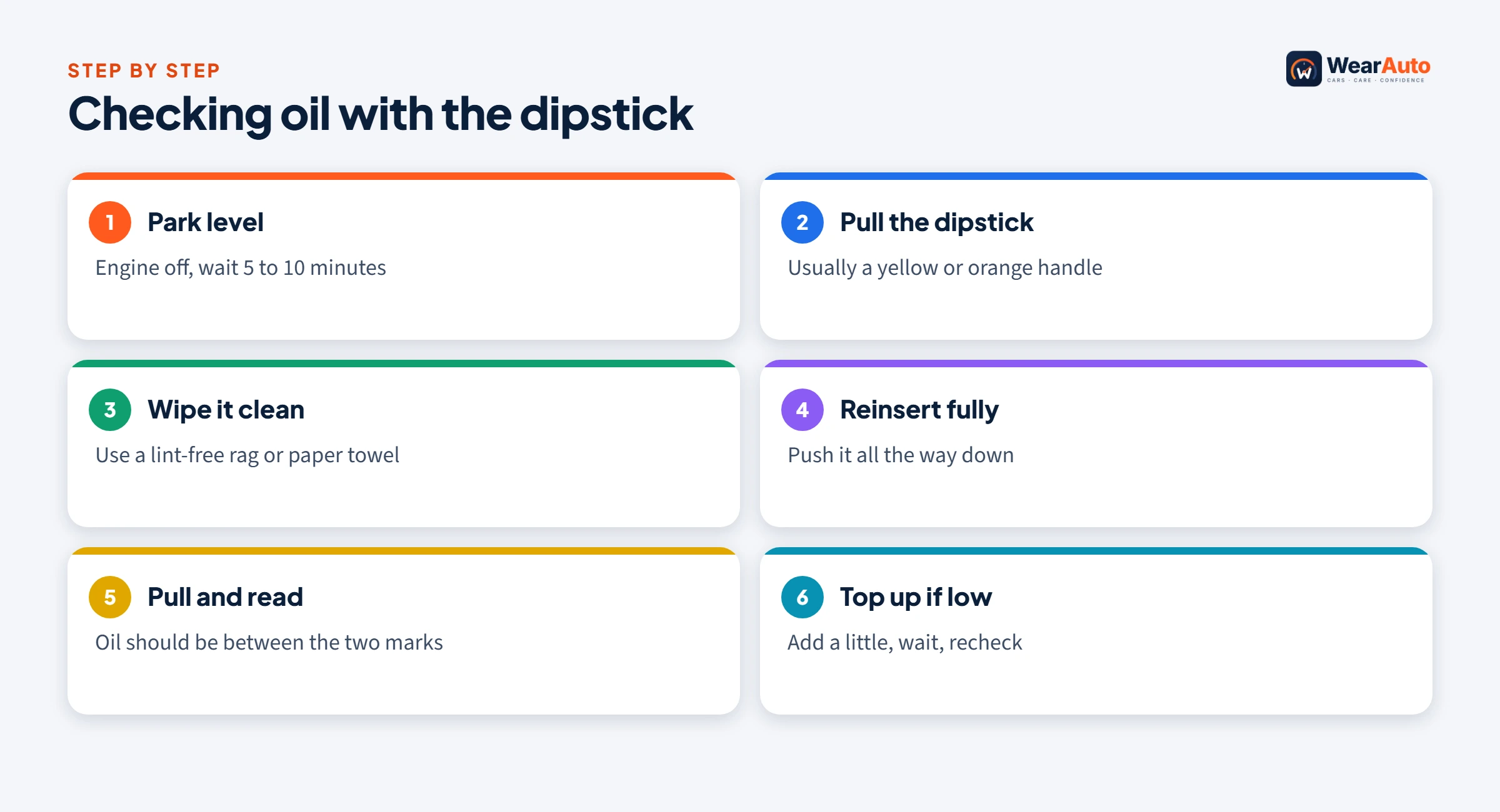
1. Park on level ground and let the engine rest
A car parked on a slope will give a false reading. Turn the engine off and wait 5 to 10 minutes so the oil drains back into the oil pan. Some manufacturers recommend checking with the engine warm, others cold. Your owner’s manual will say which, but the key point is to let the oil settle.
2. Open the hood and find the dipstick
The dipstick usually has a bright yellow or orange loop handle, often with an oil can symbol. Do not confuse it with the transmission dipstick, which some older automatic cars also have, usually further back and often red.
3. Pull it out and wipe it clean
The first reading is not accurate because oil splashes up the tube while the engine runs. Wipe the whole dipstick with a lint-free rag or paper towel.
4. Reinsert it fully
Push the dipstick all the way back into its tube until the handle seats. If it does not go in fully, the reading will look low.
5. Pull it out again and read the level
Hold the dipstick level and look at where the oil film ends. Most dipsticks have two marks, holes, or a crosshatched area. The top mark is full and the bottom mark is low. On many engines, the space between them equals about one quart (just under a liter).
6. Top up if needed
If the oil is at or below the low mark, add oil through the filler cap on top of the engine. Add about half a quart, wait a minute, and recheck. Repeat until the level is near the full mark.
Do not overfill
Oil above the full mark can be whipped into foam by the crankshaft, which reduces lubrication and can damage seals and the catalytic converter. If you overfill by more than about half a quart, have the extra drained.
Reading the Oil: Color, Texture, and Smell
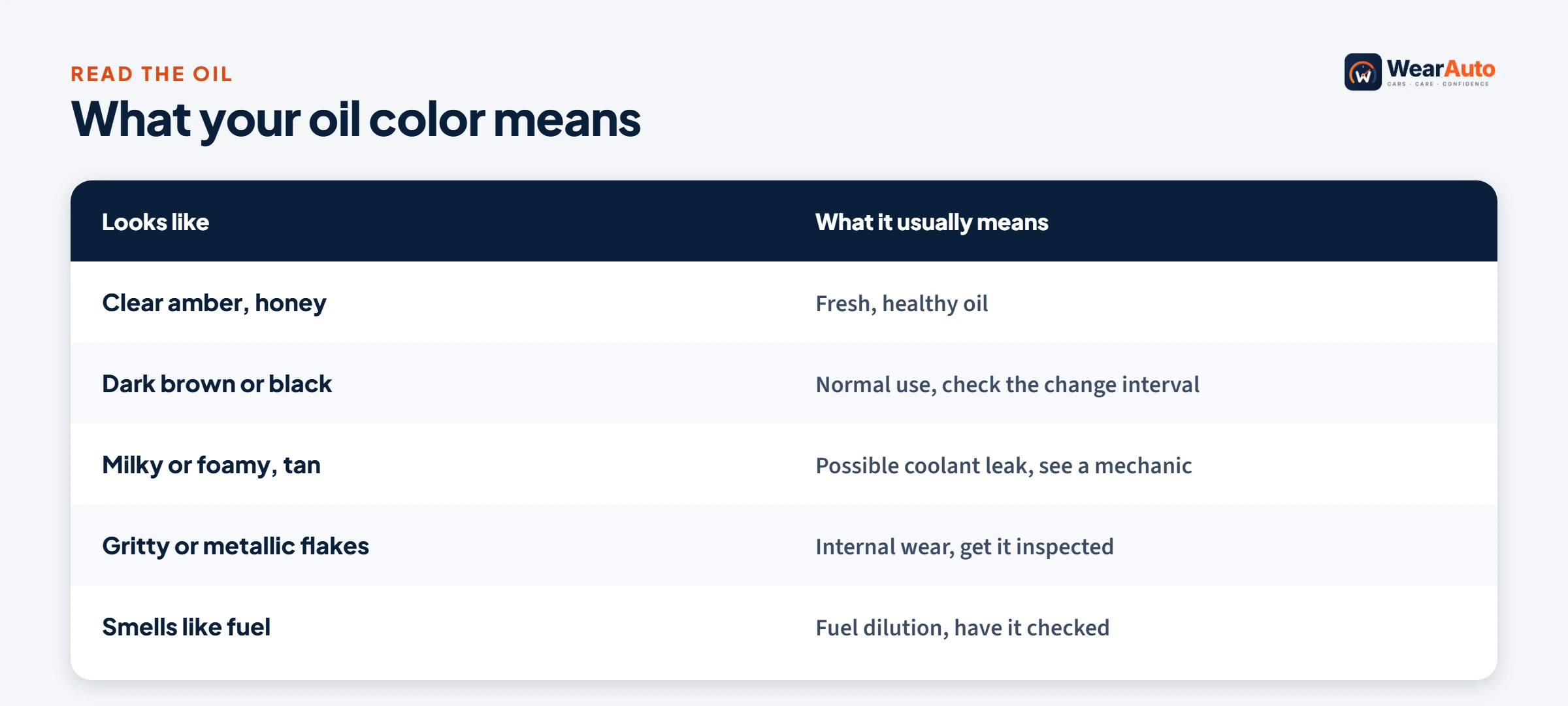
While the dipstick is out, take a look at the oil itself. Rub a drop between your fingers.
- Amber and smooth: healthy oil.
- Dark brown or black: normal for used oil, especially in older engines. Darkness alone does not mean it needs changing, but it is a good reminder to check your mileage since the last change.
- Milky, tan, or frothy: this can mean coolant is getting into the oil, often from a failing head gasket. Get it inspected promptly.
- Gritty or shiny particles: possible internal wear. Have a mechanic look at it.
- Strong fuel smell: fuel may be diluting the oil, which is more common with lots of short trips in cold weather.
Which Oil Should You Add?
Use the oil grade listed in your owner’s manual or on the oil filler cap, such as 0W-20 or 5W-30. Using the wrong viscosity can affect protection and fuel economy. Our comparison of synthetic vs conventional oil explains the difference if your car allows either.
| If the level is | What to do |
|---|---|
| Between the marks | Nothing. Check again next month. |
| At the low mark | Add about 1 quart, a bit at a time |
| Below the low mark | Add oil now and check for leaks or burning |
| Above the full mark | Have the excess drained |
| No oil on the stick | Do not drive. Add oil and get it checked. |
Cars Without a Dipstick
Many newer cars, including some BMW, Mercedes-Benz, Audi, and Porsche models, have no dipstick. They use an electronic oil level sensor instead. You check the level through the dashboard menu or infotainment screen, usually with the engine warm, running or recently shut off, and the car on level ground. Follow the steps in your owner’s manual, as each brand does it a little differently.
Signs Your Engine Is Low on Oil
- The oil pressure warning light comes on (a red oil can symbol)
- Ticking or knocking noises from the engine, especially at startup
- A burning oil smell
- Blue smoke from the exhaust
- The engine running hotter than normal
Red oil light means stop
If the red oil pressure light comes on while driving, pull over safely and turn off the engine as soon as you can. Driving with low oil pressure can destroy an engine within minutes.
Why Is My Car Losing Oil?
Needing to add a little oil between changes can be normal. Many manufacturers consider up to about one quart per 1,000 to 1,500 miles acceptable on some engines. If you are adding oil more often than that, the common causes are:
- External leaks from a valve cover gasket, oil pan gasket, or drain plug
- Burning oil from worn piston rings or valve seals
- A faulty PCV valve pushing oil into the intake
Look under the car for drips, and keep track of how much oil you add and how often. That record will help a mechanic diagnose the cause.
Frequently Asked Questions
Should I check my oil hot or cold?
Follow your owner’s manual. Most cars give an accurate reading a few minutes after the engine is turned off, once the oil has drained back into the pan. A completely cold engine also gives a reliable reading.
How much oil is between the low and full marks?
On most passenger cars it is about one quart, or just under a liter. Some larger engines have a bigger range, so check your manual.
Can I mix different brands of oil?
Yes. Different brands of the same grade and specification can be mixed safely. Try to use the same viscosity listed for your engine.
Is it bad if my oil is black?
Not necessarily. Oil darkens as it carries dirt away from the engine. Use the mileage and time since your last oil change to decide when to change it, not color alone.
Can I drive if my oil is a little low?
A short drive to buy oil is usually fine if the level is just at the low mark and the oil light is off. If the dipstick shows no oil or the oil light is on, do not drive.
The Bottom Line
Checking your engine oil takes five minutes and can prevent one of the most expensive engine repairs there is. Park level, wait a few minutes, wipe and reinsert the dipstick, and read the level between the marks. Top up slowly with the correct oil, never overfill, and watch for milky oil or a level that drops quickly. Make it a monthly habit and do it before every long trip.
Sources and further reading
- American Petroleum Institute: Motor oil guide
- Car Care Council: Check your oil
- AAA: Car maintenance basics
Written and fact-checked by the WearAuto Editorial Team. This guide is general information; always follow your vehicle manufacturer’s specifications and see a qualified mechanic for safety-critical repairs. See our editorial policy for how we research and update articles.