
Standing in the oil aisle can feel like a test you didn’t study for. There are dozens of bottles, a handful of grades that look almost identical, and labels covered in letters like API SP, ILSAC GF-6 and dexos. Pick the wrong one and you probably won’t destroy your engine overnight, but you can hurt fuel economy, void a warranty claim or shorten the life of a turbocharger.
The good news is that your car already tells you exactly what it needs. You just have to know where to look. This guide shows the fastest ways to find the right oil, explains what the numbers mean, and covers how much oil your engine holds so you buy the right amount the first time.
Quick answer
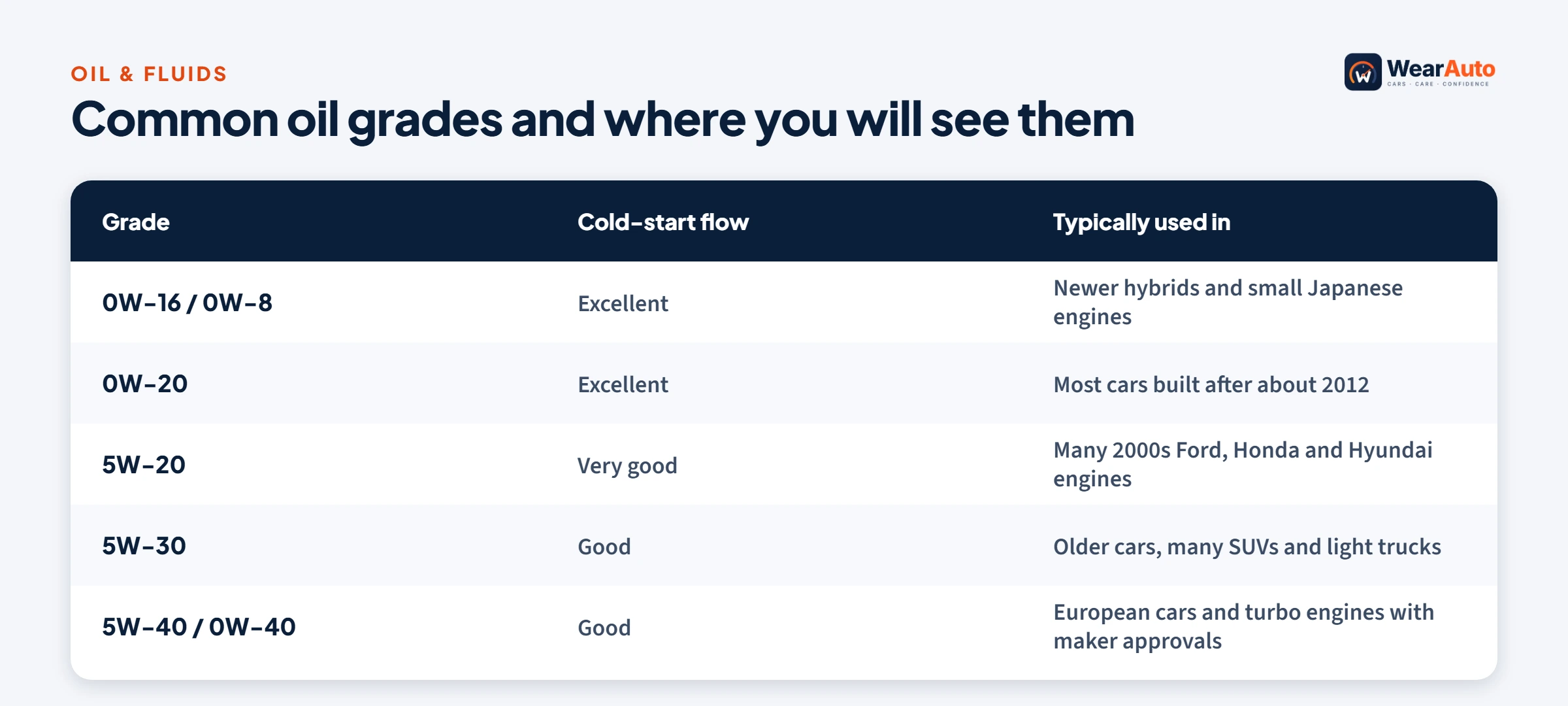
Your car takes the oil viscosity grade (for example 0W-20 or 5W-30) and specification (such as API SP or a carmaker approval) printed in your owner’s manual. Most cars built after about 2012 use 0W-20 or 5W-20; many older cars and trucks use 5W-30.
- Check the manual first, then the oil filler cap.
- Match both the grade and the spec, not just the grade.
- Synthetic or blend is fine if it meets the same grade and spec.
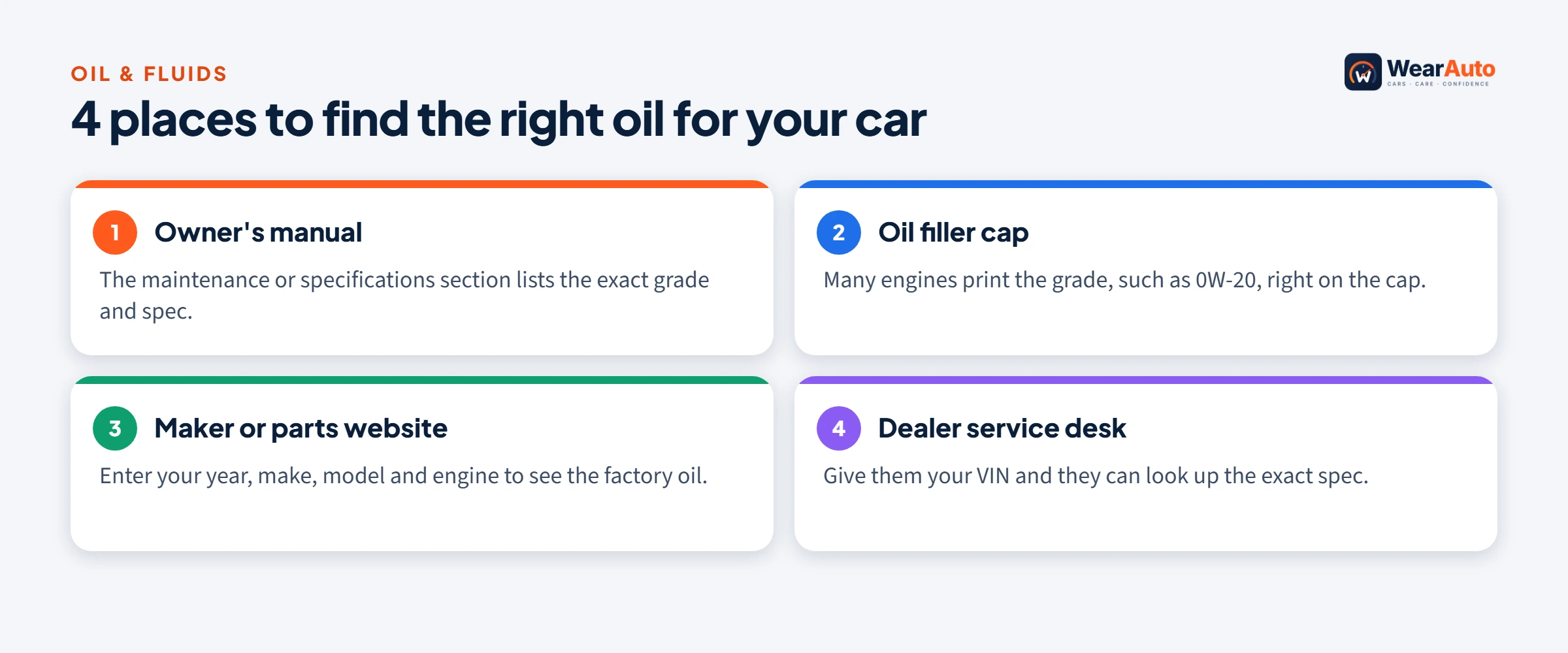
The 4 Fastest Ways to Find Your Car’s Oil
1. Your owner’s manual
This is the most reliable source. Look in the index for “engine oil,” “lubricants” or “capacities and specifications.” You’ll usually find three pieces of information: the viscosity grade, the oil specification and the oil capacity with a filter change. Some manuals list more than one grade depending on climate, so read the small print about temperature ranges.
If you’ve lost the paper manual, most carmakers publish free digital copies on their owner websites. Search for your brand plus “owner’s manual” and enter your model year.
2. The oil filler cap
Pop the hood and look at the cap where you pour in oil. Many Japanese, Korean and American engines have the grade molded or printed right on it, such as “SAE 0W-20.” It’s a handy confirmation, but it won’t tell you the full specification, so treat it as a second check rather than the only source.
3. A carmaker or oil brand lookup
Oil companies and parts retailers run free “oil finder” tools. You enter the year, make, model and engine size, and they show the factory-recommended grade and capacity. These are generally accurate, but double-check the engine size. A 2.0L and a 2.0L turbo version of the same model can need different oil.
4. Ask the dealer with your VIN
Call any franchised dealer for your brand, give them your 17-digit VIN, and ask what oil spec and capacity your engine needs. It takes two minutes and removes all guesswork, which is useful for European cars with very specific approvals.
What the Numbers on the Bottle Mean
The grade is set by the SAE (Society of Automotive Engineers) J300 standard. Take 5W-30 as an example:
- 5W is the cold rating. The “W” stands for winter. The lower this number, the more easily oil flows when the engine is cold. A 0W oil reaches the top of the engine faster on a freezing morning than a 10W oil.
- 30 is the hot rating, measured at about 100°C (212°F), which is roughly normal operating temperature. A higher number means the oil stays thicker when hot.
So 0W-20 and 5W-20 have the same hot thickness, but the 0W oil flows better at startup. Most engine wear happens in the first seconds after a cold start, which is why modern engines with tight tolerances are designed around thin oils. If you want the full explanation, our guide to synthetic vs conventional oil covers how base oils affect this too.
Grade Is Only Half the Answer: Check the Spec
Two bottles of 0W-20 can be very different oils. The specification tells you which performance tests the oil passed. Look for these symbols on the back label:
- API “donut” (service symbol). The current gasoline rating is API SP. It replaced SN and SN Plus and adds protection against low-speed pre-ignition in small turbo engines. API SP oils are backward compatible with older cars that called for SN, SM and earlier.
- ILSAC “starburst.” ILSAC GF-6A covers common grades like 0W-20 and 5W-30. GF-6B is a separate shield used for 0W-16 and thinner oils.
- Carmaker approvals. Some brands require their own approval code. Common examples include GM dexos1 Gen 3, Volkswagen VW 504 00 / 508 00, Mercedes-Benz MB 229.5 / 229.71, BMW Longlife-01 / LL-17 FE+ and Porsche A40. If your manual lists one, buy oil that shows that exact code.
- Diesel ratings. Diesel pickups usually need API CK-4 (or the newer CK-4/FA-4 split depending on the engine). Don’t put a gasoline-only oil in a diesel.
Warranty tip
If your car is under warranty, keep receipts showing the oil grade and spec you used. You don’t have to use the dealer’s brand, but the oil must meet the spec in your manual.
How Much Oil Does My Car Take?
Capacity depends on engine size and design. As a rough guide, small four-cylinder engines hold about 4 to 5 quarts, V6 engines about 5 to 6 quarts, and V8 trucks 6 to 8 quarts or more. Some European engines and diesels take much more.
| Engine type | Typical capacity with filter | Notes |
|---|---|---|
| 1.0L to 2.0L 4-cylinder | 3.7 to 4.8 quarts | Most compact cars and small crossovers |
| 2.4L to 2.5L 4-cylinder | 4.5 to 5.0 quarts | Midsize sedans and SUVs |
| 3.5L to 3.6L V6 | 5.5 to 6.0 quarts | Larger sedans, minivans, 3-row SUVs |
| 5.0L to 6.2L V8 | 6.0 to 8.0 quarts | Full-size pickups and SUVs |
| Turbo diesel pickup | 10 to 15 quarts | Check manual, varies widely |
These are typical ranges, not specs for your car. Always fill to the manual figure, wait a minute, then check the dipstick and top up in small amounts. Overfilling is a real problem, and our step-by-step guide on how often to change engine oil explains why the right level and interval matter. To get the figure for your exact engine, try our engine oil capacity lookup.
Not sure how much oil to buy?
Look up the typical oil capacity for your engine size before your next oil change.
Open the Oil Capacity Lookup →Synthetic, Blend or Conventional?
Your manual’s grade and spec matter more than the oil type. If your car calls for 5W-30 API SP, a full synthetic, a synthetic blend or a conventional oil that meets 5W-30 API SP will all technically qualify. That said, there are good reasons to choose synthetic:
- Many modern engines, especially turbocharged ones and anything that uses 0W-20 or thinner, are only offered with synthetic oils in those grades anyway.
- Synthetic resists breakdown at high temperatures and flows better in cold weather.
- It often allows longer change intervals when your manual or oil life monitor supports it.
Conventional oil is still perfectly fine for many older, non-turbo engines driven gently. High-mileage oils add seal conditioners that can help engines over 75,000 miles that are starting to seep or burn a little oil.
What If I Use the Wrong Oil?
Here’s the honest answer: one oil change with a slightly different grade, such as 5W-30 instead of 5W-20, is unlikely to cause damage in a typical engine. You may see a small drop in fuel economy, and some engines with variable valve timing can throw a check engine light because the oil pressure behaves differently.
The bigger risks come from:
- Using a much thicker oil in an engine designed for 0W-16 or 0W-20, which can slow oil flow at startup.
- Ignoring a required approval on European engines, especially those with long service intervals or diesel particulate filters.
- Putting gasoline oil in a diesel or vice versa.
If you realize you used the wrong oil, don’t panic. Drive gently and switch to the correct oil at your next change, or sooner if your car is under warranty or uses a strict maker approval.
Common Mistakes to Avoid
- Going by what the last shop put in. Quick-lube places sometimes use a “house” grade. Trust the manual, not the sticker on your windshield.
- Buying by brand instead of spec. A cheap store-brand oil with the right API and ILSAC symbols is better than an expensive one without them.
- Mixing up engine variants. Turbo and non-turbo versions of the same car can need different oil.
- Forgetting the filter. The right oil in the wrong filter still causes problems. Match the filter to your engine too.
Frequently Asked Questions
How do I know what oil my car takes without the manual?
Check the oil filler cap for a grade like 0W-20, use a carmaker or oil brand online lookup with your year, make, model and engine, or call a dealer with your VIN.
Can I use 5W-30 instead of 5W-20?
In most engines, a single fill of 5W-30 won’t cause harm, but it can slightly reduce fuel economy. Go back to the grade in your manual at the next oil change, and always use the correct grade if your car is under warranty.
Is 0W-20 the same as 5W-20?
They have the same thickness at operating temperature. The 0W-20 flows better on a cold start, so it can usually be used where 5W-20 is specified, but check your manual first.
Does my car need synthetic oil?
If your manual lists a grade like 0W-20 or 0W-16, a carmaker approval or a turbocharged engine, you will almost always need synthetic. Older non-turbo engines can usually use conventional oil that meets the right spec.
What does API SP mean?
API SP is the current American Petroleum Institute rating for gasoline engine oils. It is backward compatible, so it can be used in cars that originally called for API SN, SM or older ratings.
The Bottom Line
To find what oil your car takes, start with the owner’s manual and confirm with the oil cap or a dealer VIN lookup. Match three things: the viscosity grade, the specification or approval code, and the capacity. Do that and any reputable brand will protect your engine.
When in doubt, choose the exact grade in your manual in a full synthetic that carries the current API and ILSAC symbols. It’s the safest, simplest choice for most modern cars.
Keep reading
Free tools for this topic
Sources and further reading
- American Petroleum Institute: Engine Oil Licensing and Certification (EOLCS)
- SAE International: J300 Engine Oil Viscosity Classification
- U.S. Department of Energy, fueleconomy.gov: Keep your car in shape
Written and fact-checked by the WearAuto Editorial Team. This guide is general information; always follow your vehicle manufacturer’s specifications and see a qualified mechanic for safety-critical repairs. See our editorial policy for how we research and update articles.