
If you’re new to electric cars, charging can sound more complicated than it is. You’ll hear people talk about Level 1, Level 2, DC fast charging, kilowatts and connector types, sometimes all in one sentence. Underneath the jargon, there are really just three ways to charge an EV, and each one has a clear job.
This guide explains each charging level in plain English: how much power it delivers, how many miles it adds per hour, roughly what it costs and when it makes sense to use it.
Quick answer
Level 1 uses a regular 120V outlet and adds about 3 to 5 miles of range per hour. Level 2 uses 240V, like a dryer outlet, and adds about 20 to 60 miles per hour. DC fast charging feeds power straight to the battery at 50 to 350 kW and can take many EVs from 10% to 80% in about 20 to 40 minutes.
- Most owners do 80% or more of their charging at home on Level 2.
- DC fast charging is mainly for road trips.
- Your car’s maximum charging rate limits every level.
Why EV Charging Has “Levels”
The levels describe how power gets from the grid into your battery. Your home supplies alternating current (AC), but batteries store direct current (DC). With Level 1 and Level 2, the conversion from AC to DC happens inside the car using its onboard charger. With DC fast charging, a large charger at the station does the conversion and sends DC straight into the battery, which is why it can be so much faster.
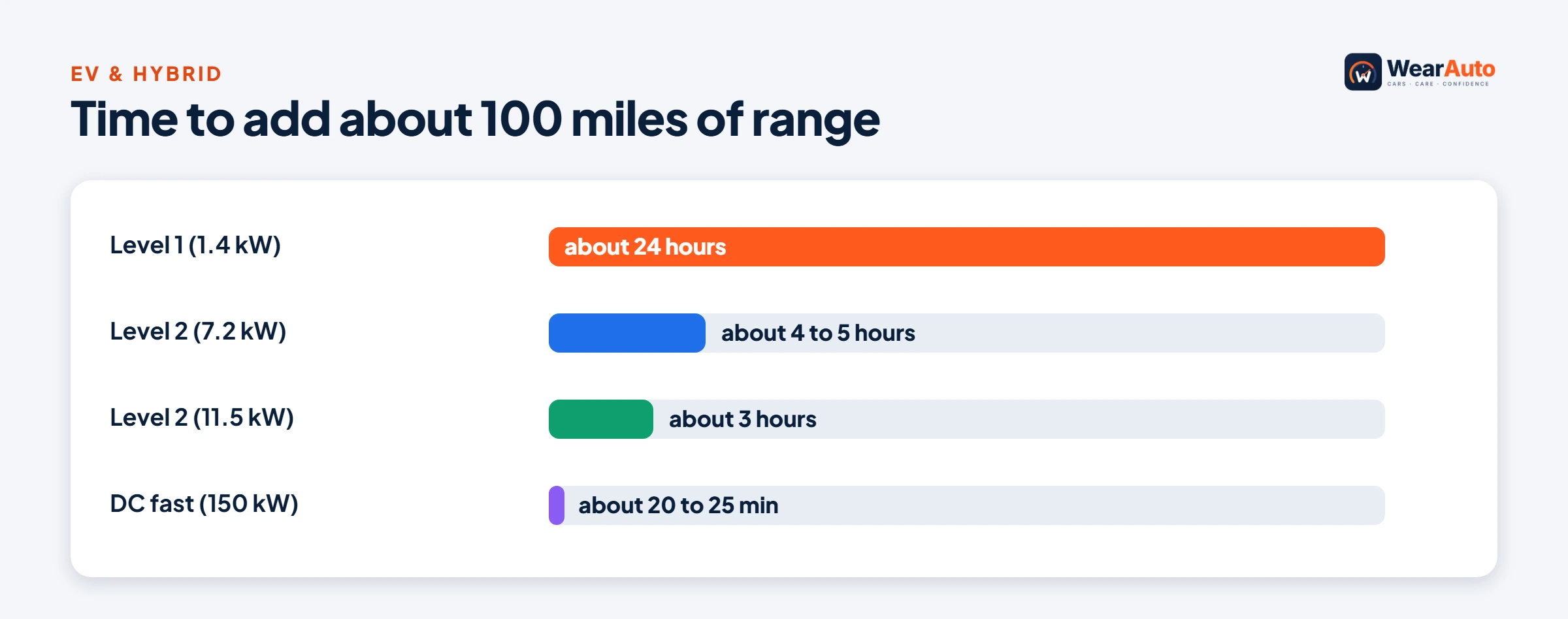
That onboard charger is important. If your car’s onboard charger is rated at 7.2 kW, plugging into an 11.5 kW Level 2 station won’t make it charge any faster than 7.2 kW.
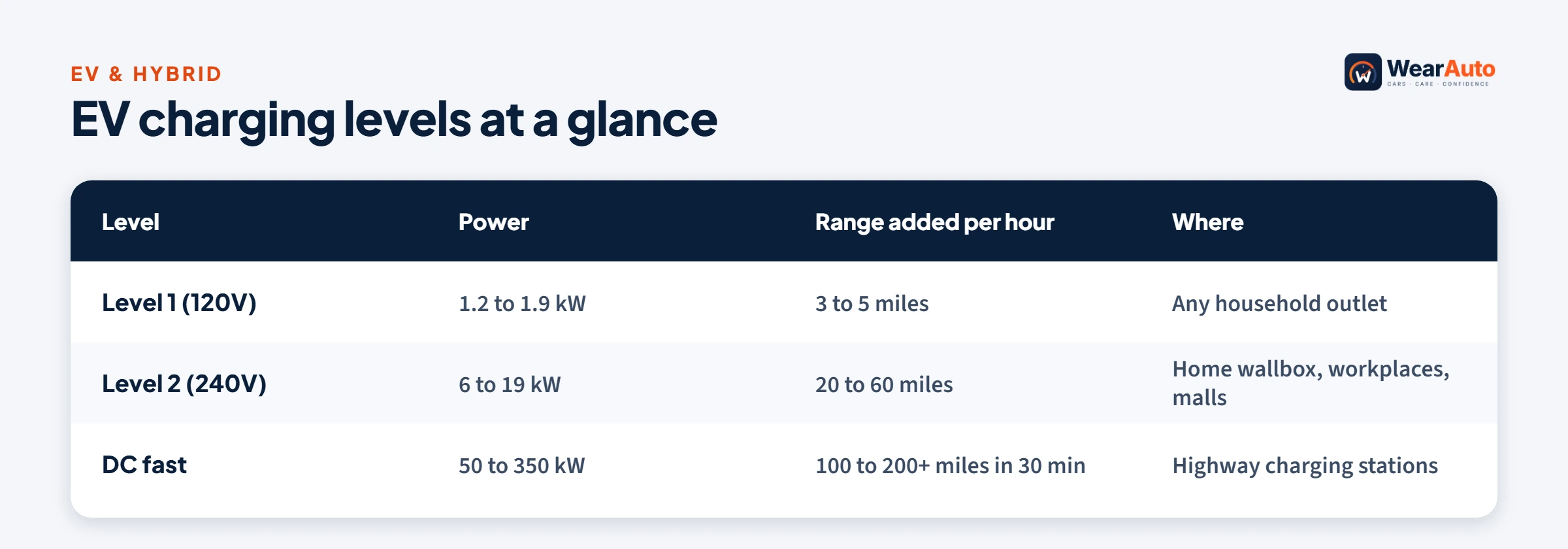
Level 1 Charging (120V)
Level 1 is the simplest option. You plug the portable cord that comes with most EVs into a standard household outlet. No installation is required.
- Power: about 1.2 to 1.9 kW.
- Range added: roughly 3 to 5 miles per hour of charging, or about 30 to 50 miles overnight.
- Best for: plug-in hybrids with small batteries, and EV drivers who commute less than about 30 to 40 miles a day.
Level 1 is slow, but it’s more useful than its reputation suggests. If your car sits in the driveway for 12 hours every night, that’s enough to replace an average daily commute. It’s also a handy backup when you’re staying with friends or family.
The main downsides are speed and cold weather. In winter, part of the power goes into warming the battery, so you may add noticeably fewer miles overnight.
Level 2 Charging (240V)
Level 2 is the sweet spot for most EV owners. It uses a 240-volt circuit, the same type that powers an electric dryer or oven, and either a wall-mounted charger or a portable unit that plugs into a 240V outlet.
- Power: typically 6 to 11.5 kW at home, and up to 19.2 kW on some installations.
- Range added: about 20 to 60 miles per hour, depending on the power and your car’s efficiency.
- Best for: daily home charging, workplaces, hotels and shopping centers.
A common 48-amp home charger delivers about 11.5 kW and can fully charge most EVs overnight from nearly empty. Public Level 2 chargers are useful when you’ll be parked for a few hours, such as at work, the gym or a movie.
Installing a Level 2 charger at home usually involves an electrician, a dedicated circuit and sometimes a permit. Costs vary widely, from a few hundred dollars when your panel is close to the garage to a couple of thousand when upgrades are needed.
DC Fast Charging
DC fast charging is what you’ll use on road trips. These large chargers sit along highways and in shopping areas and deliver power directly to the battery.
- Power: about 50 kW on older units, and 150 kW to 350 kW on newer ones.
- Range added: commonly 100 to 200 miles or more in about 20 to 30 minutes, depending on the car.
- Best for: long trips, and drivers without home charging who need a quick top-up.
Fast charging is not a steady speed. Your EV charges fastest when the battery is low and slows down as it fills, especially above about 80%. That’s why road-trip charging stops usually go from around 10% to 80%. Waiting for the last 20% can take almost as long as the first 70%.
Charging Levels Compared
| Feature | Level 1 | Level 2 | DC fast |
|---|---|---|---|
| Voltage | 120V AC | 208 to 240V AC | 400 to 1,000V DC |
| Typical power | 1.2 to 1.9 kW | 6 to 19.2 kW | 50 to 350 kW |
| Miles per hour of charging | 3 to 5 | 20 to 60 | Hundreds |
| Full charge (typical EV) | 2 to 4 days | 6 to 12 hours | 20 to 60 min to 80% |
| Home installation | None | Electrician, dedicated circuit | Not practical at home |
| Relative cost per kWh | Lowest (home rate) | Low at home | Highest |
How Much Does Each Level Cost?
Cost depends on where you charge more than on the level itself. Charging at home on Level 1 or Level 2 costs whatever you pay for electricity, which averages roughly 15 to 18 cents per kWh in the US, with big regional differences. A typical EV that uses about 30 kWh per 100 miles costs around $5 for 100 miles at home.
Public DC fast charging is usually much more expensive per kWh, often 40 to 60 cents or more, and some networks also charge idle fees if you stay plugged in after charging finishes. It’s still often cheaper per mile than gasoline, but the gap is smaller.
Charge smarter at home
Many utilities offer cheaper overnight rates. Set your car or charger to start after the off-peak period begins and you can cut home charging costs significantly.
Which Charging Level Do You Need?
- You drive under 40 miles a day and have a garage outlet: Level 1 may be enough, especially for a plug-in hybrid.
- You drive more, have two EVs, or live somewhere cold: a home Level 2 charger is worth it.
- You live in an apartment with no home charging: rely on workplace or public Level 2 and occasional DC fast charging.
- You take regular road trips: check that your car supports at least 100 to 150 kW DC fast charging.
Connector Types in a Nutshell
In North America, Level 1 and Level 2 have long used the J1772 connector, while DC fast charging has used CCS1 and, on older Nissans, CHAdeMO. Tesla’s connector has been standardized as SAE J3400 (NACS), and most carmakers are adopting it, with adapters available during the transition. Always check which plug your car uses and which adapters it supports before relying on a network.
Frequently Asked Questions
How long does it take to charge an EV with Level 2?
Most EVs charge from nearly empty to full in about 6 to 12 hours on a home Level 2 charger, depending on battery size and charger power. A typical overnight session is more than enough for daily driving.
Is Level 1 charging bad for an EV battery?
No. Slow charging is gentle on the battery. The only real drawback of Level 1 is speed.
Does DC fast charging damage the battery?
Occasional fast charging is fine and is what EVs are designed for. Relying on it almost exclusively, especially in hot climates, can speed up battery wear slightly over many years, which is why most owners charge at home day to day.
Can I install a Level 2 charger myself?
A plug-in Level 2 charger can be used with an existing 240V outlet, but adding a new 240V circuit should be done by a licensed electrician, and many areas require a permit.
Why does fast charging slow down after 80%?
The battery management system reduces power as the cells fill to protect them from heat and stress. That is why road-trip stops usually charge to about 80%.
The Bottom Line
Think of Level 1 as a trickle, Level 2 as your everyday charger and DC fast charging as your road-trip fuel stop. Most EV owners are happiest with a Level 2 charger at home and occasional fast charging on longer trips.
Before buying an EV, check two numbers: its onboard AC charging rate and its peak DC fast charging rate. Together, they tell you how quickly it will charge at home and on the highway.
Sources and further reading
- U.S. Department of Energy, Alternative Fuels Data Center: Developing infrastructure to charge electric vehicles
- U.S. Department of Transportation: Electric vehicle charging speeds
- U.S. Energy Information Administration: Electric power monthly, average retail prices
Written and fact-checked by the WearAuto Editorial Team. This guide is general information; always follow your vehicle manufacturer’s specifications and see a qualified mechanic for safety-critical repairs. See our editorial policy for how we research and update articles.