Driving a manual car, also called a stick shift, looks complicated at first. There is a third pedal, a gear lever, and the constant fear of stalling at a traffic light. But once your feet learn the rhythm, it becomes second nature, and many drivers find it more engaging and more controllable than an automatic.
This guide walks you through how a manual transmission works, how to pull away without stalling, when to shift gears, and how to handle hills and stops.
Quick answer
To drive a manual car, press the clutch fully, select first gear, then slowly lift the clutch until you feel the car start to pull (the bite point). Add a little gas as you keep lifting the clutch smoothly. Shift up at around 2,000 to 3,000 rpm by pressing the clutch, moving to the next gear, and releasing the clutch while adding gas. To stop, press the clutch and brake together.
- Practice in an empty parking lot before driving on the road.
- Stalling is normal. Restart and try again.
How a Manual Transmission Works
A manual car has three pedals. From left to right:
- Clutch: connects and disconnects the engine from the wheels. Press it with your left foot whenever you change gear or come to a stop.
- Brake: slows the car, operated with your right foot.
- Accelerator (gas): controls engine speed, also with your right foot.
The gear lever lets you choose gears. Most cars have five or six forward gears plus reverse. The shift pattern is printed on top of the knob. Lower gears give more pulling power for starting and climbing. Higher gears let you cruise at speed with lower engine revs.
Before You Start: Get Comfortable
- Adjust the seat so you can push the clutch all the way to the floor with a slight bend in your knee.
- With the engine off and the clutch pressed, practice moving the lever through each gear.
- Find neutral, the position where the lever moves freely side to side.
How to Start the Car
Most manual cars need the clutch pressed to start. Put the lever in neutral, press the clutch fully, press the brake, and turn the key or press the start button. Keep the clutch down for a moment while the engine settles.
How to Pull Away Without Stalling
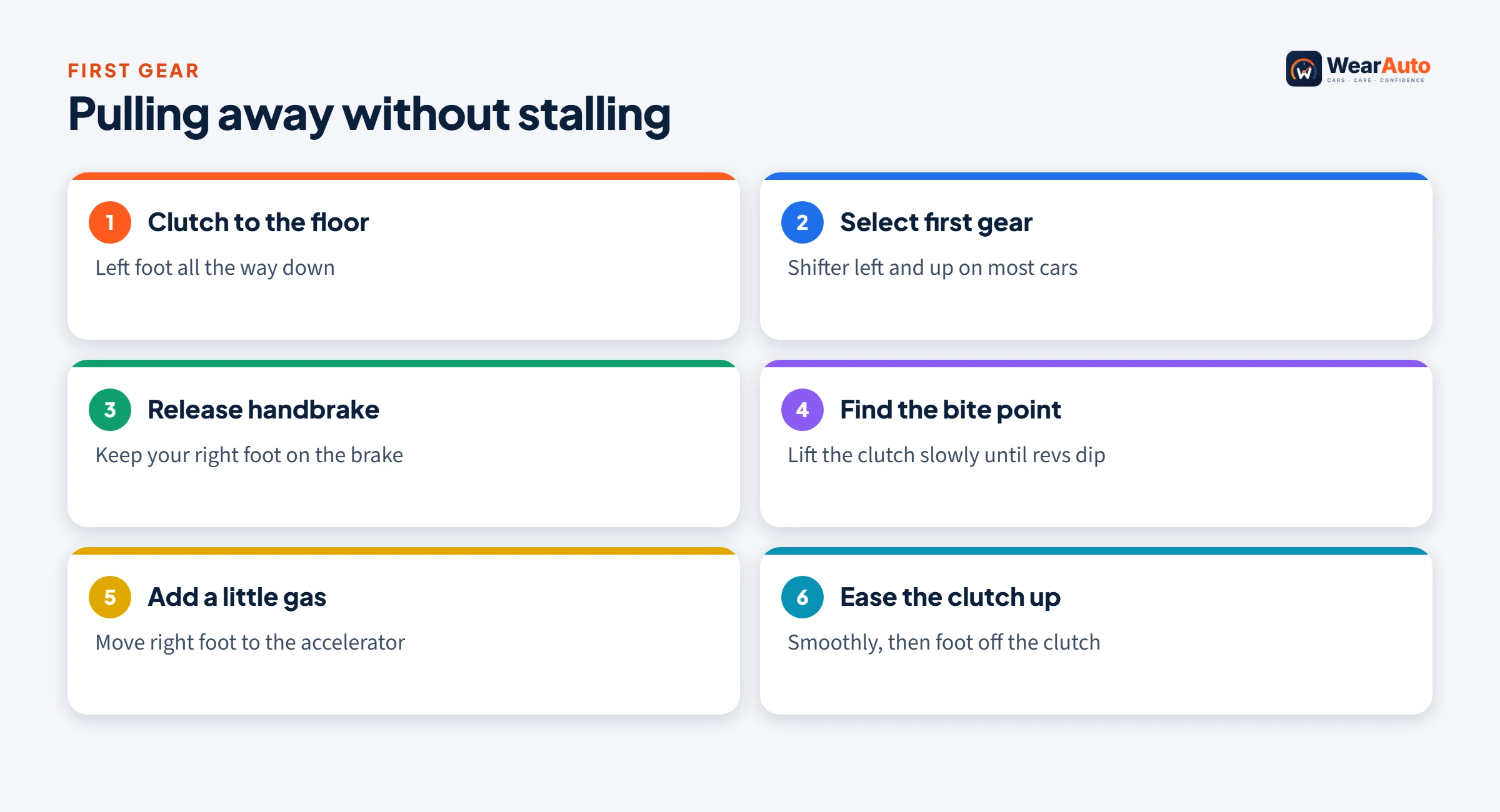
This is the step most beginners struggle with. The key is the bite point, the place in the clutch pedal’s travel where the engine starts to connect to the wheels. You will feel the car want to move, hear the engine note drop slightly, and see the rev counter dip.
- With the clutch fully pressed, move the lever into first gear.
- Release the parking brake while keeping your right foot on the brake.
- Slowly lift the clutch until you reach the bite point. Hold it there.
- Move your right foot to the gas and press gently, to about 1,200 to 1,500 rpm.
- Keep lifting the clutch slowly and smoothly while adding a little more gas.
- Once the clutch is fully up, take your left foot off the pedal entirely.
Practice the bite point on flat ground
In an empty parking lot, try lifting the clutch to the bite point without any gas. Many cars will creep forward on their own. This teaches your foot exactly where the bite point is.
When and How to Shift Gears
Shifting up
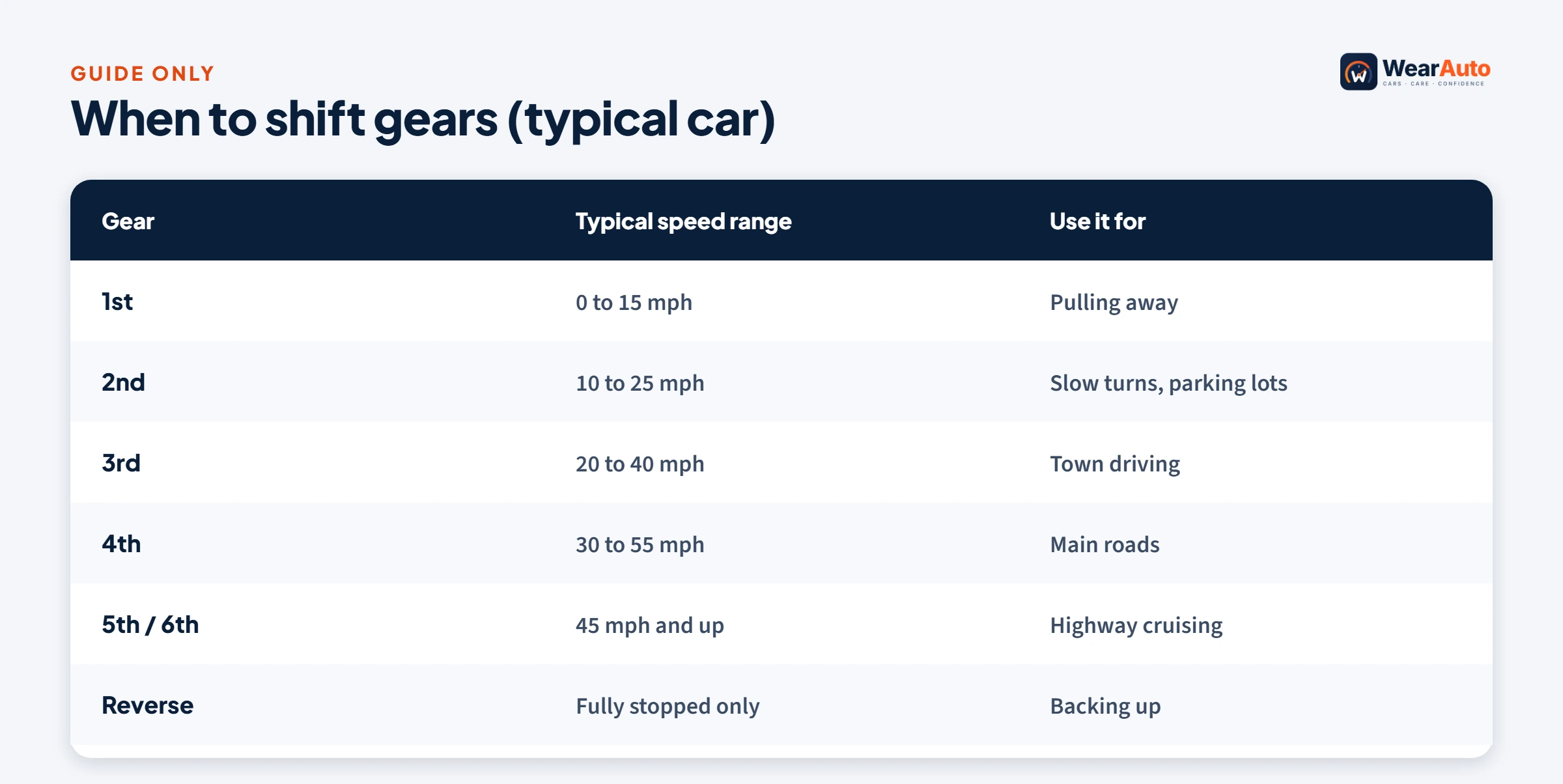
Shift to a higher gear when the engine reaches roughly 2,000 to 3,000 rpm in normal driving. If you do not have a rev counter, listen to the engine. When it starts to sound busy, it is time to shift.
- Lift off the gas.
- Press the clutch fully.
- Move the lever to the next gear.
- Release the clutch smoothly while gently pressing the gas.
Shifting up early, without making the engine labor, is one of the easiest ways to improve gas mileage in a manual car.
Shifting down
Downshift when you slow down and the engine starts to shudder or feel sluggish, or when you need more power to pass or climb a hill. Press the clutch, select the lower gear, and release the clutch smoothly. A small blip of gas as you release the clutch makes the change smoother.
Never shift into reverse while moving
Always come to a complete stop before selecting reverse. Shifting into reverse while rolling forward can damage the gearbox.
How to Stop a Manual Car
- For a gentle stop: brake normally. When speed drops to about 10 to 15 mph, or the engine starts to shudder, press the clutch fully and keep braking until you stop.
- At a stop: keep the clutch pressed with the car in first gear if you are about to move off, or shift to neutral and release the clutch if you will be waiting.
- When parking: set the parking brake firmly. Leave the car in first gear (or reverse if facing downhill), since a manual car has no Park position.
How to Start on a Hill
Hill starts are the next challenge after basic pulling away. The car can roll backward in the moment between releasing the brake and the clutch biting.
- Hold the car on the parking brake with the clutch pressed and first gear selected.
- Add a bit more gas than on flat ground, about 1,500 to 2,000 rpm.
- Lift the clutch to the bite point until you feel the car pulling against the brake.
- Release the parking brake while keeping the clutch steady and adding gas.
- Continue lifting the clutch smoothly as the car moves off.
Many modern manual cars have hill start assist, which holds the brakes for a second or two after you lift your foot. It makes hill starts much easier.
Common Beginner Mistakes
| Mistake | What happens | How to fix it |
|---|---|---|
| Lifting the clutch too fast | The car jerks or stalls | Lift slowly through the bite point |
| Too little gas | Stall when pulling away | Add gas as the clutch bites |
| Too much gas | Engine roars, clutch wears | Use gentle throttle, about 1,500 rpm |
| Riding the clutch | Clutch wears out early | Take your foot off when not shifting |
| Wrong gear for the speed | Engine labors or screams | Match gear to speed and rpm |
| Resting a hand on the shifter | Wear on gearbox parts | Keep both hands on the wheel |
How Long Does It Take to Learn?
Most people get the basics of pulling away and shifting in one or two hours of practice. Feeling comfortable in traffic and on hills usually takes a couple of weeks of regular driving. Start in a quiet area, then move to light traffic before tackling busy roads.
Frequently Asked Questions
Is it bad to stall a manual car?
An occasional stall does not damage the car. Press the clutch, shift to neutral, restart, and try again. Frequent stalling just means you need more practice with the bite point.
Should I coast in neutral?
No. Coasting in neutral reduces your control and engine braking, and it does not save fuel in modern cars. Stay in gear and lift off the gas instead.
Can I skip gears when shifting?
Yes, skipping gears, such as going from 3rd to 5th when cruising, is fine if the engine speed suits the new gear. It is also fine to downshift from 5th to 3rd when slowing.
Do I need to press the clutch when braking?
Not right away. Brake normally and press the clutch just before the engine starts to shudder, usually around 10 to 15 mph in a low gear.
How long does a clutch last?
Many clutches last 60,000 to 100,000 miles or more. Riding the clutch, slipping it on hills, and harsh launches wear it out faster.
The Bottom Line
Learning to drive a manual car is mostly about one skill: controlling the clutch smoothly through the bite point. Practice in an empty lot until pulling away feels easy, shift up around 2,000 to 3,000 rpm, press the clutch before you stop, and use the parking brake to help with hill starts. Stall a few times, laugh it off, and keep going. Within a week or two, it will feel natural.
Sources and further reading
- NHTSA: Teen driving and learning to drive
- AAA: Driving tips and education
- U.S. Department of Energy: Driving more efficiently
Written and fact-checked by the WearAuto Editorial Team. This guide is general information; always follow your vehicle manufacturer’s specifications and see a qualified mechanic for safety-critical repairs. See our editorial policy for how we research and update articles.