Search for ways to save gas and you’ll find everything from fuel additives to magnets that clip onto your fuel line. Most of that is a waste of money. The things that genuinely move your miles per gallon are less exciting: how you use the pedals, how fast you cruise, and a few minutes of basic maintenance.
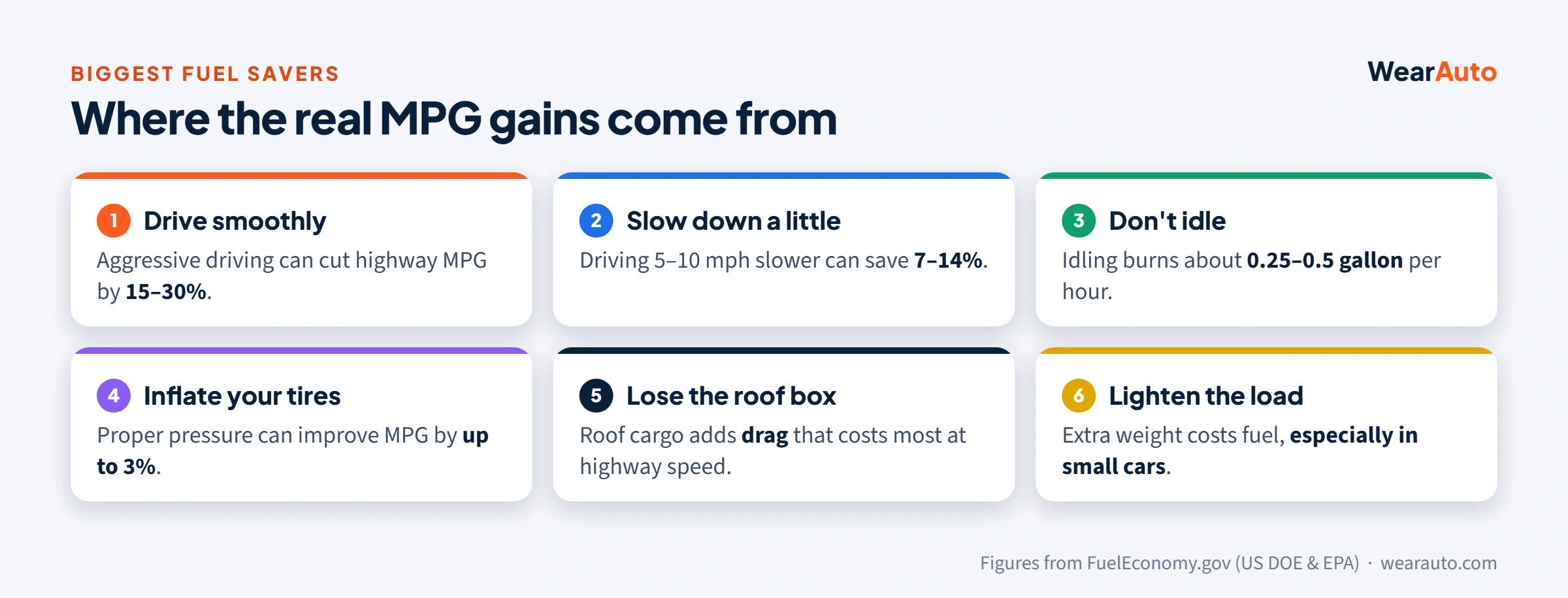
The upside is that they’re free or close to it, and the savings are real. According to the US Department of Energy and EPA’s FuelEconomy.gov, aggressive driving alone can lower gas mileage by 15% to 30% at highway speeds. Here are 20 tips, starting with the ones that make the biggest difference.
Quick answer
The three biggest wins: drive smoothly (gentle acceleration and early braking), slow down a little on the highway (5 to 10 mph slower can save 7% to 14%), and keep your tires at the correct pressure. After that, cut idling, remove roof boxes and extra weight, and keep up with basic maintenance.
Driving Habits: The Biggest Savings
1. Accelerate gently
Flooring it from a stop uses far more fuel than rolling on the throttle smoothly. Imagine there’s a cup of coffee on the dashboard you don’t want to spill. You’ll still keep up with traffic, and you’ll use noticeably less fuel.
2. Look ahead and coast
Every time you brake, you throw away energy you paid for. Watch the traffic a few cars ahead and the lights in the distance. If the light ahead is red, lift off early and coast. Modern fuel-injected engines use little or no fuel while coasting in gear. It also helps your brakes last longer, as we explain in our guide on how long brake pads last.
3. Slow down on the highway
Air resistance rises sharply with speed, and most cars’ fuel economy drops quickly above about 50 mph. FuelEconomy.gov estimates that driving 5 to 10 mph slower improves fuel economy by roughly 7% to 14%. On a long trip, the time you lose is usually just a few minutes.
4. Use cruise control on open roads
Holding a steady speed avoids the small surges of acceleration that creep in when you drive by foot. On hilly roads, though, cruise control can be too eager to hold speed uphill, so consider switching it off and letting your speed drop a little on climbs.
5. Cut the idling
An idling engine burns roughly a quarter to half a gallon of fuel per hour, getting zero miles per gallon. Restarting a warm engine uses only about ten seconds’ worth of fuel, so switch off if you’ll be parked for more than a minute. You don’t need to idle to warm up a modern car in winter, either. Drive off gently after 30 seconds or so.
6. Combine trips
A cold engine is much less efficient than a warm one. Several short trips from a cold start use considerably more fuel than one longer loop covering the same errands.
7. Use the highest sensible gear
In a manual car, shift up early, around 2,000 to 2,500 rpm in normal driving. Most automatics do this on their own, especially in eco mode.
8. Try eco mode
Eco modes soften throttle response, shift earlier and sometimes reduce climate control power. They nudge you into efficient habits without having to think about it.
Maintenance That Pays You Back
9. Keep tires properly inflated
Underinflated tires flex more and increase rolling resistance. FuelEconomy.gov says keeping tires at the right pressure can improve mileage by up to 3%, and that every 1 PSI drop across all four tires costs about 0.2%. Check monthly against your door jamb sticker, not the number on the tire. Our guide to the correct tire pressure for your car shows how.
10. Use the recommended motor oil
Using the viscosity your manufacturer specifies, such as 0W-20, keeps internal friction low. A heavier oil than recommended can cost a little efficiency. See our comparison of synthetic vs conventional oil for help choosing.
11. Fix check engine light problems
Faulty oxygen sensors, misfires and dirty airflow sensors can all quietly drain fuel economy. If the light is on, read the code and fix the cause. Our guide to check engine light causes walks through it.
12. Keep the alignment straight
Wheels that are out of alignment drag slightly instead of rolling freely, wasting fuel and wearing tires. If the car pulls to one side, get it checked.
13. Replace a clogged air filter (on older cars)
On modern fuel-injected cars, a dirty air filter mostly affects acceleration rather than mileage, but it’s cheap and easy to replace at the recommended interval.
14. Use the octane your car needs
If your owner’s manual says regular, premium fuel won’t improve mileage or performance. If it says premium is required, use premium. If it says “recommended,” regular is usually fine, with a small performance trade-off.
Weight, Drag and Accessories
15. Remove roof boxes and racks when not in use
A large roof cargo box is like towing a small parachute. FuelEconomy.gov estimates it can reduce fuel economy by around 2% to 8% in city driving and 6% to 17% on the highway. Rear-mounted carriers cause far less drag.
16. Clear out the trunk
An extra 100 pounds can cut mileage by about 1%, with smaller cars affected more. Golf clubs, tool boxes and bags of salt you’re carrying “just in case” add up.
17. Windows or A/C?
Around town, opening the windows is usually more efficient than running the air conditioning. At highway speeds, open windows add drag, so the A/C is often the better choice. Either way, avoid running the A/C colder than you need.
18. Park smart
In summer, park in the shade to reduce A/C load when you set off. In winter, a garage keeps the engine warmer so it reaches efficient operating temperature faster.
Planning and Tracking
19. Avoid rush hour when you can
Stop-and-go traffic is where aggressive driving costs the most, and it’s also where any car’s mileage suffers. Shifting a trip by 30 minutes can make a real difference.
20. Track your real mileage
Fill the tank, reset the trip meter, and at the next fill-up divide the miles driven by the gallons added. Doing this every tank shows you which habits are actually working and can also flag a mechanical problem early, since a sudden drop in MPG often means something’s wrong.
What Doesn’t Work
- Fuel-saving gadgets and magnets. Independent testing has repeatedly found no meaningful benefit.
- Most fuel additives. Gasoline sold in the US already contains detergents. Additives won’t raise mileage on a healthy engine.
- Overinflating tires beyond the placard. The tiny gain isn’t worth the loss of grip and uneven wear.
- Coasting in neutral. It saves nothing on modern cars and reduces control. Coasting in gear is better.
For more ways to drive safer and spend less, browse our Driving Tips & Safety guides.
Frequently Asked Questions
What speed gives the best gas mileage?
For most cars, fuel economy is best somewhere between about 40 and 55 mph and drops quickly above 50 mph as air resistance increases. The exact sweet spot varies by vehicle.
Does using A/C waste a lot of gas?
It does use extra fuel, mostly in city driving. On the highway, open windows create drag, so using the A/C is often about as efficient.
Does premium gas improve mileage?
Only if your car is designed for it. In a car that calls for regular fuel, premium doesn’t improve mileage or performance.
How much can I realistically save?
Combining smoother driving, slightly lower highway speeds and correct tire pressure often improves fuel economy by 10% or more, depending on how you drive now.
Is it better to idle or restart the engine?
If you’ll be stopped for more than about a minute, switching off and restarting usually saves fuel. Restarting a warm engine uses only about ten seconds’ worth of fuel.
The Bottom Line
Better gas mileage mostly comes from your right foot. Accelerate gently, look ahead so you brake less, ease off a few mph on the highway and don’t sit idling. Back that up with correct tire pressure, the right oil and prompt repairs, and lose the roof box when you don’t need it. Track your MPG for a few tanks and you’ll see the difference in real numbers.
Start with the easiest win
Correct tire pressure improves mileage, grip and tire life. Here’s how to find your number and check it in five minutes.
Read: Correct Tire Pressure →Sources and further reading
Written and fact-checked by the WearAuto Editorial Team. Fuel savings vary by vehicle, traffic and driving style. See our editorial policy for how we research and update articles.