A breakdown in your own neighborhood is annoying. A breakdown 300 miles from home, on a holiday weekend, with a car full of luggage and tired passengers, is a different story. Most road trip breakdowns come from simple things: underinflated tires, a weak battery, overdue oil or a cooling system problem that a quick check would have caught.
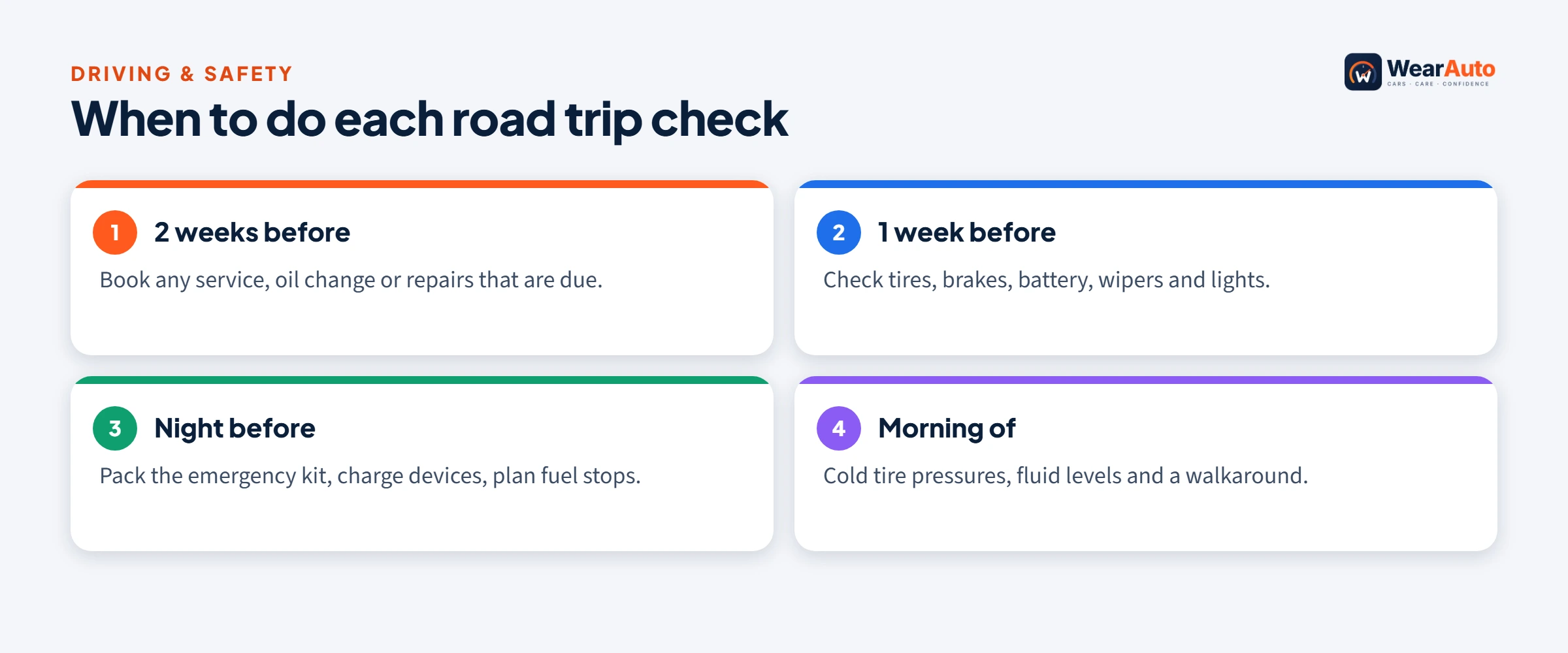
This checklist covers everything to check on your car before a long drive, plus what to pack and how to plan your fuel and rest stops. Start about two weeks before you leave so there’s time to fix anything you find.
Quick answer
Before a road trip, check tire pressure and tread, oil and coolant, brakes, battery, lights and wipers, and pack an emergency kit. Get any due service done one to two weeks before you leave.
- Set tire pressure cold, to the door jamb placard figure.
- Top up washer fluid and replace streaky wipers.
- Plan fuel and rest stops every two hours or so.
1. Tires: The Most Important Check
Your tires do more work on a road trip than any other part of the car. Long highway miles, heavy loads and hot pavement all raise the risk of a blowout on a weak or underinflated tire.
- Check pressure when the tires are cold, before you’ve driven more than a mile or two. Use the pressure on the driver’s door jamb sticker, not the maximum on the sidewall. Our guide to the correct tire pressure for your car explains the difference.
- Add pressure for heavy loads if your owner’s manual lists a loaded pressure. Many cars specify a few extra PSI when fully loaded.
- Measure tread depth. At 4/32 inch or less, wet-road grip drops noticeably. Consider new tires before a long trip. Our article on how long tires last shows the limits.
- Look for damage: bulges, cuts, cracks or nails in the tread.
- Check the spare or the tire repair kit. Make sure the spare is inflated and you know where the jack and lug wrench are.
2. Oil and Fluids
- Engine oil. If you’re within 1,000 miles of a scheduled change, get it done before you go. Check the level on the dipstick either way. Our guide to what oil your car takes helps if you need to top up.
- Coolant. Check the overflow tank level when the engine is cold. Low coolant is a leading cause of summer breakdowns.
- Brake fluid. The level should sit between the MIN and MAX marks.
- Windshield washer fluid. Fill it up. Bugs and road grime build up fast on highway trips.
- Power steering and transmission fluid, if your car has dipsticks or reservoirs you can check.
3. Brakes
Listen for squealing or grinding and notice whether the car pulls to one side when you brake. If the pedal feels soft or the brake warning light is on, get it checked before the trip. Mountain driving and heavy loads put extra strain on brakes, so worn pads are not something to carry into a long drive.
4. Battery and Charging System
Most car batteries last about three to five years. If yours is older than that, or the engine cranks slowly in the morning, have it tested for free at most auto parts stores. Clean any white or green corrosion off the terminals and make sure the clamps are tight.
5. Lights, Wipers and Glass
- Walk around the car with the headlights, high beams, turn signals and hazards on. Have someone press the brake while you check the rear.
- Replace wiper blades that streak, chatter or skip. They’re cheap and quick to change.
- Get windshield chips repaired. Temperature changes and highway vibration can turn a small chip into a long crack.
6. Belts, Hoses and Air Filter
With the engine off and cool, look at the serpentine belt for cracks or fraying and squeeze the radiator hoses. They should feel firm, not soft, swollen or crunchy. A clogged engine air filter can slightly reduce performance, and a dirty cabin air filter makes the AC work harder on a hot drive.
Watch your load
Every car has a maximum payload, listed on the door jamb sticker. Roof boxes, bikes and a full trunk add up quickly. Overloading increases braking distance and tire heat, so pack only what you need.
7. Pack an Emergency Kit
Even a perfectly prepared car can get a flat or run into bad weather. A basic kit turns a crisis into an inconvenience.
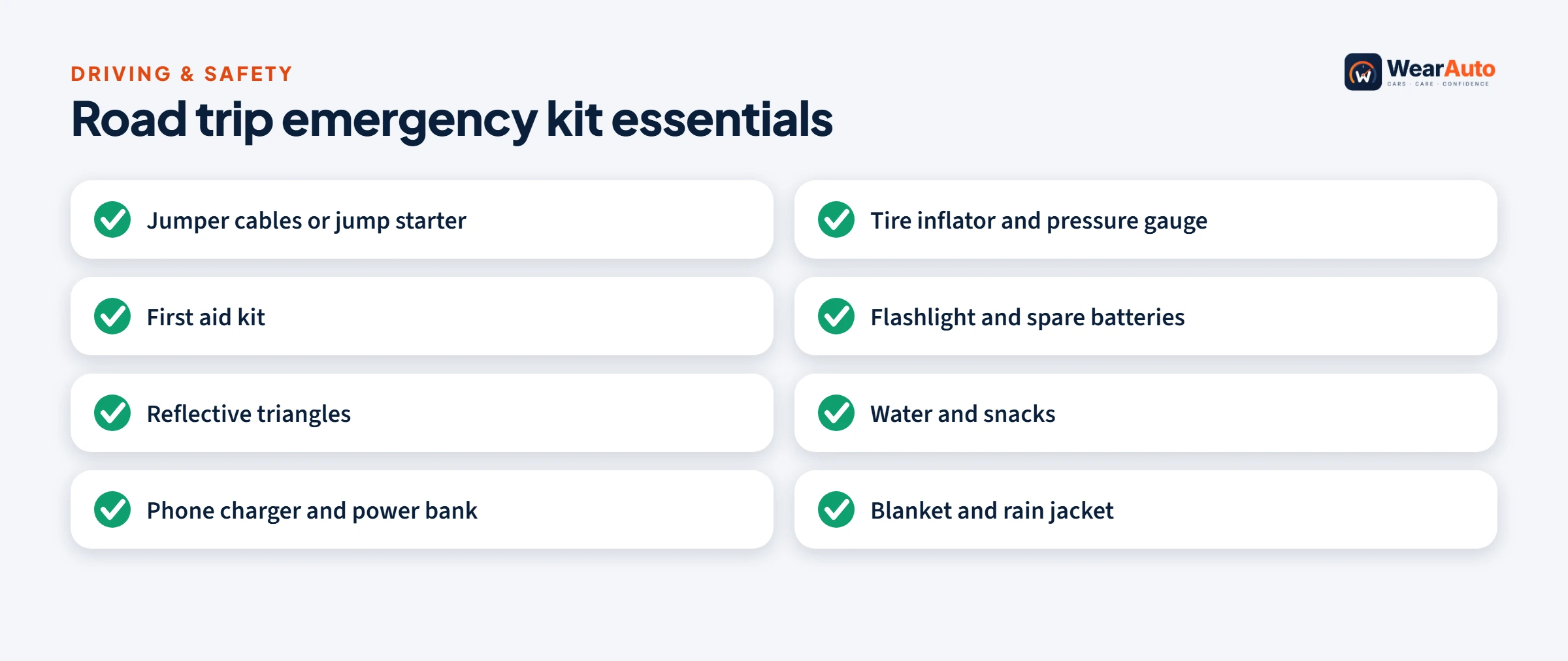
Add any personal medications, paper copies of your insurance and roadside assistance numbers, and an offline map in case you lose cell signal.
8. Plan Fuel, Breaks and Budget
Long drives are tiring, and fatigue is a real safety risk. Plan a break at least every two hours or 100 to 150 miles, and share the driving if you can. Fill up before the tank drops below a quarter, especially in rural areas where stations can be far apart.
It helps to know your fuel cost before you go. Our trip fuel cost calculator estimates the gas bill from your distance, MPG and local prices, and the travel time calculator helps you plan realistic arrival times including stops.
How much will your road trip cost in gas?
Enter your distance, MPG and fuel price to get a quick estimate for the whole trip.
Open the Trip Fuel Cost Calculator →Small habits also improve fuel economy on long drives. Keeping a steady speed, using cruise control on flat highways and not overloading the roof all help. See our guide on how to improve gas mileage for more ideas.
Quick Road Trip Checklist
| Check | What to look for | When |
|---|---|---|
| Tire pressure | Door placard figure, cold | Morning of departure |
| Tread depth | More than 4/32 inch | 1 week before |
| Engine oil | Level and service due date | 2 weeks before |
| Coolant | Between MIN and MAX, cold | 1 week before |
| Brakes | No noise, firm pedal | 1 week before |
| Battery | Age, clean terminals | 1 week before |
| Lights and wipers | All working, clear sweep | 1 week before |
| Emergency kit | Packed and complete | Night before |
Common Road Trip Mistakes
- Checking tire pressure after driving. Warm tires read higher, so you’ll underinflate them.
- Doing the oil change the day before. If something goes wrong, you have no time to fix it.
- Ignoring a warning light because you’re in a hurry to leave.
- Packing heavy items loose in the cabin. In a sudden stop they become projectiles. Put them in the trunk.
Frequently Asked Questions
How far in advance should I prepare my car for a road trip?
Start about two weeks before you leave. That gives you time to book an oil change or repair and to replace tires or wipers if needed. Do a final quick check the morning you leave.
Should I get an oil change before a road trip?
If you are close to your next scheduled oil change, or will pass it during the trip, get it done one to two weeks before you leave. Otherwise just check the level and top up if needed.
What tire pressure should I use for a road trip?
Use the pressure on your driver’s door jamb placard, measured cold. If your manual lists a higher pressure for a full load, use that when the car is packed.
How often should I stop on a long drive?
Plan a break about every two hours or 100 to 150 miles, and stop sooner if you feel drowsy. Short breaks help you stay alert.
What should I keep in my car for a road trip?
Jumper cables or a jump starter, a tire inflator and gauge, a first aid kit, a flashlight, reflective triangles, water, snacks, a phone charger and a blanket.
The Bottom Line
Preparing your car for a road trip takes an hour or two of checks spread over a couple of weeks. Focus on tires, fluids, brakes and the battery, pack a simple emergency kit, and plan your stops.
That small effort makes a breakdown far less likely and means you can focus on the drive, not on strange noises or warning lights.
Keep reading
Sources and further reading
- NHTSA: Road trip safety tips
- NHTSA: Tires and tire safety
- U.S. Department of Energy, fueleconomy.gov: Driving more efficiently
Written and fact-checked by the WearAuto Editorial Team. This guide is general information; always follow your vehicle manufacturer’s specifications and see a qualified mechanic for safety-critical repairs. See our editorial policy for how we research and update articles.