One of the biggest selling points of an electric car is cheaper running costs. But how much does it actually cost to charge an EV? The answer ranges from a few dollars to well over $30 for a full charge, depending on where and when you charge.
This guide breaks down the cost of charging at home, at public Level 2 stations, and at DC fast chargers, shows you how to calculate your own cost per mile, and explains how to keep charging costs low.
Quick answer
At the US average residential rate of about 17 cents per kWh, a full charge for a typical EV with a 65 to 75 kWh battery costs around $12 to $14 at home, or roughly 4 to 6 cents per mile. Public Level 2 chargers often charge 20 to 35 cents per kWh, and DC fast chargers 35 to 60 cents per kWh or more, which can make fast charging two to three times as expensive as home charging. Charging at off-peak rates at home is usually the cheapest option.
- Cost = kWh used x price per kWh.
- Use our EV charging cost calculator for your car and local rates.
How to Calculate EV Charging Cost
The formula is simple:
Cost = energy added (kWh) x electricity price ($ per kWh)
Add about 10% for charging losses, since some energy is lost as heat. For example, adding 60 kWh at home at 17 cents per kWh costs about 60 x 1.1 x $0.17, or roughly $11.
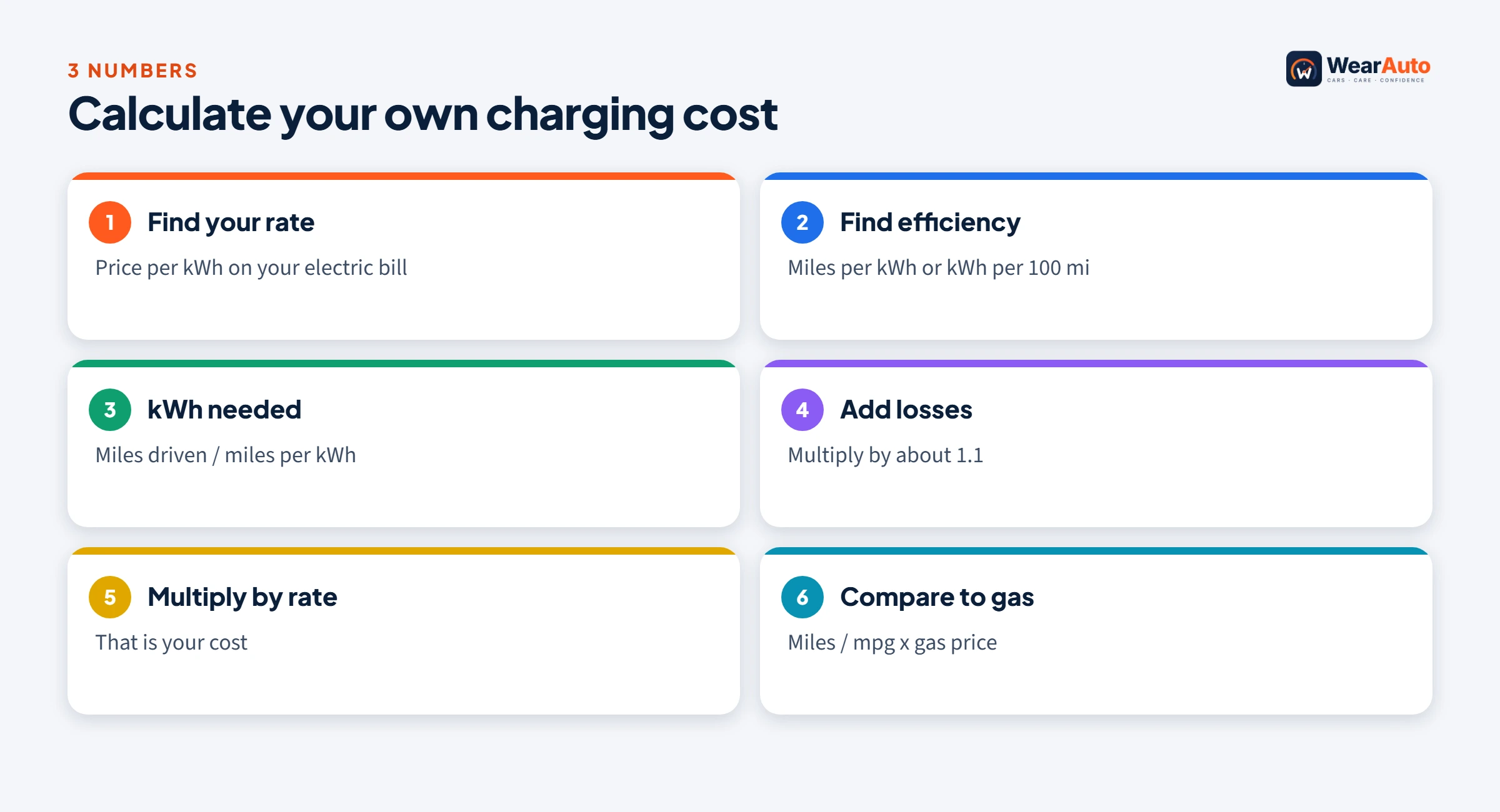
To get cost per mile, divide the price per kWh by your car’s efficiency in miles per kWh. A car that gets 3.5 miles per kWh at 17 cents per kWh costs about 5 cents per mile, before losses. If your car shows efficiency in kWh per 100 miles, our kWh per 100 miles converter switches between the two.
Cost of Charging at Home
Home charging is the cheapest and most convenient option for most EV owners. US residential electricity prices vary widely by state, from roughly 11 cents to over 40 cents per kWh.
| Electricity rate | Full charge, 65 kWh battery (10 to 90%) | Cost per 100 miles |
|---|---|---|
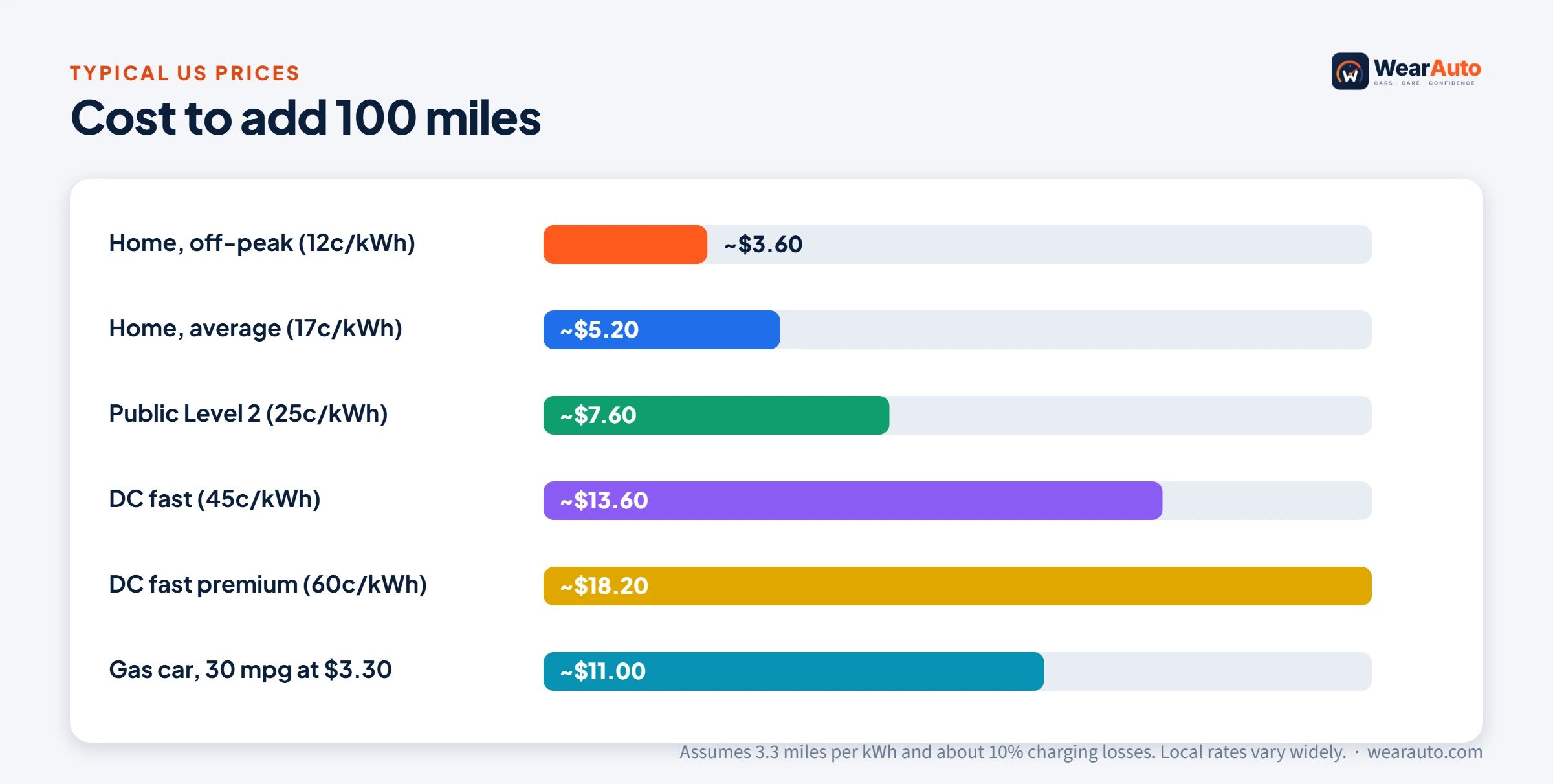
| 12 cents/kWh (off-peak) | About $7 | About $3.60 |
| 17 cents/kWh (US average) | About $10 | About $5.20 |
| 25 cents/kWh | About $14 | About $7.60 |
| 35 cents/kWh (high-cost states) | About $20 | About $10.60 |
Time-of-use rates
Many utilities offer time-of-use (TOU) plans with much cheaper rates at night. Scheduling your car to charge overnight can cut your cost significantly. Some utilities also offer special EV rates or rebates on home chargers.
Level 1 vs Level 2 at home
The price per kWh is the same whether you charge on a regular outlet or a Level 2 charger. Level 2 is faster and slightly more efficient, but the main cost difference is the upfront price of the charger and installation, usually $800 to $2,500 total. Our guide on how long it takes to charge an electric car explains the speed difference.
Cost of Public Charging
Public Level 2
Public Level 2 chargers at shopping centers, offices, and hotels often cost 20 to 35 cents per kWh. Some charge by the hour instead, and some are free as a perk for customers or employees.
DC fast charging
DC fast chargers are the most expensive, often 35 to 60 cents per kWh or more, depending on the network, location, and time of day. Some networks charge per minute in states where per-kWh pricing is not allowed, which can be more expensive for cars that charge slowly.
Many networks offer membership plans that reduce the per-kWh price for a monthly fee. They can pay off if you fast charge often, such as on frequent road trips.
Watch for idle fees
Many fast-charging networks charge idle fees, often around $0.40 to $1.00 per minute, if you leave your car plugged in after it finishes charging. Move your car promptly.
EV vs Gas: Fuel Cost Comparison
A gas car that gets 30 mpg with gas at $3.30 per gallon costs about 11 cents per mile in fuel. A typical EV charged at home at the US average rate costs about 5 to 6 cents per mile, about half. Relying heavily on DC fast charging can make the EV’s fuel cost similar to, or even higher than, a fuel-efficient gas car.
Calculate your EV charging cost
Enter your battery size, efficiency and electricity rate to see your cost per charge and per mile.
Open the calculator →What Affects Your Charging Cost
- Your electricity rate, the biggest factor.
- Your car’s efficiency. Smaller, aerodynamic EVs use less energy per mile than large trucks and SUVs.
- Weather. Cold weather increases energy use, especially for cabin heating, and can reduce range by 20% to 40%.
- Driving style and speed. Highway speeds above about 70 mph use noticeably more energy.
- Charging losses, typically 10% to 15% on Level 1 and Level 2.
- Where you charge. Home, workplace, public Level 2, and fast charging all have very different prices.
How to Lower Your EV Charging Costs
- Charge at home overnight on an off-peak or EV rate plan.
- Use free or cheap workplace charging if available.
- Use fast chargers only when needed, such as on road trips.
- Precondition while plugged in, so the cabin and battery warm up using grid power rather than the battery.
- Drive efficiently. Smooth acceleration and moderate speeds extend range. Many tips from our guide on how to improve gas mileage apply to EVs too.
- Consider solar. Home solar panels can lower the long-term cost of home charging.
Frequently Asked Questions
How much does it cost to fully charge an electric car at home?
For a typical EV with a 65 to 75 kWh battery at the US average rate of about 17 cents per kWh, a full charge from near empty costs roughly $12 to $14. Most owners rarely charge from empty, so typical sessions cost less.
Is it cheaper to charge an EV than to buy gas?
Usually, yes, when charging at home. Home charging often costs about half as much per mile as gas. Frequent DC fast charging can narrow or erase the savings.
Will charging an EV raise my electricity bill a lot?
Driving 1,000 miles a month typically adds about 300 kWh, or about $50 at the US average rate. The actual amount depends on your car’s efficiency and your electricity price.
Are public EV chargers free?
Some are, especially at certain shopping centers, hotels, and workplaces. Most public chargers, and nearly all DC fast chargers, charge a fee.
Why does fast charging cost so much more?
DC fast chargers are expensive to build and maintain, and operators often pay high demand charges to utilities for the large amount of power they deliver.
The Bottom Line
Charging an EV at home is usually the cheapest option, costing around 4 to 6 cents per mile at typical US electricity rates. Public Level 2 chargers cost more, and DC fast chargers can cost two to three times as much as home charging. To keep costs low, charge at home overnight on an off-peak rate, and save fast charging for road trips.
Sources and further reading
- U.S. Energy Information Administration: Electric power monthly, average retail prices
- U.S. Department of Energy: Charging at home
- FuelEconomy.gov: Compare electric vehicles
Written and fact-checked by the WearAuto Editorial Team. This guide is general information; always follow your vehicle manufacturer’s specifications and see a qualified mechanic for safety-critical repairs. See our editorial policy for how we research and update articles.