Dashboard warning lights are your car’s way of talking to you, but the language isn’t always obvious. Some symbols are clear, like a fuel pump when you’re low on gas. Others look like a submarine, a horseshoe with an exclamation point or a car with squiggly lines behind it. When one lights up on the highway, you want to know right away whether it’s a “pull over now” problem or a “book a service next week” reminder.
This guide explains the warning lights you’re most likely to see, sorted by how serious they are, and what to do about each one. Symbols vary a little between brands, so keep your owner’s manual handy for anything unusual.
Quick answer
Dashboard warning lights use a color code: red means a serious or safety problem (stop when safe), amber or yellow means something needs checking soon, and green or blue just shows a system is on. A flashing light usually means the problem is active right now.
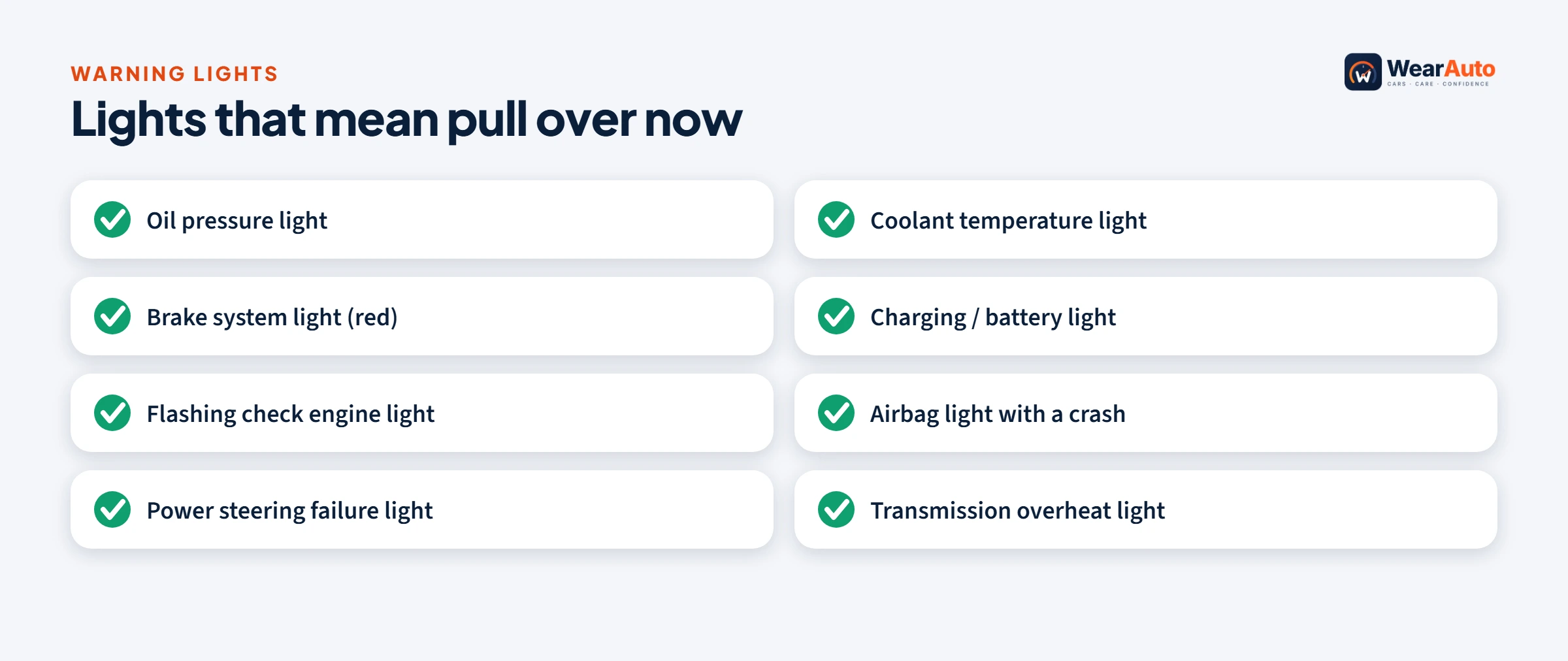
- Red oil, temperature, brake or battery lights: pull over safely.
- Steady amber check engine light: safe to drive short term, get it scanned.
- Lights that stay on after a restart need attention.
How the Color Code Works
Almost every carmaker follows the same basic logic, borrowed from traffic lights. Understanding it lets you judge urgency even when you don’t recognize the symbol.
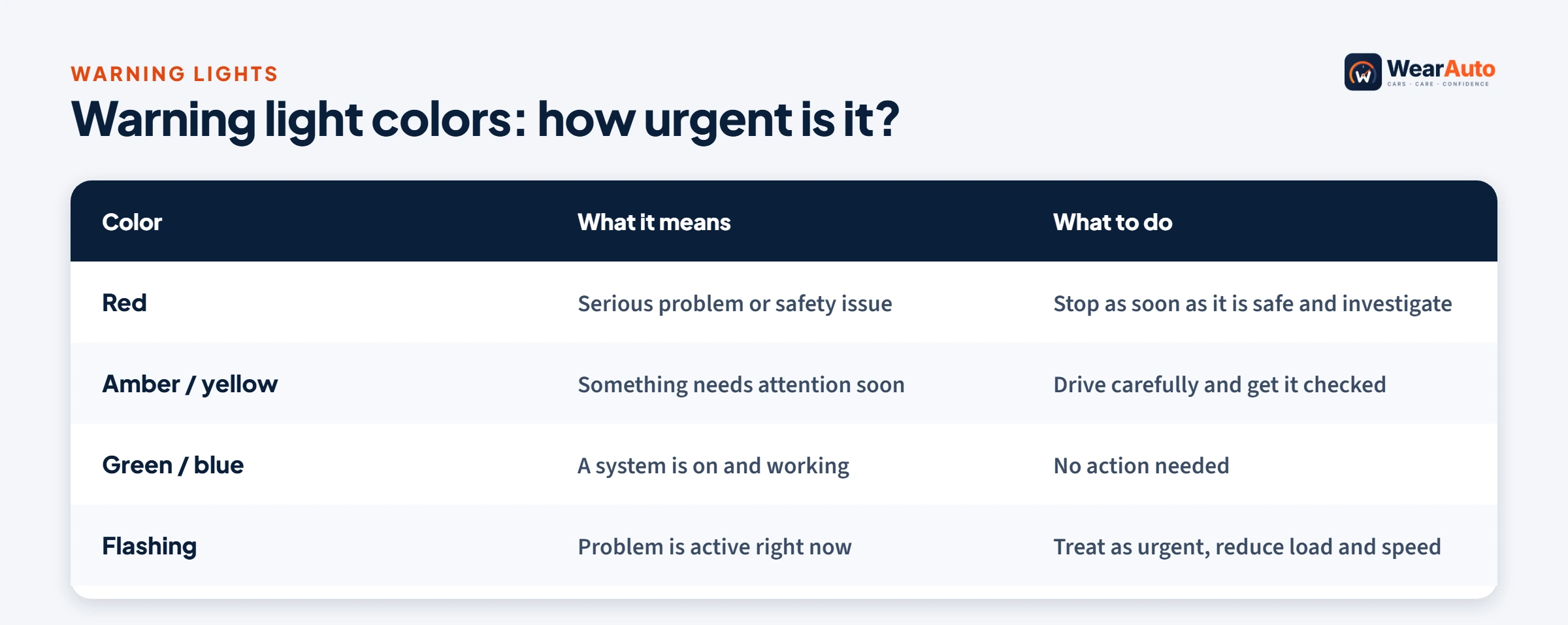
When you first turn the key or press the start button, most lights flash on for a second or two as a bulb check. That’s normal. A light that stays on after the engine starts, or comes on while you drive, is the one to pay attention to.
Red Warning Lights: Stop When It’s Safe
Oil pressure warning
The symbol looks like an old oil can with a drip. It means the engine isn’t getting enough oil pressure, either because the oil level is very low or the pump or a sensor has failed. Without oil pressure, an engine can be damaged in minutes. Pull over, turn off the engine, wait a few minutes and check the dipstick. If the level is fine and the light stays on, have the car towed rather than driving it. Our guide to what oil your car takes will help if you need to top up.
Engine temperature warning
This looks like a thermometer floating in water. It means the coolant is too hot. Turn off the air conditioning, turn the heater to full hot to pull heat away from the engine, and pull over when safe. Never open a hot radiator cap, because pressurized coolant can cause severe burns.
Brake system warning
Usually a circle with an exclamation point inside, or the word BRAKE. First check that the parking brake is fully released. If it is and the light stays on, the brake fluid may be low or there could be a hydraulic problem. Brakes are not something to gamble on, so drive slowly to a shop or call for help. If the pedal feels soft or sinks, stop driving.
Charging system or battery warning
Shaped like a small battery with plus and minus signs. It means the alternator isn’t charging the battery, not that the battery itself is bad. Your car is running on stored battery power and may die within 20 to 60 minutes. Turn off nonessential electrics like the stereo and seat heaters and head straight to a safe stop or repair shop.
Airbag warning
A seated person with a large circle in front of them. The airbag system has a fault and may not deploy in a crash. The car is drivable, but it’s a serious safety issue, so book a repair quickly.
Power steering warning
A steering wheel with an exclamation point. Steering will suddenly feel much heavier. You can still steer, but it takes much more effort, especially at low speed. Drive carefully to a safe place.
Amber and Yellow Lights: Get It Checked Soon
Check engine light
The engine outline symbol is the most common warning light of all. A steady light means the engine computer has stored a fault code. Causes range from a loose gas cap to a failing oxygen sensor or catalytic converter. You can usually keep driving, but get the code read soon. If the light is flashing, that usually means an active misfire that can overheat the catalytic converter. Reduce speed, avoid heavy acceleration and get it checked right away. Read our full guide on check engine light meaning for common causes.
Tire pressure (TPMS)
A horseshoe shape with an exclamation point, which is actually a cross-section of a tire. One or more tires are at least 25% below the recommended pressure. Check all four with a gauge and inflate to the figure on the driver’s door jamb sticker. Our guide to the correct tire pressure for your car explains where to find it. If the light flashes for about a minute and then stays on, the TPMS system itself has a fault.
ABS warning
The letters ABS in a circle. The anti-lock braking system is off, but your regular brakes should still work. You’ll lose anti-lock function in a hard stop, so leave extra distance and get it checked.
Traction or stability control
A car with wavy lines behind it. If it flickers while you drive on slippery roads, the system is working. If it stays on, either the system has been switched off or there’s a fault, often linked to a wheel speed sensor.
Low fuel and washer fluid
These are simple reminders. The low fuel light typically comes on with roughly 1 to 3 gallons left, depending on the car. Don’t push it too far, because running the tank dry can overheat an in-tank fuel pump.
Green and Blue Lights: Information Only
These lights confirm a system is switched on. Common ones include headlights and high beams (blue), cruise control, turn signals, eco mode and fog lights. If your turn signal flashes much faster than usual, a bulb has probably burned out on that side.
Quick Reference Table
| Light | Color | Can I keep driving? | What to do |
|---|---|---|---|
| Oil pressure | Red | No | Stop, check level, tow if light stays on |
| Engine temperature | Red | No | Stop, let it cool, check coolant when cold |
| Brake system | Red | Only with great care | Check parking brake and fluid, get help |
| Battery / charging | Red | Short distance only | Head to a shop, turn off accessories |
| Check engine (steady) | Amber | Yes, short term | Get the code read soon |
| Check engine (flashing) | Amber | Gently, to a shop | Reduce load, get it checked today |
| Tire pressure | Amber | Yes, after checking | Inflate to door placard pressure |
| ABS | Amber | Yes, carefully | Book a diagnosis |
If you’re not sure which symbol you’re looking at, our dashboard warning light identifier lets you match it by shape and color.
Not sure what that symbol is?
Pick the shape and color of the light on your dash and see what it means and how urgent it is.
Identify My Warning Light →What to Do When a Warning Light Comes On
- Note the color and whether it’s steady or flashing. That tells you how urgent it is.
- Check your gauges. Look at temperature and, if your car has one, the oil pressure or voltage gauge.
- Find a safe place to stop if the light is red or flashing.
- Check the basics. Oil level, coolant level when cold, parking brake, gas cap and tire pressures.
- Read the code. A basic OBD2 scanner costs less than a tank of gas and tells you why the check engine light is on.
- Look it up in your manual for brand-specific symbols.
Don’t just clear the light
Disconnecting the battery or clearing codes with a scanner turns the light off but doesn’t fix the cause. The light will return, and you may erase information a mechanic needs.
Frequently Asked Questions
Which dashboard lights are the most serious?
Red oil pressure, engine temperature, brake system and charging lights, plus a flashing check engine light. These can mean engine damage or a safety problem, so stop when it is safe.
Is it safe to drive with the check engine light on?
If it is steady and the car drives normally, it is usually safe for a short time, but get the code read soon. If it is flashing, reduce speed and get the car checked the same day.
Why did all my dashboard lights come on at once?
Several lights at once often points to a weak battery, a failing alternator or a low-voltage problem, because many modules report errors when voltage drops. Have the charging system tested.
Why does a warning light come on and then go off?
Some faults are intermittent, such as a loose connection or a borderline sensor reading. The light can turn off when the condition clears, but the computer often stores a code you can still read.
What does the exclamation point in a circle mean?
A red exclamation point in a circle is usually the brake system warning. In a horseshoe shape it is the tire pressure warning. Check your manual, since some brands use it for general system alerts.
The Bottom Line
Don’t let dashboard lights scare you, but don’t ignore them either. Red means stop when it’s safe, amber means get it checked soon, and green or blue are just information. A flashing light is always more urgent than a steady one.
Learn the handful of red lights by heart, keep a cheap OBD2 scanner in the glovebox, and you’ll handle almost any warning calmly and safely.
Keep reading
Free tools for this topic
Sources and further reading
- NHTSA: Tire Pressure Monitoring System and vehicle safety
- ISO 2575: Road vehicles, symbols for controls, indicators and tell-tales
- AAA: Car care and maintenance advice
Written and fact-checked by the WearAuto Editorial Team. This guide is general information; always follow your vehicle manufacturer’s specifications and see a qualified mechanic for safety-critical repairs. See our editorial policy for how we research and update articles.