
A digital multimeter is one of the most useful tools a DIY car owner can own. For about $20 to $50, it lets you check whether your battery is healthy, whether the alternator is charging, whether a fuse or wire is broken, and what is draining your battery overnight.
This guide explains the basic settings and walks you through the most common multimeter tests on a car.
Quick answer
To test a car battery, set the multimeter to DC volts (20V range), touch the red probe to the positive terminal and the black probe to the negative. A rested battery should read about 12.6 volts. With the engine running, you should see 13.7 to 14.7 volts if the alternator is charging. Use the continuity or ohms setting to test fuses and wires, and the 10A setting with the meter wired in series to measure parasitic draw.
- Start every test on the correct setting before touching the probes.
- Never use the amps setting to measure voltage.
Multimeter Basics
The main settings you will use
- DC volts (V with a straight line): for battery, charging, and sensor voltage. Use the 20V range on manual-ranging meters.
- Resistance (Ω, ohms): for checking sensors, coils, and wires.
- Continuity (a sound wave or diode symbol): beeps when there is a complete path, useful for fuses and wires.
- DC amps (A): for measuring current draw. Usually needs the red lead moved to the 10A jack.
Lead placement
The black lead always goes in the COM jack. The red lead goes in the V/Ω jack for voltage, resistance, and continuity, and in the 10A jack for current. Moving it back after an amps test is important. Forgetting can blow the meter’s fuse the next time you test voltage.
Stay safe around the battery
Remove rings and watches, keep tools from bridging the terminals, and keep sparks and flames away from the battery. Never probe airbag circuits, which are marked with yellow connectors.
Test 1: Battery Voltage
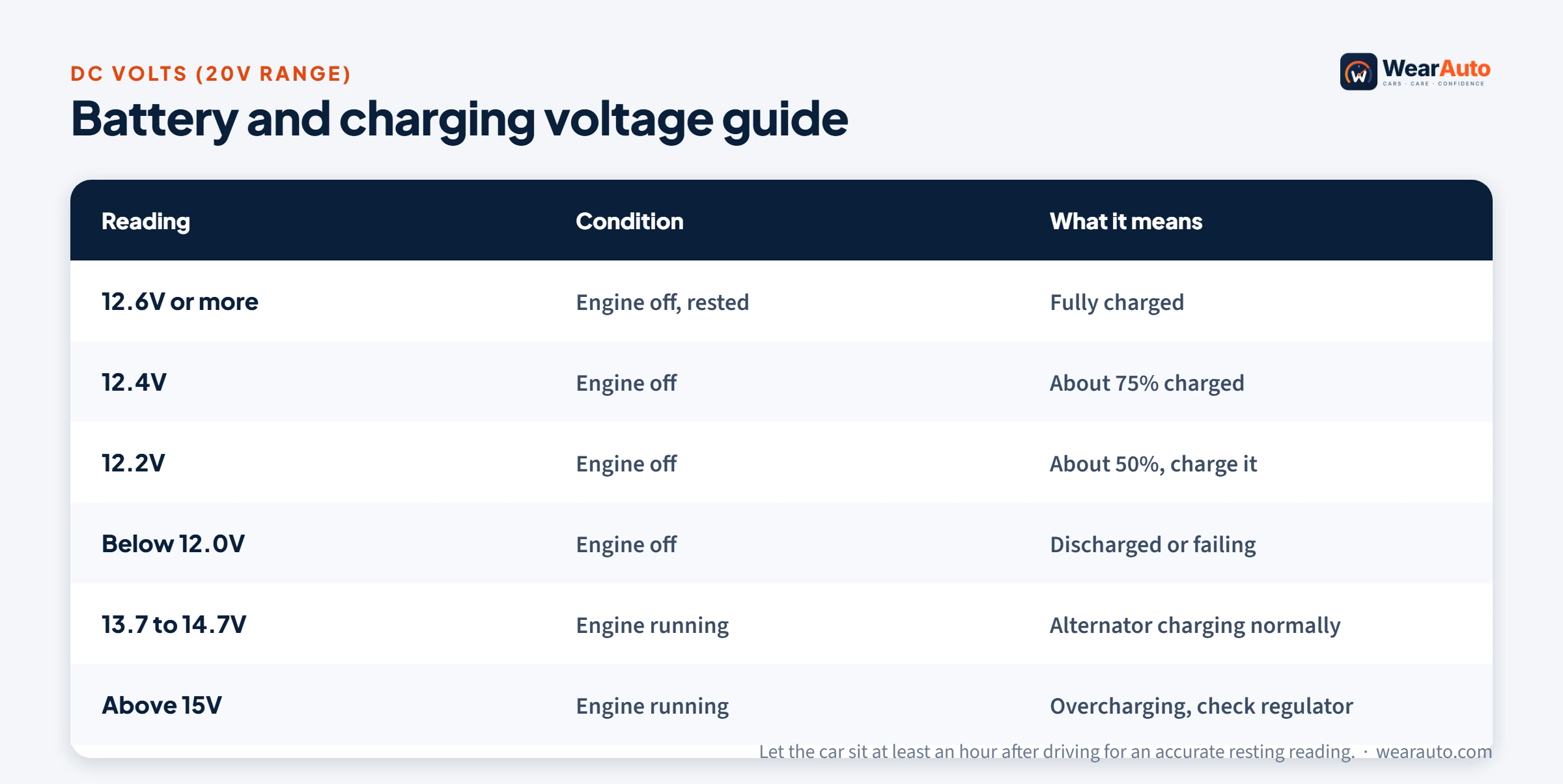
- Turn the car off and let it sit for at least an hour, or turn on the headlights for a minute to remove any surface charge.
- Set the meter to DC volts, 20V range.
- Touch the red probe to the positive (+) terminal and the black probe to the negative (-) terminal.
- Read the voltage.
A fully charged 12-volt battery reads about 12.6 volts or more. At 12.2 volts it is about half charged. Below 12.0 volts it is deeply discharged. Our 12V battery voltage chart shows the full state-of-charge table.
A voltage test does not tell you how much power the battery can deliver under load. A battery can show 12.6 volts and still fail to crank the engine. If yours is several years old, our guide on how long car batteries last explains when testing under load makes sense.
Test 2: Cranking Voltage
Have a helper crank the engine while you watch the meter on the battery terminals. A healthy battery should stay above about 9.6 to 10 volts while cranking. A drop well below that points to a weak battery or poor connections.
Test 3: Alternator Charging
- Start the engine and let it idle.
- Measure across the battery terminals again.
- You should see about 13.7 to 14.7 volts.
- Turn on the headlights, heater fan, and rear defroster. The voltage should stay above about 13.2 volts.
Below 13 volts with the engine running suggests the alternator is not charging properly or there is a wiring problem. Above about 15 volts suggests the voltage regulator is overcharging, which can damage the battery.
Test 4: Fuses and Wires (Continuity)
- Remove the fuse, or disconnect the circuit’s power.
- Set the meter to continuity (or the lowest ohms range).
- Touch the probes together first. The meter should beep or read near zero.
- Touch one probe to each blade or end of the fuse or wire.
A beep or a reading near 0 ohms means the path is complete. No beep or “OL” (open loop) means it is broken. Always test continuity with the circuit unpowered.
Quick fuse check without removing it
With the ignition on, set the meter to DC volts, put the black probe on a good ground, and touch the red probe to the tiny test points on top of each blade fuse. A good fuse shows battery voltage on both sides. A blown fuse shows voltage on one side only.
Test 5: Parasitic Battery Draw
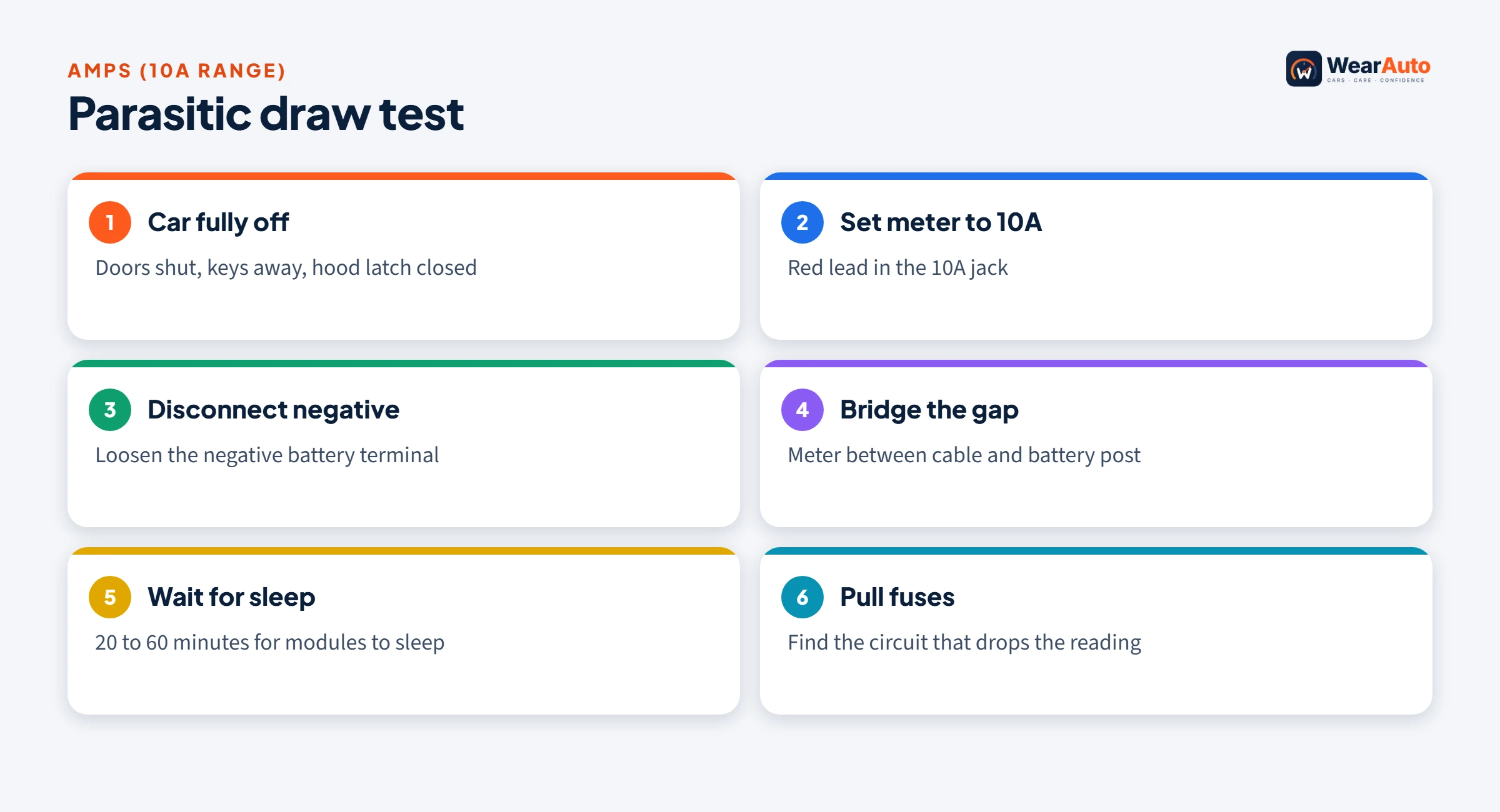
If your battery keeps going flat after the car sits for a few days, something may be drawing too much current with the car off.
- Turn everything off, close the doors, and move the keys well away from the car. Latch the hood switch or trick it closed so the underhood light stays off.
- Set the meter to DC amps and move the red lead to the 10A jack.
- Loosen and remove the negative battery cable.
- Connect one probe to the negative cable and the other to the negative battery post, so current flows through the meter.
- Wait 20 to 60 minutes for the car’s computers to go to sleep.
- Read the current. Most modern cars should settle below about 50 milliamps (0.05 A). Some older cars are lower, around 25 to 35 mA.
- If the draw is high, pull fuses one at a time and watch for the reading to drop. That circuit is the source.
Do not crank or turn on accessories during the test
Starting the car or switching on high-current accessories while the meter is in series can blow the meter’s fuse or damage it.
Common causes of parasitic draw include glovebox or trunk lights staying on, aftermarket stereos and alarms, a stuck relay, and modules that fail to sleep.
Useful Reference Readings
| Test | Setting | Normal result |
|---|---|---|
| Resting battery | DC V, 20V | 12.4 to 12.8 V |
| Engine running | DC V, 20V | 13.7 to 14.7 V |
| While cranking | DC V, 20V | Above 9.6 to 10 V |
| Fuse or wire | Continuity | Beep, near 0 ohms |
| Parasitic draw | DC A, 10A jack | Under about 50 mA |
| Voltage drop across a ground cable (cranking) | DC V | Under 0.2 to 0.3 V |
Choosing a Multimeter for Car Work
- Auto-ranging meters are easier for beginners.
- A 10A current range is needed for draw tests.
- CAT III safety rating and good-quality leads with sharp probes.
- Optional extras: a clamp meter for measuring current without disconnecting the battery, and back-probe pins for testing connectors without damaging them.
Frequently Asked Questions
What should a car battery read on a multimeter?
About 12.6 volts or more when fully charged and rested with the engine off, and about 13.7 to 14.7 volts with the engine running.
Can I test an alternator with a multimeter?
Yes. Measure battery voltage with the engine running. A reading between about 13.7 and 14.7 volts, staying above 13.2 volts with loads on, indicates the alternator is charging.
What is a normal parasitic draw?
Most modern cars draw under about 50 milliamps once all modules have gone to sleep. Higher readings can drain the battery over several days.
Why does my multimeter read zero on the amps setting?
The 10A or mA fuse inside the meter may be blown, or the red lead may not be in the correct jack. Check both.
Can a multimeter test a spark plug or ignition coil?
A multimeter can measure ignition coil resistance and compare it with the manufacturer’s spec. It cannot fully test a coil under load, so results are a guide rather than proof.
The Bottom Line
A basic multimeter lets you diagnose most car electrical problems yourself. Start with battery voltage engine off and running, use continuity to check fuses and wires, and run a parasitic draw test if the battery keeps going flat. Always set the meter correctly before touching the probes, and move the red lead back to the voltage jack when you are done.
Sources and further reading
- Fluke: How to use a digital multimeter
- Interstate Batteries: Battery testing basics
- Battery Council International: Battery care
Written and fact-checked by the WearAuto Editorial Team. This guide is general information; always follow your vehicle manufacturer’s specifications and see a qualified mechanic for safety-critical repairs. See our editorial policy for how we research and update articles.