A flat tire usually happens at the worst possible moment. But changing it yourself is a skill almost anyone can learn, and it can save you a long wait for roadside assistance. With the right steps, the job takes about 15 to 30 minutes.
This guide walks you through how to change a tire safely at the roadside, what tools you need, and what to do after the spare is on.
Quick answer
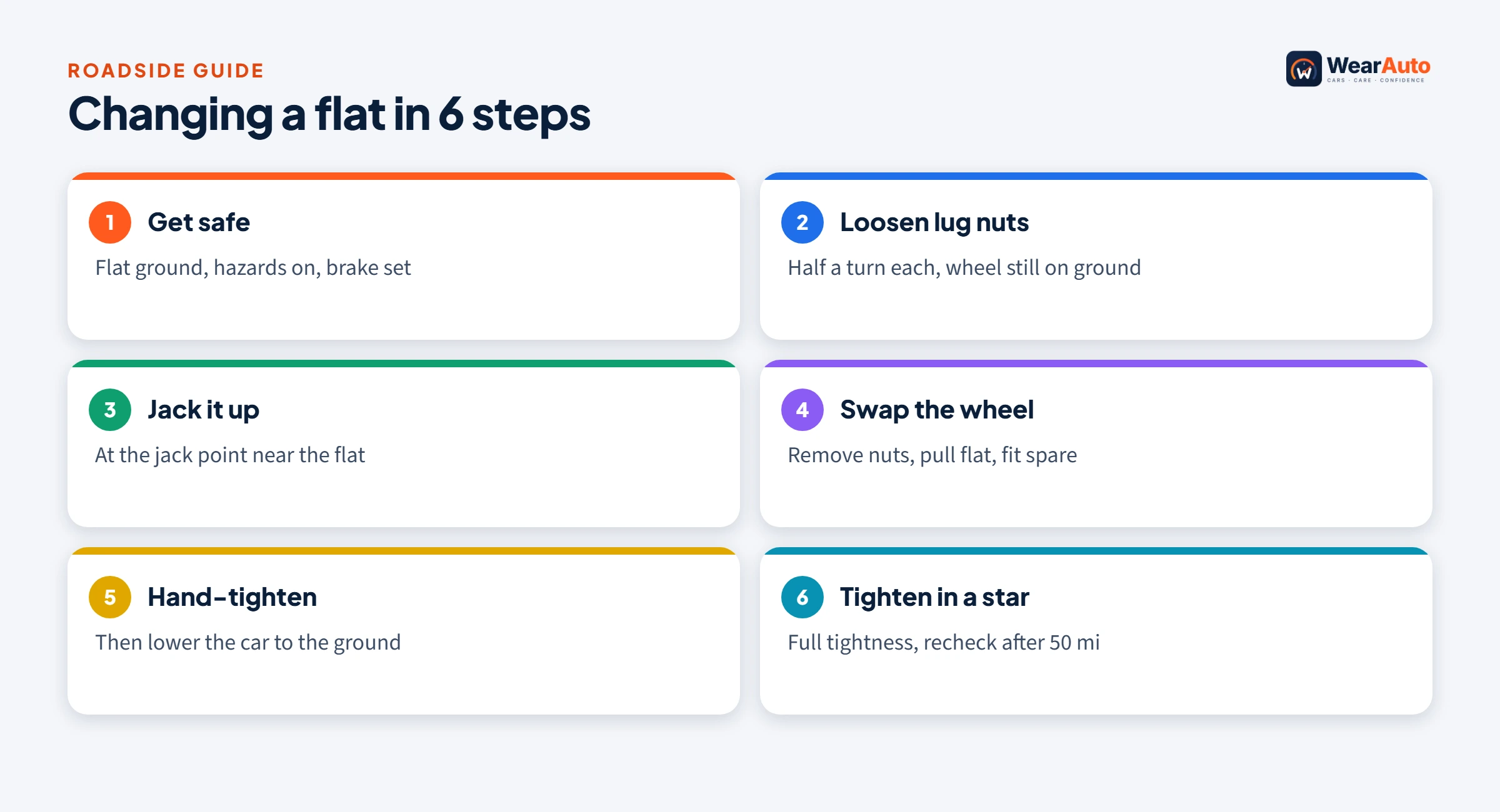
Pull over to a flat, safe spot away from traffic, turn on your hazard lights, and set the parking brake. Loosen the lug nuts about half a turn while the wheel is still on the ground. Jack up the car at the jack point closest to the flat, remove the lug nuts and the flat tire, and mount the spare. Hand-tighten the nuts, lower the car, then tighten them fully in a star pattern. Drive gently to a tire shop.
- Never get under a car supported only by a jack.
- Compact spares are usually limited to about 50 mph.
What You Need
Most cars come with these tools, usually under the trunk floor or a side panel:
- A spare tire (compact, full-size, or a tire sealant kit instead)
- A jack
- A lug wrench
- A wheel lock key, if your car has locking lug nuts
Helpful extras include gloves, a flashlight or headlamp, a reflective vest, wheel chocks, and a small board to put under the jack on soft ground. Our car emergency kit checklist covers these and more.
Check your spare before you need it
Many spares are found flat when they are finally needed. Check its pressure every few months. Compact spares often need 60 psi, much higher than regular tires. The correct pressure is printed on the spare or on the door jamb sticker.
How to Change a Tire Step by Step
1. Get to a safe place
As soon as you notice a flat, slow down gradually and avoid hard braking. Pull over somewhere flat and well away from traffic, such as a parking lot or a wide shoulder. Driving a short distance slowly on a flat to reach safety is better than stopping in a dangerous spot, even if it damages the wheel.
Turn on your hazard lights, put the car in Park (or first gear for a manual), set the parking brake, and turn off the engine. Have passengers wait in a safe spot away from the road. Place warning triangles behind the car.
2. Chock the wheels
Put wheel chocks, or rocks or blocks if you have nothing else, against the tire diagonally opposite the flat. This stops the car from rolling when it is lifted.
3. Loosen the lug nuts
Remove any wheel cover or hubcap. With the wheel still on the ground, use the lug wrench to turn each lug nut counterclockwise about half a turn. Do not remove them yet. If they are tight, stand on the wrench handle carefully, using your body weight.
4. Jack up the car
Place the jack under the jack point nearest the flat tire. Your owner’s manual shows where it is, usually a reinforced spot on the pinch weld just behind the front wheel or in front of the rear wheel. Our guide on how to jack up a car safely explains jack points in detail.
Raise the car until the flat tire is about an inch or two off the ground.
Keep your body out from under the car
A roadside jack is only for lifting. Never place any part of your body under the car while it is on the jack.
5. Remove the flat and mount the spare
Unscrew the lug nuts completely and keep them together, for example in the hubcap. Pull the flat tire straight toward you and lay it flat on the ground so it cannot roll.
Line up the spare’s holes with the wheel studs and push it onto the hub. Screw the lug nuts on by hand, then snug them lightly with the wrench.
6. Lower the car and tighten the nuts
Lower the car until the spare is on the ground, and remove the jack. Now tighten the lug nuts fully in a star pattern, tightening opposite nuts in turn rather than going around in a circle. This seats the wheel evenly.
If you have a torque wrench, check the specification. Our lug nut torque chart lists typical values. Most cars need about 75 to 100 lb-ft.
7. Pack up and check the spare’s pressure
Put the flat tire, jack, and tools back in the car. Check the spare’s pressure as soon as you can at a gas station.
Know Your Spare Tire’s Limits
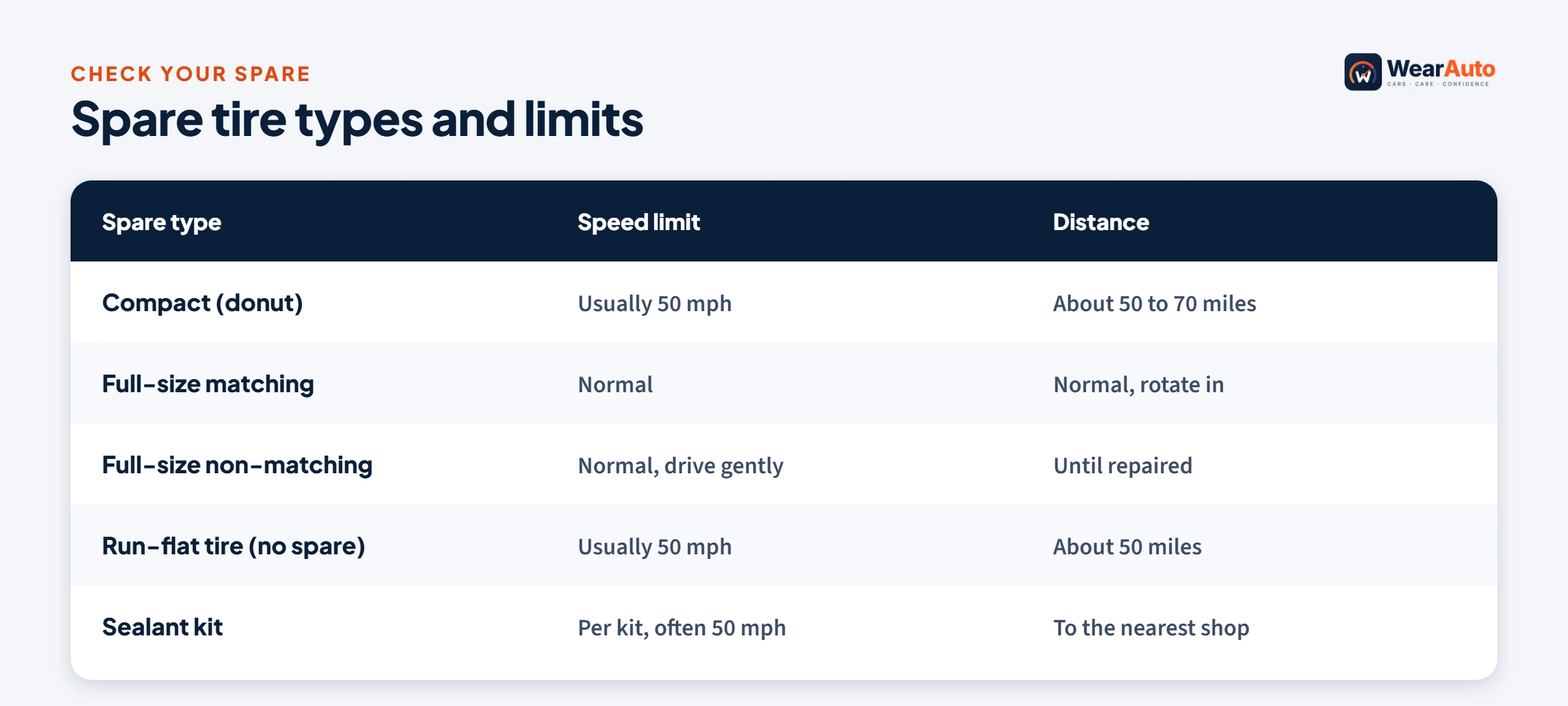
Most new cars come with a compact temporary spare, often called a donut. These are lighter and smaller than regular tires and are designed only to get you to a repair shop. Do not drive faster than the speed printed on the spare, usually 50 mph, or farther than about 50 to 70 miles.
Some cars have no spare at all and include a tire sealant kit with a small compressor instead. Others use run-flat tires that can be driven a limited distance after a puncture.
After Changing Your Tire
- Recheck the lug nuts after about 50 miles. They can loosen slightly as the wheel settles.
- Get the flat repaired or replaced quickly. A shop can often plug or patch a tread puncture for $15 to $40. Damage to the sidewall cannot be repaired.
- Put the repaired or new tire back on and stow the spare.
- Reset the TPMS if needed. Our guide to the TPMS light explains why the warning may stay on with a spare.
If you need a new tire, our guide on how much new tires cost shows typical prices and whether you need to replace more than one.
| Problem | What to do |
|---|---|
| Lug nuts will not loosen | Use body weight on the wrench, or a breaker bar. Spray penetrating oil if available. |
| Locking lug nut, no key | Call roadside assistance. Do not force it. |
| Car on a slope or soft ground | Do not jack it. Call for help or move to a better spot. |
| Spare is flat | Use a portable inflator, or call roadside assistance. |
| On a busy highway shoulder | Stay safe behind the guardrail and call for help. |
Frequently Asked Questions
How long does it take to change a tire?
Most people can change a tire in 15 to 30 minutes. It goes faster with practice, so consider trying it once at home on a calm day.
How fast can I drive on a spare tire?
Most compact spares are rated for a maximum of 50 mph and about 50 to 70 miles. Full-size spares can usually be driven normally. Check the label on your spare.
Which way do I turn lug nuts to loosen them?
Counterclockwise loosens them, clockwise tightens them. Remember: lefty loosey, righty tighty.
Should I loosen lug nuts before jacking up the car?
Yes. Loosening them with the wheel on the ground stops the wheel from spinning. Remove them completely only after the car is lifted.
Can I drive on a flat tire to get somewhere safe?
Driving slowly for a short distance to get out of danger is acceptable, but it will likely ruin the tire and may damage the wheel. Do not drive any longer than needed.
The Bottom Line
Changing a tire comes down to doing things in the right order: get safe, loosen the nuts on the ground, jack up the car, swap the wheel, then lower it and tighten the nuts in a star pattern. Respect the speed and distance limits of your spare, recheck the nuts after a short drive, and get the flat fixed quickly. Practice once at home, and you will be ready when it counts.
Keep reading
Related guides
Free tools for this topic
Sources and further reading
Written and fact-checked by the WearAuto Editorial Team. This guide is general information; always follow your vehicle manufacturer’s specifications and see a qualified mechanic for safety-critical repairs. See our editorial policy for how we research and update articles.